
The Balkan Countries: A Guide for Those Who Want to Understand the Region
The Balkans is not a single country, but a mosaic of states, languages and histories. Here is MOST’s gateway to the region – from the Adriatic Sea and the Dinaric Alps to the plains of the Danube, along with the practical essentials you need to know before you travel.
One Name, Multiple Maps
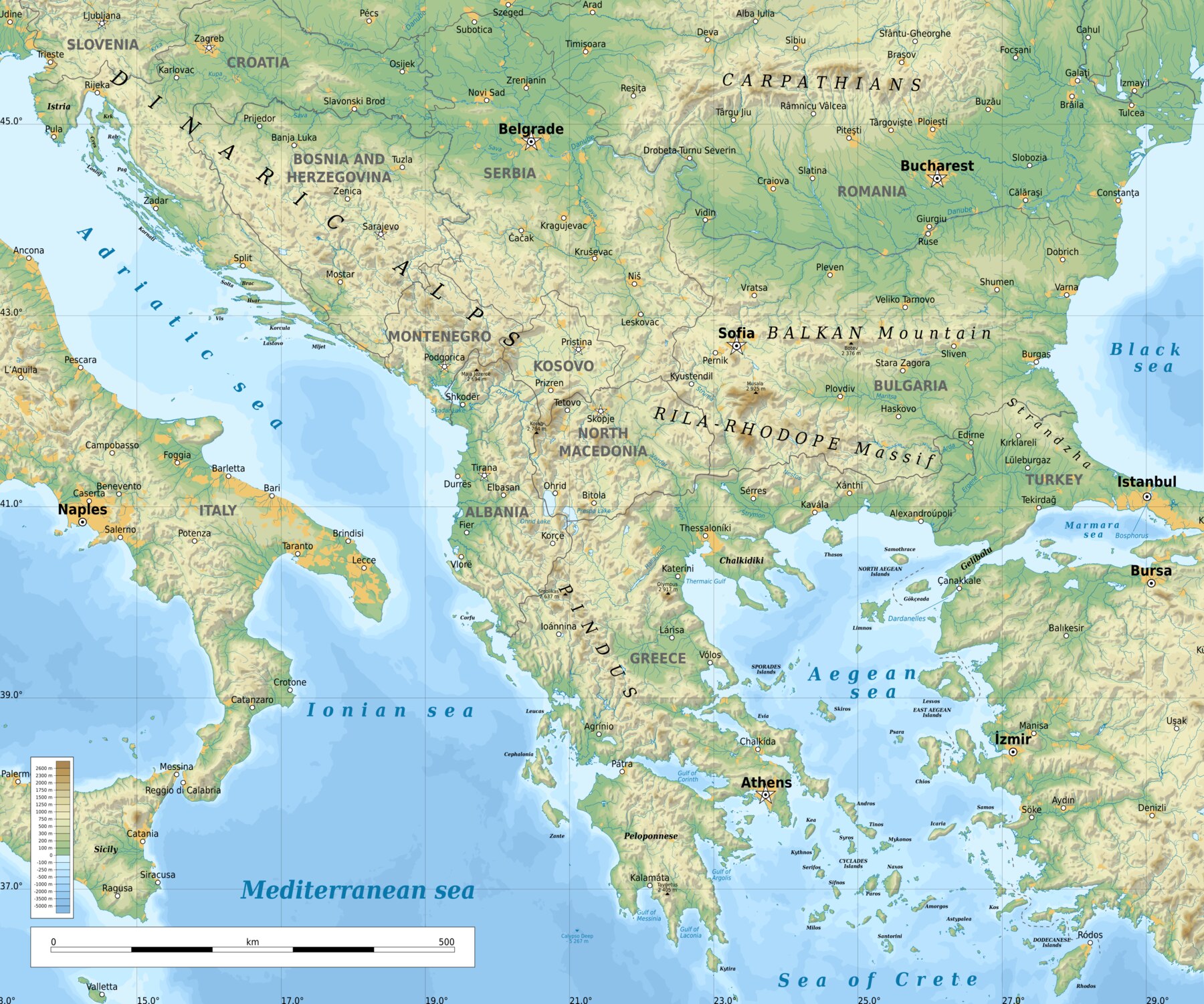
The Balkans appear clearly on a map but are more difficult to capture in a single definition. The peninsula juts out between the Adriatic Sea, the Ionian Sea, the Aegean Sea and the Black Sea, but where to draw the northern border remains a subject of debate. Encyclopaedia Britannica notes that there is no universally accepted list of Balkan countries. Albania, Bosnia and Herzegovina, Bulgaria, Croatia, Kosovo, Montenegro, North Macedonia, Romania, Serbia and Slovenia are usually included; Greece and the European part of Turkey also appear in broader definitions.
MOST focuses on eleven countries: Bosnia and Herzegovina, Croatia, Serbia, Montenegro, Greece, Romania, Bulgaria, Slovenia, Kosovo, North Macedonia and Albania. This is an editorial definition, not an attempt to draw a definitive cultural border. The region has been shaped by Ottoman, Habsburg, Venetian and Yugoslav contexts, but each country has its own history and contemporary identity.
This is also why the word “Balkans” should be used with care. It can describe a geography and a shared realm of experience, but it must not erase the differences between Sarajevo and Sofia, Zagreb and Pristina, or Bucharest and Tirana.
From the Alps to the Aegean Sea
In the north-west, Slovenia and Croatia meet Central Europe and the Adriatic Sea. Slovenia is small, alpine and closely connected to its neighbours. Croatia stretches from the inland plains to a long coastline of islands and port cities. Both are members of the EU, the eurozone and Schengen.
To the south and east of Croatia lies the landscape long associated with the former Yugoslavia. Bosnia and Herzegovina carries a multilingual and multi-religious history, where Ottoman quarters, Austro-Hungarian facades and Yugoslav modernism can meet on the very same street. Serbia has Belgrade as its metropolis and transport hub on the Danube and Sava. Montenegro combines a short Adriatic coastline with dramatic mountains, while North Macedonia is landlocked around the Vardar River, Skopje and Lake Ohrid. Kosovo is the region's youngest state, with Albanian as its primary language.
In a short space of time, Albania has gone from being one of Europe’s most closed countries to a destination where the coast, mountains and urban life pull in different directions. In Bulgaria and Romania, the region opens up towards the Black Sea and the plains of the Danube. Greece is geographically part of the Balkan Peninsula, although the country is more often presented primarily as a Mediterranean country and Southern European destination.
Languages Do Not Always Follow Borders
Bosnian, Croatian, Serbian and Montenegrin are closely related standard languages with a high degree of mutual intelligibility. Serbian is written in both Cyrillic and Latin alphabets. Macedonian and Bulgarian are closely related South Slavic languages written in Cyrillic. Slovene is also South Slavic but has its own distinct standard.
Albanian and Greek each constitute their own independent branches of the Indo-European language family. Romanian is a Romance language. Added to this are minority languages, dialects and local identities that cannot be neatly defined by national borders. For the traveller, this means a familiar word may reappear across several countries – but also that the name of the language itself can carry significant weight.
A Region Close to Sweden
The connections between Sweden and the Balkans are not new. During the 1960s and 1970s, Sweden recruited labour from the former Yugoslavia. A bill of the Riksdagen (Swedish Parliament), proposition 1969:14, states that Sweden and Yugoslavia signed a labour agreement on 16 September 1966, and that the convention on social security was signed on 5 July 1968. Mato Bošnjaks study “Labour Migration in the Service of the Sending State: The Yugoslav State’s Agenda in Regulating Labour Migration to Sweden” analyses the role of the Yugoslav state in labour migration to Sweden. Johan Svanberg's “Labour Migration and the Swedish Labour Market Model: A Case Study of Recruitment of Yugoslav Workers to Svenska Fläktfabriken in Växjö, 1969–1970” shows how recruitment operated in Swedish industry around the turn of the decade in 1970.
During the wars of the 1990s, there was a large-scale influx of refugees from the collapsing Yugoslavia. SCB (Statistics Sweden) has specifically studied the integration of people arriving from the former Yugoslavia between 1991 and 1995. This partly explains why the languages, family ties, entrepreneurship, food and culture of the region are so present in many Swedish towns and cities today.
MOST’s starting point lies precisely there: in the movement between the Nordic countries and the Balkans. The region is not merely a travel destination to the south, but also an integral part of modern-day Sweden.
EU, Euro and Borders: Three Different Maps
The EU, the eurozone and Schengen are not the same thing. Croatia, Greece, Romania, Bulgaria and Slovenia are EU members. Albania, Bosnia and Herzegovina, Montenegro, North Macedonia and Serbia are candidate countries. Kosovo submitted a membership application in December 2022 but is still described by the EU Commission as a potential candidate country.
According to the European Central Bank, Bulgaria adopted the euro on 1 January 2026, becoming the 21st member of the eurozone. Montenegro and Kosovo also use the euro without being members of the EU or the eurozone. Romania still uses the leu, while Serbia, North Macedonia, Albania and Bosnia and Herzegovina have their own currencies.
According to the EU Commission, Romania and Bulgaria became full members of the Schengen Area on 1 January 2025, when checks on persons at internal land borders were lifted. Temporary border checks may still occur within Schengen. Therefore, always check current regulations and carry a valid travel document.
Who Does the EU's Entry/Exit System Apply To?
The EU's Entry/Exit System, abbreviated as EES, registers third-country nationals crossing the external borders of the Schengen Area for a short stay – a maximum of 90 days in any 180-day period. It applies to both travellers who require a visa and those who are visa-exempt.
Here, “third-country nationals” refers to individuals who are not citizens of an EU country, Iceland, Liechtenstein, Norway or Switzerland. EU and Schengen citizens are therefore not included. Individuals from other countries who present a valid residence permit or residence card are also exempt. For travellers who are registered, the system records, among other things, data from the travel document, a facial image, fingerprints, and the date and place of entry and exit.
The phased roll-out of the EES began on 12 October 2025 and, according to the EU Commission, has been fully operational since April 2026. The system should not be confused with ETIAS, which is a separate travel authorisation system. Since entry requirements depend on citizenship and travel documents, you should always check the latest information with Polismyndigheten (the Swedish Police Authority) and UD's travel advice (the Swedish Ministry for Foreign Affairs) before travelling.
Mobile Phones on the Road
Within the EU and the European Economic Area (EEA), “Roam Like At Home” normally applies, according to Post- och telestyrelsen (the Swedish Post and Telecom Authority): calls, messages and data are charged at domestic rates, subject to the operator's fair use terms and conditions. This covers EU countries as well as Norway, Iceland and Liechtenstein. Since 1 January 2026, according to the EU Commission, Ukraine and Moldova have also been included.
The EU's full roaming regulations do not yet apply between Sweden and Albania, Bosnia and Herzegovina, Kosovo, Montenegro, North Macedonia or Serbia. The Western Balkans has its own regional roaming agreement, and tariffs between the EU and the region have been reduced through voluntary agreements. Nevertheless, always check your operator's terms and conditions before using mobile data.
Read More on MOST
Here are the eight published articles with their exact web addresses:
https://mostnorden.se/artikel/vagen-till-lukomir-dar-bosnien-fortfarande-kanns-vild
https://mostnorden.se/artikel/rakija-lamnar-koksbordet-och-kliver-in-i-premiumbaren
Sources
https://www.britannica.com/place/Balkans
https://enlargement.ec.europa.eu/enlargement-policy/candidate-countries-and-potential-candidates_en
https://enlargement.ec.europa.eu/countries/bosnia-and-herzegovina_en
https://enlargement.ec.europa.eu/countries/kosovo_en
https://www.ecb.europa.eu/press/pr/date/2026/html/ecb.pr260101~c830245e42.en.html
https://home-affairs.ec.europa.eu/news/bulgaria-and-romania-join-schengen-area-2025-01-03_en
https://travel-europe.europa.eu/sv/ees/what-is-the-ees
https://polisen.se/lagar-och-regler/resa-till-fran-sverige/tredjelandsmedborgare/entry-exit-system/
https://home-affairs.ec.europa.eu/news/entryexit-system-ees-fully-operational-2026-04-10_en
https://www.pts.se/internet-och-telefoni/roaming/
- Mato Bošnjak, ”Labour Migration in the Service of the Sending State: The Yugoslav State’s Agenda in Regulating Labour Migration to Sweden”, Journal of Migration History 12(2), 367–393 (2026). DOI: 10.1163/23519924-bja10002
- Johan Svanberg, ”Labour Migration and the Swedish Labour Market Model: A Case Study of Recruitment of Yugoslav Workers to Svenska Fläktfabriken in Växjö, 1969–1970”, Scandinavian Journal of History 36(1), 91–113 (2011). DOI: 10.1080/03468755.2010.540702
- Kungl. Maj:ts proposition nr 14 år 1969 om konventionen mellan Sverige och Jugoslavien rörande social trygghet
https://www.riksdagen.se/sv/dokument-och-lagar/dokument/proposition/kungl-majts-proposition-nr-it-ar-1969_eu3014/
https://www.scb.se/contentassets/8515f8a3af8b4074af400550515cd537/uf0549_1995i17_sm_a40br2003.pdf
https://www.regeringen.se/ud-reseinformation/
https://digital-strategy.ec.europa.eu/en/news/roam-home-extended-moldova-and-ukraine
Sources & further reading
- Encyclopaedia BritannicaBalkans
- Europeiska kommissionenCandidate countries and potential candidates
- Europeiska kommissionenBosnia and Herzegovina
- Europeiska kommissionenKosovo
Share the article
Translated from Swedish with AI assistance. Read the original.


