
The wild valley’s grapes: How Slovenian natural wines took over Stockholm’s wine bars
Once a blank spot on Sweden’s wine map, Slovenia’s border regions have become synonymous with uncompromising craftsmanship and vibrant orange wines. Meet the pioneers from Goriška Brda and the Vipava Valley who have won the hearts of Nordic sommeliers.
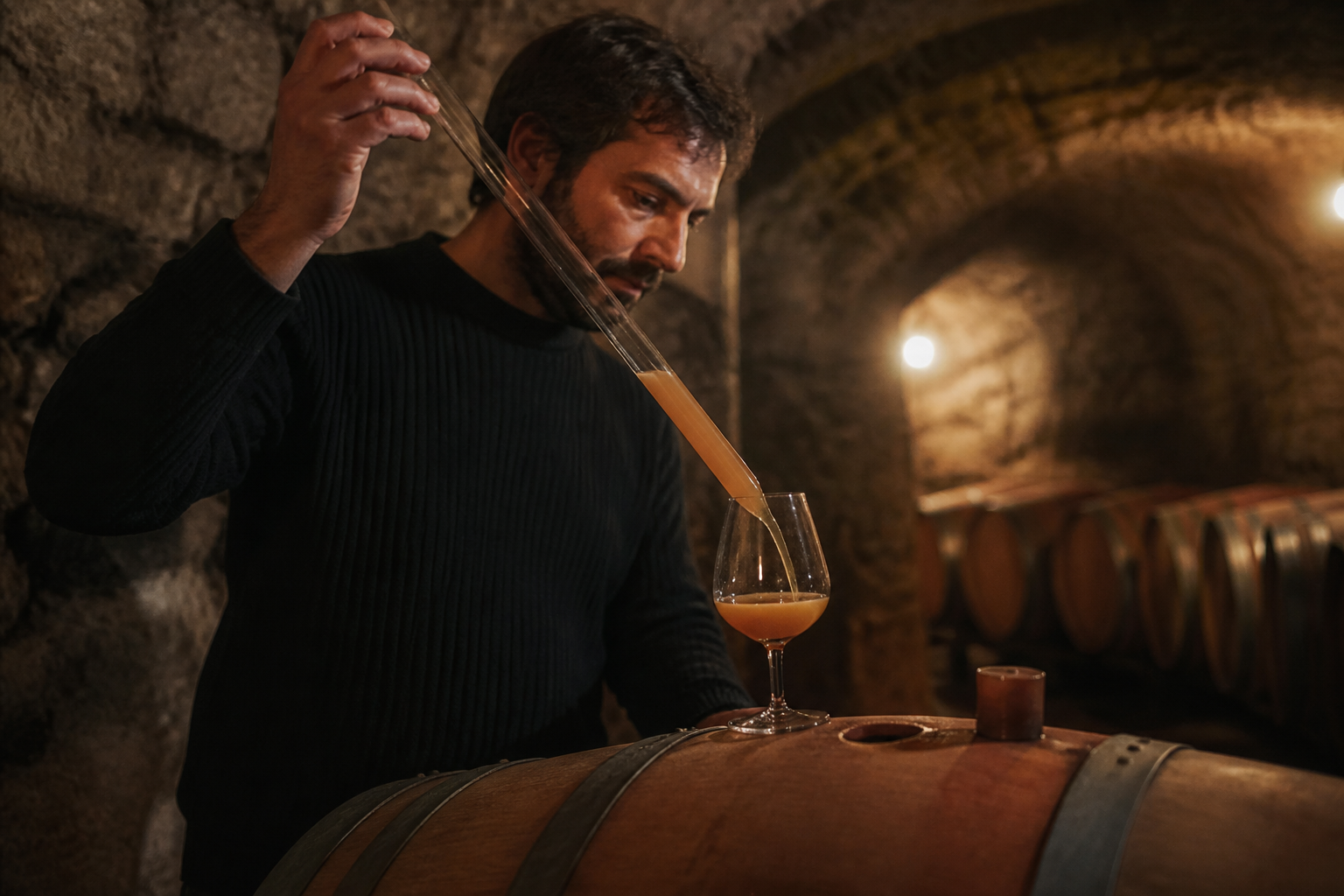
A glass is filled with a liquid that shimmers deep amber, almost like liquid apricot. The aroma is complex – full of dried fruit, ripe stone fruit, wild herbs and a subtle hint of beeswax. It is Friday evening at one of Stockholm’s busiest natural wine bars on Södermalm, and the glass just placed on the bar comes neither from the Jura, the Loire nor Sicily. It comes from a steep, sun-drenched slope in western Slovenia.
Over the past decade, Nordic drinking culture has undergone a quiet but noticeable revolution. The conventional and predictable have increasingly given way to the unfiltered, lively and handcrafted. Natural wines are at the forefront of this movement, and in recent years one particular origin has established itself as sommeliers’ absolute favourite: Slovenia. Once an uncut gem on Sweden’s wider wine map, Slovenia’s wine regions, led by Goriška Brda and the Vipava Valley, have become synonymous with high-quality craftsmanship, uncompromising biodynamic practices and characterful orange wines.
Orange pioneers in Goriška Brda
To understand why Slovenian wines are now flowing from bottles in Stockholm, you have to travel to Goriška Brda – the hilly landscape bordering Italy’s Friuli. It is here, in a region shaped by a Mediterranean climate and dramatically rolling hills, that the modern orange wine revolution has its home.
When industrial wine production swept across Europe in the post-war years, bringing temperature-controlled stainless-steel tanks, selected laboratory yeast and heavy chemical pesticides in the vineyards, a handful of winemakers in this border region chose to go in the opposite direction. Names such as Joško Gravner and Stanko Radikon (both based in Oslavia, just across the border on the Italian side, but with deep Slovenian roots and family ties) began experimenting with a return to ancient methods. They asked why white wine could not be made in the same way as red – by allowing the juice to ferment with the grape skins for an extended period.
This process is called maceration, and the result is what we now call orange wine, or skin-contact white wine. Gravner took it a step further and began fermenting his wines in Georgian clay amphorae (kvevri) buried in the ground, without any added yeast or temperature control. Radikon stopped filtering his wines altogether and bottled them in specially designed bottles with narrow necks to give the wines optimal oxygenation during ageing.
On the Slovenian side of the border, the baton was quickly taken up by visionaries such as Aleks Klinec in the village of Medana and the charismatic Aleš Kristančič at Movia. Klinec has become one of the region’s leading advocates of holistic, biodynamic farming, where vines share space with fruit trees and wild herbs. Kristančič, in turn, has become known around the world for his boundary-pushing wines, such as the sparkling "Puro", which is delivered undisgorged, with the lees still in the bottle.
At the heart of this production is the local grape Rebula (known as Ribolla Gialla in Italian). Its thick skin makes it ideal for long maceration. Through maceration, the grape, which would ordinarily produce fairly anonymous and neutral white wines, is transformed into complex, deeply structured wines with pronounced tannins, fresh acidity and a minerality that reflects the region’s unique soil – locally known as opoka, a lime-rich mixture of clay, sandstone and marl.
The borderland where wine ignores the map
One of the most fascinating aspects of winemaking in Goriška Brda is how little the political border matters to winemakers. The region blends seamlessly into Italy’s Collio Goriziano. Families have historically owned vineyards on both sides of the border, and during the Yugoslav era it was not unusual for farmers to cross the border every day with their agricultural tools to tend their vines.
This borderland has created a unique culture where Italian gastronomy meets Slavic craftsmanship and a refusal to compromise. It is an area where grapes such as Friulano (often called Jakot on the Slovenian side, a playful anagram following the EU ban on the original name Tokaj) are grown alongside Rebula and international varieties such as Pinot Gris and Chardonnay.
The collaboration and constant exchange of ideas between winemakers in Brda and Collio have created one of the world’s most dynamic natural wine movements. It is a place where people are not afraid to look back to find a way forward.
The Vipava Valley’s wild winds and living soils
A few miles south-east of Brda lies the Vipava Valley (Vipavska dolina), a narrow and dramatic valley stretching from the Vipava River’s source towards the steep karst plateaux. If Brda is rolling and harmonious, the Vipava Valley is more powerful, wild and wind-swept.
Here, one natural phenomenon in particular dictates the conditions for both people and winemaking: Burja (Buran). This extremely powerful, cold downslope wind can reach hurricane force in winter and spring as it sweeps down from the mountain peaks. But for winegrowers, the wind is also a blessing. It quickly dries out damp vineyards after rain, reducing the risk of fungal diseases and making it much easier to farm organically and biodynamically without chemicals.
In the Vipava Valley, we find producers who have taken the wild and unfiltered to its limits. Historical, almost forgotten local grape varieties such as Zelen and Pinela are grown here, producing fresh, aromatic and deeply individual wines. By focusing on these unique grapes and using natural methods in the cellar – wild yeast, no fining, no filtration and minimal added sulphur – the Vipava Valley’s winemakers have created wines with an identity all their own.
From Slovenian hills to Stockholm glasses
The fact that these wines have now become a fixture at Stockholm’s trendiest wine bars is the result of a perfect match between Slovenian craftsmanship and Nordic gastronomy.
As the Nordic restaurant scene moved towards the hyperlocal, seasonal and ingredient-focused, sommeliers needed wines that could match these clean, often tart and complex flavours. Conventional, oak-aged wines often dominated or felt too heavy. Slovenian natural wines, with their lively acidity, unique texture and deep, earthy notes, proved to be perfect companions to dishes based on fermented vegetables, game, mushrooms and fresh fish.
Today, Slovenian producers such as Kmetija Štekar and Nando are regular names on the wine lists at Stockholm’s more progressive restaurants. Kmetija Štekar, located in the heart of Brda, is run by Jure Štekar, who produces uncompromising, skin-macerated wines with tremendous energy and purity. Nando, led by Andrej Kristančič, focuses on exceptionally pure, mineral wines made from both local and international grapes, grown in the characteristic opoka soil.
But it is not only the most niche natural wine enthusiasts who have embraced Slovenian wines. The large cooperative Klet Brda, too, has managed to introduce orange wine to a wider audience through projects such as "Krasno Orange". By combining traditional methods with modern accessibility, it has shown that skin-contact wine need not be an obscure niche product, but can be both inviting and wonderfully food-friendly.
The next time you sit down at a wine bar in Stockholm and see a slightly cloudy, amber-coloured wine being poured, there is a good chance you have a little piece of Slovenia’s border country in your glass. It is a wine shaped by the Burja wind, the lime-rich opoka soil and a generation of winemakers who refused to compromise with nature.
Facts
Share the article
Translated from Swedish with AI assistance. Read the original.


