
The Stones That Survived History
When Albania opened up to the world after decades of isolation, the Ottoman stone houses of Gjirokastër were at risk of collapse. Sweden played a part in saving them. Through the organisation Cultural Heritage without Borders, generations of young architects and craftspeople from across the Balkans have gathered among the ruins to learn forgotten techniques – and build bridges across old dividing lines.
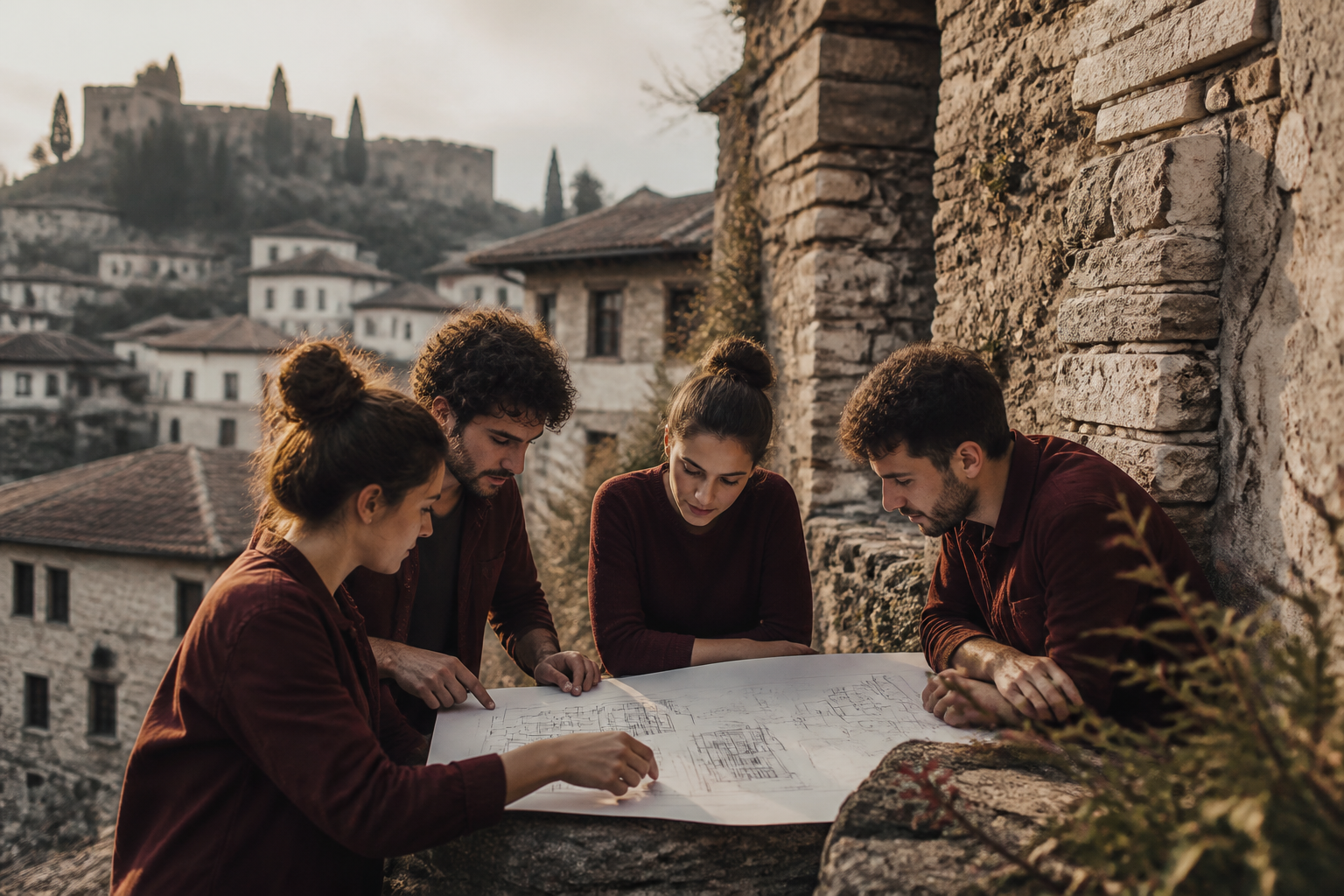
When rain falls over Gjirokastër in southern Albania, the city changes colour. The grey slate of the enormous roof tiles shines like silver, and the steep cobbled streets – the local sokaker – turn into running streams. Here, on the slopes of Mali i Gjerës, the city has clung on for centuries. Its unique architecture, shaped by monumental Ottoman fortified houses known as kule, earned it a place on the UNESCO World Heritage List in 2005.
But behind the picturesque façade lies a history of acute decay. When the harsh communist regime fell in the early 1990s, state maintenance collapsed too. Many of the historic houses were abandoned as residents sought a future in Greece or Tirana. Without heating and urgent roof maintenance, the heavy slate roofs began to give way. Restoring them required knowledge that was dying out with the old master craftspeople, and resources the Albanian state lacked.
It was at this critical point that Swedish hands and ideas found their place among the Ottoman stone walls.
The Swedish initiative against post-communist decay
During the Balkan Wars of the 1990s, the Swedish organisation Cultural Heritage without Borders (CHwB) was founded. The idea was simple but revolutionary: to use the restoration of historic buildings as a tool for reconciliation, peacebuilding and local development. With support from the Swedish International Development Cooperation Agency (Sida), the organisation turned its attention early on to Albania, and in particular to Gjirokastër.
The problem in Gjirokastër was not war damage, but slow, systematic decay and an acute shortage of trained craftspeople. Traditional techniques – slaking lime properly, carving local stone and joining timber without nails – were at risk of being lost.
CHwB realised that it was not enough to send international experts to do the work and then go home. What was needed was a long-term transfer of knowledge. The solution was the Regional Restoration Camps, a concept developed in close collaboration with local partners and Swedish experts, including the Swedish Building Conservation Association.
Craft as a bridge-builder
Since the camps began, hundreds of young architects, conservators and craftspeople from across the Balkans have met in Gjirokastër. They live and work together for two weeks, dividing into groups where theory sessions are combined with practical work led by local master craftspeople.
The camps have served as an arena for quiet diplomacy. Sitting side by side on scaffolding and mixing lime mortar builds a different kind of understanding from political negotiations. Young people from Serbia, Kosovo, Bosnia and Herzegovina, Croatia and Albania – countries whose relations are still shaped by historic wounds – have to work together to solve concrete, practical problems.
By using local materials and traditional methods, participants have learned to understand the physics of the buildings. They have discovered why the old houses withstood earthquakes better than modern concrete complexes, and why traditional lime mortar lets stone walls breathe in a way that modern cement never does.
From Babameto to renewed local pride
The results of Swedish-Albanian collaboration are clearly visible in the cityscape today. Several of Gjirokastër’s most prominent monuments have been saved from complete ruin.
One of the best-known examples is the Babameto houses (Babameto I and Babameto II), two connected Ottoman kule buildings dating from the 19th century. The buildings were virtually in ruins, with collapsed roofs and rotten floors. Through CHwB’s efforts and the work of camp participants, the houses were restored step by step. Today, Babameto serves as a living cultural centre, hostel and meeting place – concrete proof that cultural heritage can generate local jobs and tourism income.
Other important projects saved or documented over the years include Shtëpia Kore (the Kore House), Shtëpia Bakuli and Shtëpia Xhelili. The work has often been carried out in collaboration with local organisations such as the Gjirokastra Conservation and Development Organization (GCDO) and students from the University of Tirana.
This work has created a domino effect. When Gjirokastër’s residents saw that the old stone houses, which many had previously associated with poverty and underdevelopment, were so highly valued by international experts, attitudes changed. Private homeowners began seeking advice on how to renovate their own homes in keeping with their period style, rather than cladding them in modern plastic and concrete.
Albania’s former culture minister, Mirela Kumbaro, has on several occasions held up CHwB’s model as an example of how cultural heritage can be integrated into the modern economy without losing its soul. The aim is not to freeze the city in time, but to make it liveable and economically sustainable for the people who actually live there.
Heritage that brings the region together
The experience in Gjirokastër has been so successful that the model has been exported to other parts of the Balkans. Similar camps have been held in the historic wine village of Rogljevo in eastern Serbia, in Kosovo and in Bosnia and Herzegovina. What began as an emergency rescue project on an Albanian mountainside has grown into a regional network of young professionals who share a commitment to conservation and collaboration.
As the sun sets over the Drino Valley, casting long shadows across Gjirokastër’s fortress, the sound of hammers can still be heard in the upper districts. It is no longer only foreign aid money that drives the work, but a new generation of Albanian craftspeople who have taken up the baton. They carry with them the knowledge saved by Swedish hands, and ensure that the stone city continues to live – not as a dead museum, but as a living, breathing neighbourhood in the heart of the contemporary Balkans.
Facts
Sources & further reading
- javanews.alGjirokastër, ministrja Kumbaro ndjek nga afër restaurimet | JavaNews.al
- chwbalbania.orgABOUT US - CHwB
- academia.eduThe Vernacular Heritage of Gjirokastra (Albania): Analysis of Urban and ...
- chwbalbania.orgThe Regional Restoration Camps - CHwB
Share the article
Translated from Swedish with AI assistance. Read the original.


