
The Michelin-Starred Chef’s Cretan Rabbit Stew: Where Carob and Chestnuts Meet on the Plate
Cretan cuisine is often associated with simplicity, olive oil, and wild herbs. But in the hands of Michelin-starred chef Alexandros Tsiotinis, a rustic rabbit stew is transformed into a modern, balanced taste sensation, where the key lies in chestnuts and Crete’s own "black gold" – carob.
In the hip Keramikos district of Athens lies the restaurant CTC. Here, chef Alexandros Tsiotinis has created a sanctuary for modern Greek cuisine. Tsiotinis is no ordinary chef; he honed his skills in Paris at three-starred fine dining establishments under the leadership of giants such as Alain Passard at L'Arpège and Pascal Barbot at Astrance. In 2015, he won the prestigious title of S. Pellegrino Young Chef for the Mediterranean countries, a breakthrough that cemented his place on the international culinary map.
Yet, despite his French techniques and streamlined fine dining mindset, Tsiotinis constantly returns to his Greek roots. For him, modern Greek gastronomy is not about deconstructing dishes beyond recognition, but about highlighting unique ingredients. A brilliant example of this is his elegant interpretation of Cretan rabbit stew with chestnuts and carob syrup – a recipe published in the respected Greek food magazine Gastronomos.
Carob: From Wartime Food to Liquid Gold
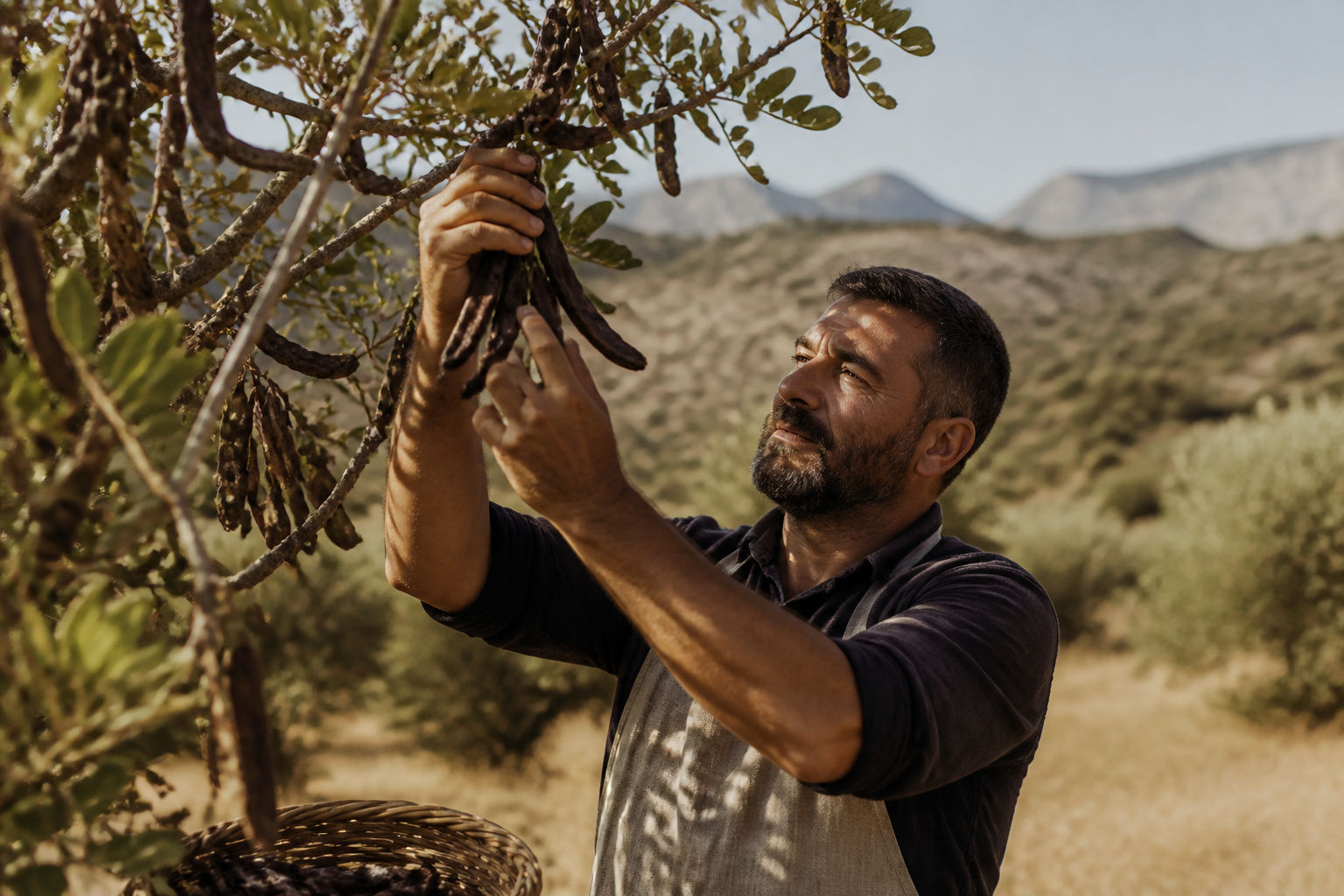
To understand the dish, one must understand carob (in Greek haroupia), the fruit of the carob tree (Ceratonia siliqua). This robust, evergreen tree grows wild all over Crete and has for centuries played a vital role in the survival of the island's population. During the Second World War, when Crete was occupied and famine was widespread, it was the highly nutritious carob pods that saved thousands of Cretans from starvation. They were ground into flour, baked into bread, and boiled down to a thick syrup.
For a long time, carob carried the stigma of poverty and hardship. It was viewed as animal feed or something eaten only when nothing else was available. But over the last decade, a culinary renaissance has taken place on the island. Young Cretans have started cooperatives and modern production facilities – for example, in the village of Argyroupoli – to process the fruit in a modern way.
Today, carob is often called "Crete's black gold". It is naturally gluten-free, packed with antioxidants, and has a completely unique flavour profile. When you boil down the carob pods, you extract a dark, amber-coloured syrup often referred to as "carob honey" or charoupomelo. It is not as cloyingly sweet as ordinary honey; instead, it has a deep, complex taste with distinct notes of dark cocoa, molasses, liquorice, and a light, natural fruit acidity. It is this syrup that forms the backbone of Tsiotinis's rabbit stew.
Chestnuts and Rabbit: The Mountain Villages' Larder
The second supporting pillar of the dish is chestnuts. In western Crete, particularly in the mountainous parts of the Chania region around the village of Elos, vast, ancient chestnut forests grow. Every autumn, the chestnut harvest is celebrated with grand festivals where the nuts are roasted over open fires, boiled in large pots, and served alongside local wine to the tunes of the Cretan lyra.
In traditional Cretan cooking, the combination of rabbit (kouneli) and chestnuts is a classic that belongs to late autumn and winter. Rabbit meat is lean, pale, and has a mild, subtle gamey flavour that resembles chicken but with significantly more character. When simmered slowly with sweet, soft chestnuts, a perfect balance is struck between the saltiness of the meat and the creamy, almost buttery texture of the nuts.
In traditional homes, the dish is often prepared as a rustic stew, not unlike a stifado, with generous amounts of pearl onions, cinnamon, and cloves. But Tsiotinis chooses a different, more subdued path. He tones down the most dominant Christmas spices, allowing the more elegant aromas of the forest and the mountains to take centre stage instead.
Building the Flavours: From Wild to Elegant
Tsiotinis's recipe begins with classic French undertones but lands softly in Greek soil. The rabbit pieces are tossed in flour and browned to a golden hue in Cretan olive oil to create a deep sear. After that, an aromatic base of onion, garlic, celeriac, and carrots is sweated in the pot together with bay leaves, thyme, and juniper berries. The juniper berries are an important detail – they pick up the wild notes of the rabbit and evoke the Cretan mountains, where wild juniper bushes grow on the barren slopes.
After some dry red wine is allowed to reduce, the stew is left to simmer under a lid for about 40 minutes until the meat is tender. It is only during the final ten minutes that the magic happens. This is when Tsiotinis stirs in the pre-boiled, peeled chestnuts and drizzles over the carob syrup.
Adding the syrup late in the process is a tactical decision. If allowed to boil for too long, its subtle acidity and chocolate notes can easily get lost in the heavy meat flavours. By letting it simmer for only the final few minutes, the syrup manages to glaze the meat and chestnuts, while simultaneously reducing the pan juices into a glossy, dark brown nectar. The taste becomes a complex dance between the acidity of the wine, the fruitiness of the juniper, the rich sweetness of the chestnuts, and the deep molasses notes of the carob.
In the Glass: Crete's Red Treasures
Such a complex dish demands its partner in the glass. Choosing a young, astringent red wine for this stew would be a mistake; the harsh tannins easily clash with the sweetness of the carob, creating a metallic aftertaste. Instead, one should look towards Crete's own grape treasures.
An excellent choice is a wine based on the Liatiko grape. This is one of Crete's oldest and most fascinating red wine grapes. Liatiko yields pale-coloured wines but with an intense aroma of dried figs, raisins, leather, and sweet spices. They often have soft acidity and very ripe tannins, making them a perfect reflection of the stew's sweet-and-sour character.
Another option is a blend of Kotsifali and Mandilaria. Kotsifali contributes alcohol, soft tannins, and aromas of red berries, while Mandilaria adds colour, structure, and acidity. Together they create a full-bodied yet round wine that easily matches the gamey flavour of the rabbit and the weight of the chestnuts, without overpowering the elegant carob syrup.
Eating Alexandros Tsiotinis's rabbit stew is like taking a journey through Crete's geography and history. It is a dish that smells of damp forest soil, salty sea breezes, dry mountain slopes, and generations of Cretan resilience. By giving the humble carob its rightful place on the fine-dining plate, Tsiotinis shows the way forward for the next generation of Greek gastronomy: a cuisine that is proud of its origins, but never afraid to look ahead.
Facts
ALEXANDROS TSIOTINIS
Chef and founder of the Michelin-starred restaurant CTC in Athens. Tsiotinis has a solid international background and has worked at renowned French restaurants such as L'Arpège and Astrance. In 2015, he won the Mediterranean regional final of S. Pellegrino Young Chef.
Sources & further reading
- Greece IsRabbit with Chestnuts & Carob Honey from Crete
- ctc-restaurant.comCHEF – ctc
- wbpstars.comCTC Urban Gastronomy restaurant review — WBP Stars
- gastrotrips.blogspot.comGastrotrips: CTC, Athens
Share the article
Translated from Swedish with AI assistance. Read the original.


