
The gaze that harms and the glass that protects: The story behind Greece’s blue eye
It hangs from the rear-view mirrors of taxis in Athens, is pinned to newborns’ clothes and is sold by the thousand along the alleys of the Cyclades. The cobalt-blue glass disc with its staring eye is Greece’s best-known souvenir – but for Greeks themselves, the “mati” is anything but a trivial tourist trinket. It is a living tradition, thousands of years old, for warding off envious looks, and one that still shapes modern everyday life, fashion and design.
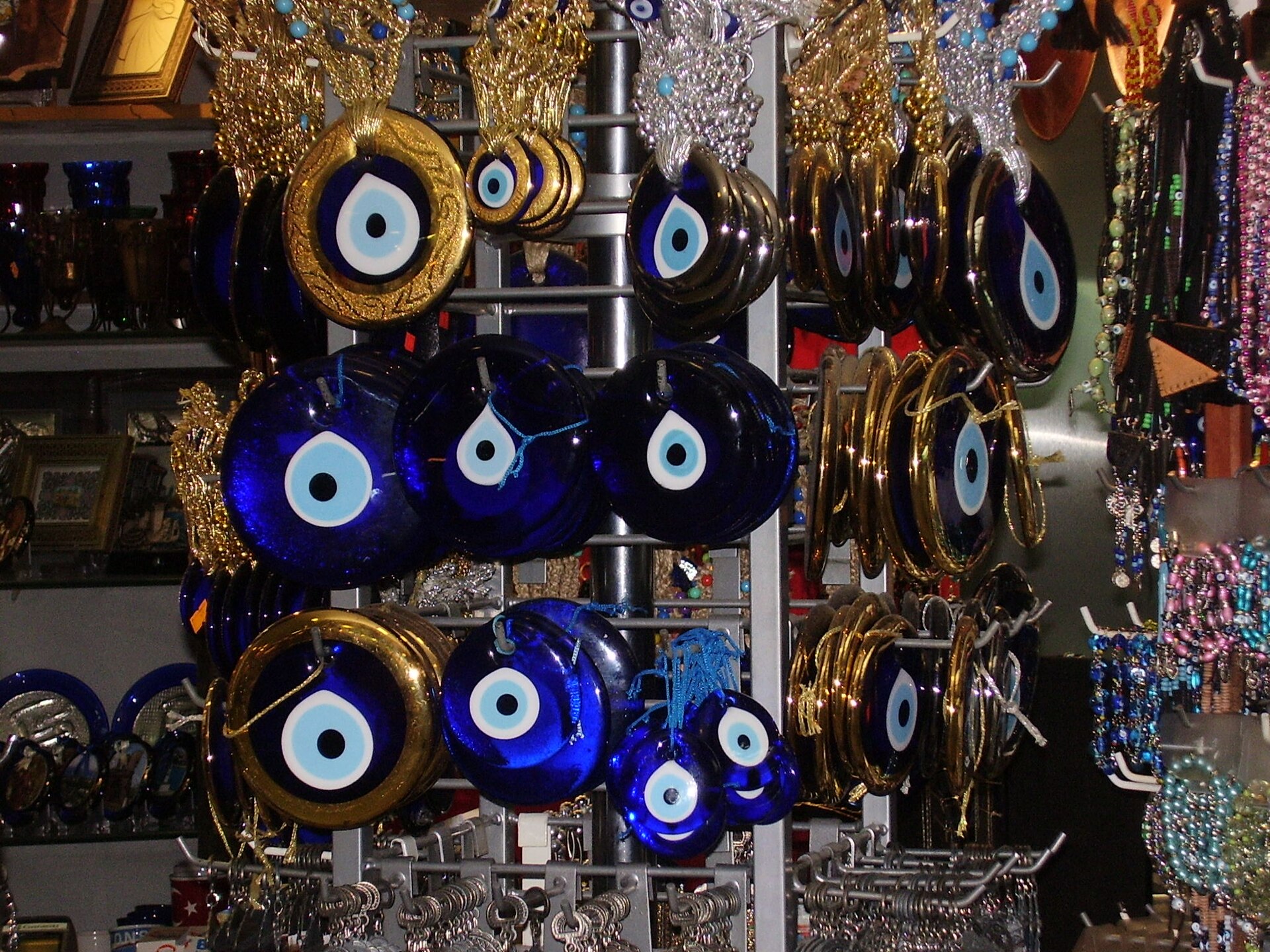
Walk through the Monastiraki flea market in Athens or the whitewashed alleys of the Cyclades, and you will encounter thousands of blue eyes. They stare out from key rings, bracelets, ceramic plates and wall decorations. For a Nordic holidaymaker, the little glass eye often seems like a colourful detail among a sea of tourist souvenirs, a charming reminder of sunshine and saltwater swims.
But behind its glossy surface lies one of the most enduring and deeply rooted beliefs in Greek cultural heritage. The blue eye is not a modern invention designed to attract tourists; it is a protective amulet, known as a mati, created to ward off matiasma – the evil eye. It is a force that Greeks from all walks of life, from olive farmers in the countryside to young tech entrepreneurs in the big cities, still treat with great respect in their everyday lives.
Matiasma – the gaze that causes physical pain
To understand the amulet, you must first understand the threat it is meant to protect against. In Greek, the word mati (which literally means “eye”) refers both to the symbol itself and to the phenomenon of the “evil eye”. The belief is that a person’s gaze can transfer negative energy, envy or ill will to someone else, consciously or unconsciously.
The most insidious thing about matiasma is that it does not take malice to trigger it. An envious thought disguised as a compliment is often the most dangerous. When someone expresses extravagant admiration for a beautiful child, a new house or a successful business, there is a risk that matiasma will be activated. This is why small children are considered particularly vulnerable; they are natural magnets for praise and attention.
The physical symptoms of being struck by the evil eye are familiar to every Greek. It often begins with a sudden, unexplained headache, overwhelming tiredness, dizziness or persistent yawning. If someone who was feeling well suddenly experiences a wave of listlessness after meeting acquaintances, the diagnosis in a Greek home is almost always the same: they have been struck by the “mati”.

Xematiasma – the secret ritual cure
Once matiasma has taken hold, the glass charm in your pocket is not enough – more active measures are needed. The process of driving away the negative energy is called xematiasma. This is a ritual governed by strict rules and carried out by someone who knows the secret formula.
Traditionally, xematiasma is often performed by an older relative, such as a grandmother. The ritual involves a special prayer, often combined with water and olive oil. The person performing the ritual drips olive oil into a glass of water while silently reciting the prayer. If the drops of oil dissolve or spread through the water instead of remaining as round droplets on the surface, it is a sign that the person has indeed been struck by the evil eye. When the oil finally dissolves completely, the energy is considered neutralised, and the afflicted person often feels immediate relief – a process frequently accompanied by both the healer and the afflicted person yawning intensely, a sign that the negative energy is leaving the body.
What is fascinating about xematiasma is the way the tradition is passed on. The prayer used is secret and may only be taught under strict conditions – traditionally on Good Friday, and almost always from a woman to a man or from a man to a woman. If someone teaches the prayer to a person of the same sex at the wrong time of year, the formula is believed to lose its power for both of them.
From ancient philosophers to the church altar
The idea of the evil eye is not a medieval superstition. Its roots reach back thousands of years. Even in antiquity, Greece’s foremost thinkers discussed the phenomenon. Philosophers such as Democritus and Aristotle tried to offer scientific explanations for how a gaze could cause harm. They believed that the human eye emitted invisible rays of energy that could negatively affect the surroundings and living creatures. The poet Theocritus also wrote about the subject, and in Homer’s Odyssey we find references to the destructive power of the evil eye, not least in the figure of the Cyclops Polyphemus, whose single staring eye personifies the devastating gaze.
The historian and writer Plutarch devoted an entire chapter to the subject in his celebrated work Moralia, written during the first and second centuries AD. At a symposium, his guests discuss how the human gaze can carry a poison so potent that it can harm infants and young animals.
When Christianity spread across the Roman and Byzantine empires, it failed to eradicate belief in mati. Instead, it was incorporated into the Orthodox Christian tradition. Although the official church may be theologically sceptical of folk superstition, the Greek Orthodox Church recognises the existence of an evil gaze (known as vaskania). Priests have special prayers to protect the faithful from it, and it is not unusual to see a blue amulet hanging right beside icons of saints in Greek homes.

The quiet protectors of everyday life
Today, the tradition lives on with undiminished strength in modern Greece. It is not about a nostalgic look back, but about practical everyday psychology. When a Greek buys a new car, one of the first things they do is hang a blue eye from the rear-view mirror. When a new business opens its doors in Athens, a discreet mati symbol is placed near the till or entrance to protect it from the envious looks of competitors.
The tradition is most visible when it comes to newborns. It is still almost obligatory to attach a small blue eye, often in gold or silver and fastened with a safety pin, to the baby’s play gym, pram or clothes before taking them out among people for the first time. It acts as a quiet shield against well-meaning but potentially harmful comments.
From folk belief to modern design and high fashion
Over the past few decades, the blue eye has undergone a remarkable aesthetic transformation. Once a traditional amulet kept tucked away in pockets or worn beneath clothing, the mati has now made its way fully into the international worlds of design and fashion.
Greek designers and jewellery makers have led the way in reimagining the classic symbol for a modern, urban audience. One prominent example is the Greek jewellery designer Marianna Lemos, who has made the stylised eye one of her most recognisable signatures. By combining the traditional form with precious metals, clean lines and modern minimalism, she and her peers have managed to transform a symbol of superstition, thousands of years old, into a sought-after fashion accessory worn on red carpets and at fashion shows around the world.
These modern interpretations, however, are about more than aesthetics. For Greeks who wear them, the jewellery represents a subtle but powerful connection to their identity and history. It is a way of carrying their cultural heritage with them, wherever in the world they may be.
The next time you find yourself in front of a souvenir stall in Greece, watching the bright blue glass discs glitter in the sunlight, you will know that you are not just looking at a cheap tourist trinket. You are looking at a survivor from antiquity – a glass shield, thousands of years old, shaped by human fear, envy and the eternal search for security.
Facts
At a glance: The Greek eye
- Name: Locally known as mati (eye) or matiasma (the gaze of the evil eye).
- Function: Acts as a “mirror” that reflects negative energy and envious looks away.
- Colour: Traditionally cobalt blue, light blue and white. The colour blue is historically believed to have an extra protective effect in the countries around the Mediterranean.
- Global spread: The phenomenon is shared with several neighbouring cultures and is known as nazar in Turkey and parts of the Middle East.
Sources & further reading
Share the article
Translated from Swedish with AI assistance. Read the original.


