
The Eagle and Gryphons Return to the University Palace in Bucharest
At the University Palace in Bucharest, the eagle and the two gryphons are returning to their posts. But behind the recreated sculptures lies a broader restoration question: how do we make historic educational spaces functional again without erasing the building's more uncomfortable memories?
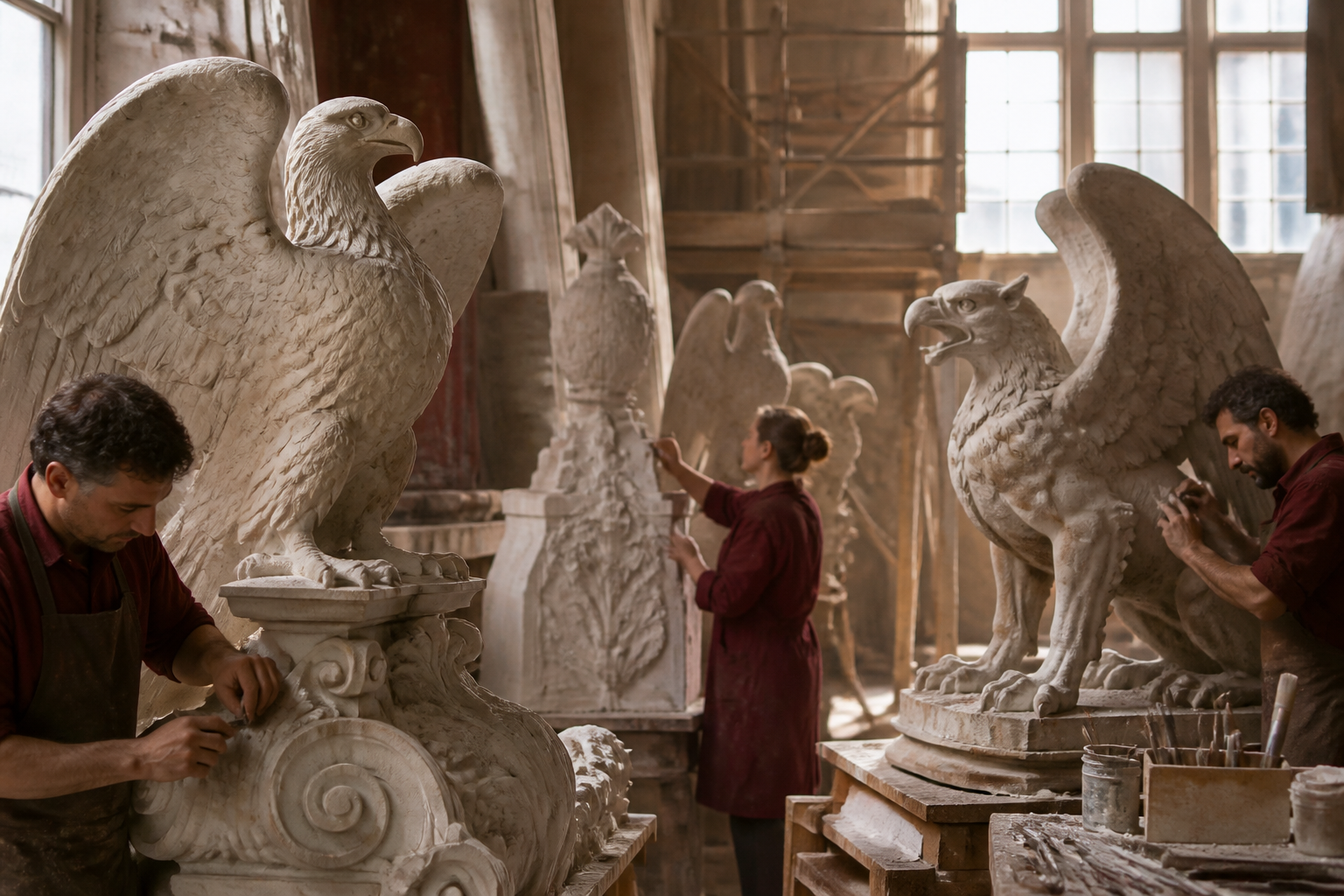
The eagle and the two gryphons are new, even though their purpose is to restore something the University Palace had lost. They belong to the building’s historical expression, but they are not preserved originals that have been cleaned and hoisted back into place. They are reconstructed sculptures. This distinction is vital to understanding what the restoration in central Bucharest is actually achieving.
In Romanian, the building is called Palatul Universității. It is both an architectural landmark on Piața Universității and a workplace where lectures, seminars, and research must function. The university has officially inaugurated the restored section for the Facultatea de Istorie (the Faculty of History). This represents a single phase, not an announcement that the entire University Palace is fully restored.
Here, several tasks meet that do not always pull in the same direction: restoring the expression of a monumental building, making it functional for today's university, and handling the traces left by the 1989 revolution and the protests in University Square. A lost sculpture is to return. A historically significant blemish, perhaps, is to remain visible.
New Sculptures Based on Historical Models
An eagle is a familiar motif in European civic architecture. The gryphon, with features of both lion and eagle, belongs to the same long-established repertoire of symbols for strength and vigilance. On a monumental university building, such figures are not standalone artworks. They are part of the architectural composition, affecting how the entire building is silhouetted against the sky.
When they are missing, therefore, more than just a decorative detail is altered. The building's proportions remain, but its silhouette and visual focal points change. Reintroducing the sculptures is a way to make an earlier architectural concept legible once more.
However, this does not mean turning back the clock. A preserved original carries information within the very material itself: the craftsmanship, the aging, the repairs. A reconstruction, by contrast, carries knowledge of how someone today has interpreted historical evidence. Both can have a place in a restoration, but they tell different stories.
For the eagle and the gryphons, therefore, the documentation behind the new fabrication is central. Historical photographs, drawings, and any surviving fragments are different kinds of evidence, each with its own possibilities and limitations. A photograph can show the outline clearly but leave the back of the figure unknown. A drawing may represent an intention rather than what was actually built.
Which of these sources were used for these specific sculptures is not clear from the available material. It is therefore impossible to describe them as exact copies or to detail their fabrication. The definite and relevant distinction is simpler: what returns are the sculptural motifs, realised through new objects.
A Palace That Must Still Serve as a University
The University Palace belongs to that Bucharest where public institutions were granted monumental architecture. The facade was meant not only to house the activity but also to make it visible in the city. Knowledge was given a prestigious address.
Today, the building stands in the heart of a capital where traffic, public transport, commerce, and university life share the space. Piața Universității is not a secluded forecourt to a monument. Strada Edgar Quinet on the other side of the palace also reminds us that the building must be understood from multiple perspectives, not just through its well-known facade facing the square.
The fact that the History Faculty's wing is being put back into use is therefore significant in itself. The result of the restoration should not only be viewed from a distance. It is to be used by people who come there to work and study, often with entirely different things on their minds than stucco and sculptures.
At the same time, the scope of the project must be kept clear. A palace with multiple wings and university functions is not complete just because one faculty returns. The restored phase can justify celebration without being made into a final verdict on the entire complex.
Nor should the restored appearance of the facade be confused with the building's structural condition. Restoration and structural reinforcement have distinct tasks. One can make older forms clear again; the other must provide the conditions for the building to continue functioning. What reinforcement measures have been carried out here requires more technical documentation than the public presentation available in the source material.
What Are the Students Returning To?
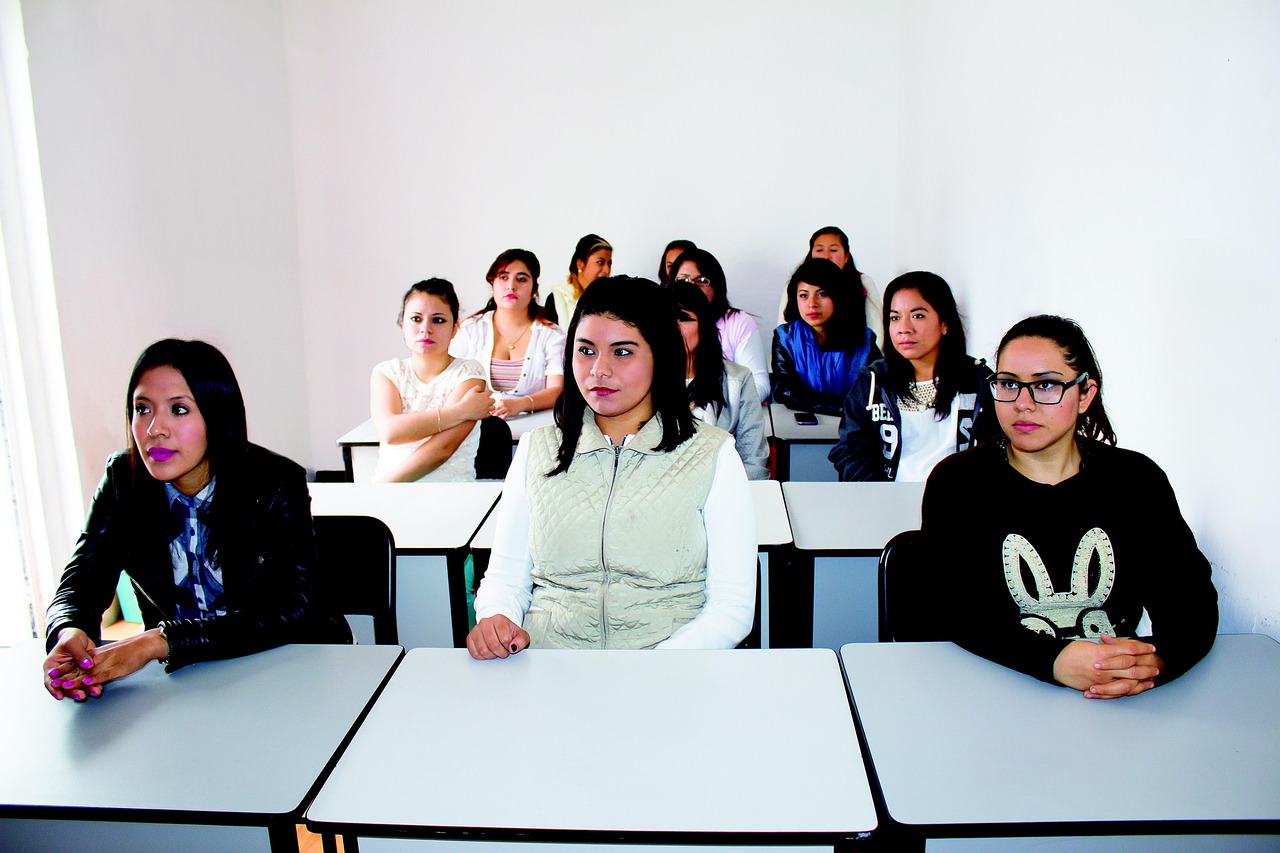
For students and teachers, much is determined by things that rarely appear in inauguration photos. Can the speaker be heard? Does the lighting work both for taking notes and for projected images? Are there usable spaces between classes? Can people with different physical abilities access the lessons?
These are practical questions in any historic university building. High ceilings, deep window recesses, and grand staircases can be architectural qualities, but they do not automatically solve acoustics, ventilation, or accessibility. Modernisation must work with the building's inherent conditions, and sometimes around them.
There is no inherent conflict here between cultural heritage and a functioning university that must be accepted in advance. Services and installations can be integrated with older rooms, and new additions can be designed to be distinguishable from the historic fabric. But each solution must be assessed on its own merits. The fact that something is newly renovated does not tell us how well it functions in daily life.
The available material does not provide a detailed account of the lecture halls' equipment, the communal areas, or the accessibility solutions. Therefore, it is impossible to state exactly what the students are getting beyond the return to the restored wing. A lift, an adapted entrance, or a certain technical standard should not be written into the narrative simply because it would be reasonable to expect.
Yet the value of adaptive reuse lies in this very direction: historic spaces are allowed to remain teaching spaces. The palace is preserved not by being liberated from daily life, but by being able to support it.
The Traces That Should Not Be Plastered Over
At University Square, the word 'restoration' carries a particular charge. The square is associated both with the 1989 revolution, when Nicolae Ceaușescu's dictatorship fell, and with the protests of 1990 regarding Romania's future path. The university's balcony became a podium and a part of the square's political history.
Those events belong to a different historical layer than the palace's original architecture. They are not necessarily visible in the building's symmetry or ornamentation, but rather in texts, marks, memorial plaques, and people's knowledge of what happened there.
An inscription addressed to philology students says—translated into English—that people were killed here, that the place should be entered with respect, and that blood is here. It is not a neutral piece of information about a calendar year. It intervenes in daily life, addressing people on their way to the university.
Such traces impose different demands than the recreated sculptures. While the eagle and the gryphons are meant to restore a lost form, an inscription may need to be protected from the very ambition to make all surfaces look whole and uniform. Restoration is also a choice of which historical layers are allowed to remain visible.
The university balcony and the plans for a revolution museum in the adjacent room belong to this issue. But a planned museum is not an opened museum. Nor is an ambition to preserve memory the same as documented measures to protect a specific inscription or physical trace. The source material does not show clearly enough which such interventions have been carried out.
This leaves an important question unanswered as the Faculty of History's wing is now presented as restored: how is the plastered, repaired, and recreated to coexist with that which must bear witness to a rupture in history?
The eagle and the gryphons make the return visible from afar. The future life of the University Palace will also be decided closer to the ground: in the rooms where teaching must function, and at the traces that do not become any less valuable because they disrupt an orderly facade.
Sources & further reading
- Universitatea din BucureștiUniversitatea din București a inaugurat sediul restaurat al Facultății de Istorie și a deschis oficial anul universitar 2026–2027
- romania.europalibera.orgOrganizațiile civice cer păstrarea inscripțiilor Revoluției Române de pe clădirea Universității București
- b365.roB365 - EXCLUSIV I Vești excelente despre Palatul Universității. Va fi refăcut de la zero spectaculosul fronton cu vultur și grifoni, distrus de bombardamentele din 1944 • MAKE BUCHAREST GREAT AGAIN
- bugetul.roPalatul Universității București și-a primit înapoi vulturul și grifonii. Cele 3 piese, repuse după aproape un secol - Bugetul.ro
Share the article
Translated from Swedish with AI assistance. Read the original.


