
The Concrete Icon on Sniper Alley: Sarajevo's Floating Masterpiece is Finally Saved
The Historical Museum of Bosnia and Herzegovina in Sarajevo is one of the most daring works of Yugoslav modernism. Yet the floating concrete pavilion, situated right on the former frontline, is also a survivor of war. After decades of political blockade and physical decay, Boris Magaš’s masterpiece is finally being brought back to life ahead of its 80th anniversary – to the delight of a new generation of Nordic architects fascinated by the Bosnian capital's raw concrete poetry.
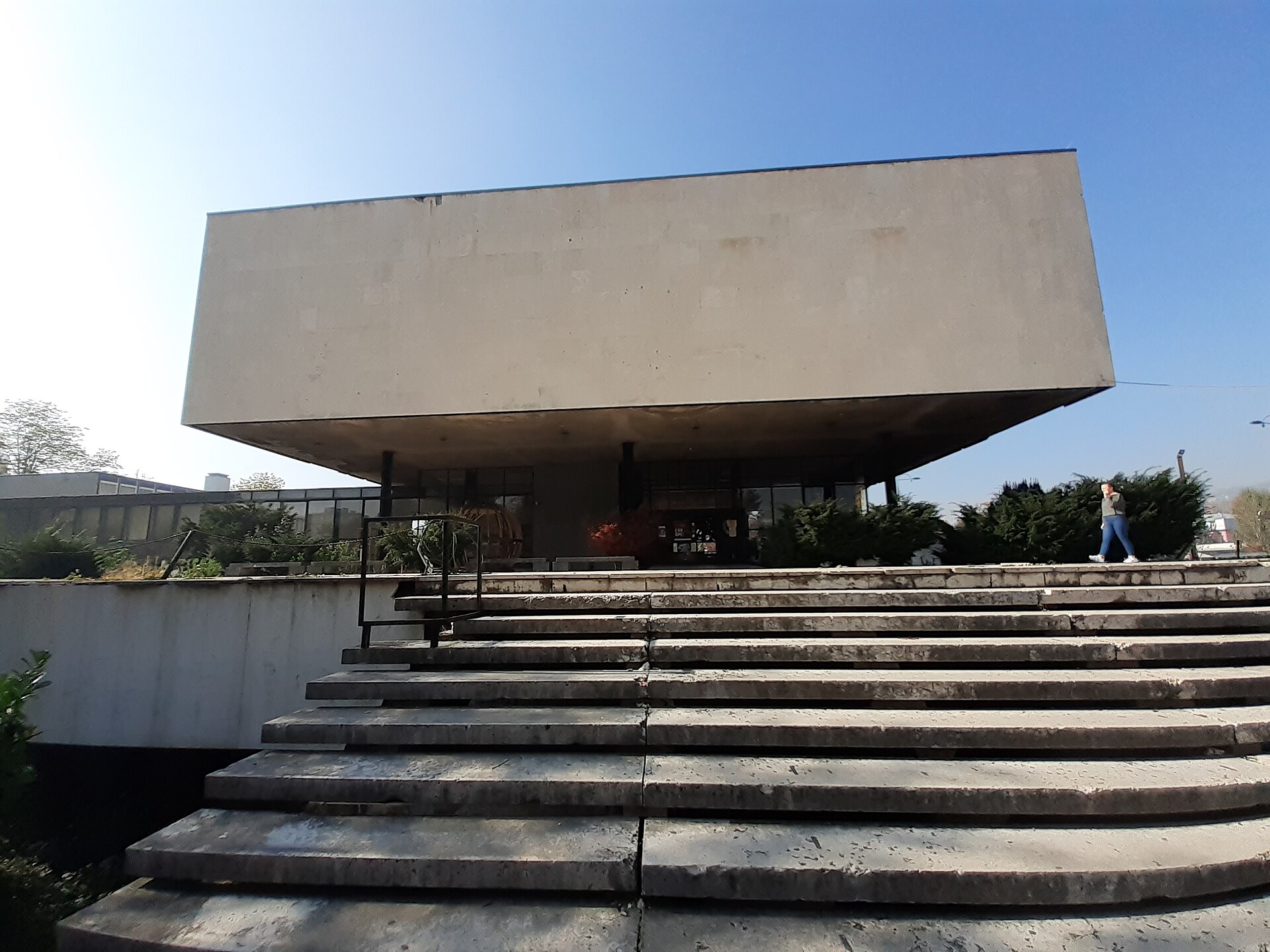
Moving westwards from Sarajevo’s Ottoman bazaar Baščaršija, the city gradually transforms. The narrow, oriental street grid opens up into wide avenues flanked by Austro-Hungarian palaces, which soon give way to large-scale post-war urban planning. Here, in the district of Novo Sarajevo, rises one of European modernism’s most fascinating yet most wounded buildings.
At first glance, the Historical Museum of Bosnia and Herzegovina (Historijski muzej BiH) appears as an architectural mirage. A huge, closed cube clad in light marble and concrete floats weightlessly above a fully glazed ground floor. It is an uncompromising piece of post-war modernism, designed by the architects Boris Magaš, Edo Šmidihen, and Radovan Horvat. Completed in 1963, the building was built to house the former Museum of the Revolution, an institution dedicated to the partisan struggle during World War II under the leadership of Josip Broz Tito.
Today, the museum is a place of pilgrimage for international architects who venture beyond the classic tourist trails to study the unique design language of Yugoslav post-war architecture. But behind the raw concrete poetry lies a darker story of survival and political neglect.
The Monolith in the Line of Fire
That the Historical Museum is standing at all is a minor miracle. During the Siege of Sarajevo between 1992 and 1995, the boulevard Zmaja od Bosne right outside the museum’s glass walls was turned into the notorious "Sniper Alley" (Aleja snajpera). The frontline cut straight through the urban landscape just a stone's throw away.
With its large glass expanses and strategic location, the museum became an easy target for artillery and snipers. The building was perforated by hundreds of pieces of shrapnel and bullet holes. During the freezing war years, the dedicated museum staff barricaded the windows with sandbags and moved the most valuable parts of the collection down into the dark basement. Lacking electricity, running water, or heating, the staff refused to abandon their posts. They guarded not just the artefacts, but the very idea of a shared Bosnian cultural heritage in the midst of a fierce ethnic war.
When peace was finally established through the Dayton Agreement (Dejtonski mirovni sporazum) in 1995, the shelling ceased, but a new kind of struggle began. The complex peace treaty divided Bosnia and Herzegovina into two highly autonomous entities but failed to define who carried the financial and administrative responsibility for the country's central cultural institutions. The museum was left in a political and economic limbo.
The Fight Against Oblivion
Without state funding, the museum had to rely on international donations, local enthusiasts, and creative grassroots initiatives to keep its doors open. The roof leaked, the heating system collapsed, and the concrete began to crumble. During the winters, staff and visitors had to keep their winter coats on indoors.
Despite this, the museum has been transformed into a vibrant cultural hub under the leadership of local cultural figures and historians. Through campaigns like Dotakni historiju (Touch History), the public, artists, and international experts have been invited to support the preservation of the building. The decision was consciously made not to plaster over the scars of war. The bullet holes in the concrete and the cracked facade tiles have been allowed to remain as part of the building's patina and history.
Now, ahead of the museum's upcoming 80th anniversary as an institution (originally founded in temporary premises in 1945), a long-awaited and comprehensive restoration has finally begun. With the help of international support and local efforts, work is underway to secure the future of the floating concrete pavilion, repair the leaking roof, and restore Boris Magaš’s vision to its former glory.
The Appeal of Yugoslav Concrete
It is no coincidence that the raw and monumental Sarajevo is increasingly drawing those with an interest in architecture. In the Nordic countries, there is a strong tradition of functionalism and brutalism – think of Sigurd Lewerentz's uncompromising brick churches in Sweden, or the public concrete architecture of the late 1960s in Finland and Norway. But while Nordic brutalism is often associated with the rational institutions of the welfare state, Yugoslav modernism carries an entirely different existential and political charge.
After the break with the Soviet Union in 1948, Yugoslavia sought its own path, both politically and aesthetically. Architecture became a tool for building a new, forward-looking identity that would unite the country's diverse ethnic groups. Turning its back on the monumental classicism of socialist realism, the country looked instead towards Western modernism, the space age, and abstraction.
The result was exceptionally daring designs. Beyond the Historical Museum in Novo Sarajevo, monumental memorials were born across the country during this era, such as the spectacular Tjentište Memorial Complex (Memorijalni kompleks Tjentište) in the Sutjeska Valley south of the city. These monuments (often called spomeniks) and buildings are characterised by an almost sculptural concrete poetry that feels both ancient and futuristic at the same time.
A Heritage to Learn From
Restoring the concrete structure of the Historical Museum is not just about preserving a physical shell. It is about saving a meeting place that dared to dream of something greater than the ethnic divisions that came to define the post-war era.
For the visitor stepping up the wide stone stairs to the floating concrete cube in Sarajevo today, it becomes clear that the building is more than just history. It is a testament to architecture's ability to withstand destruction, and proof that, in the right hands, concrete can be the most poetic and resilient material of all.
Facts
THE HISTORICAL MUSEUM IN SARAJEVO
- Name: Historijski muzej Bosne i Hercegovine (originally the Museum of the Revolution).
- Year of construction: Built 1959–1963, opened 1963.
- Architects: Boris Magaš, Edo Šmidihen, and Radovan Horvat.
- Architectural style: Yugoslav post-war modernism / brutalism. Characterised by the floating white marble and concrete cube resting on a transparent glass and steel ground floor.
- Location: Located in the Novo Sarajevo district, right next to the Miljacka River and the boulevard Zmaja od Bosne.
Sources & further reading
- frontiersin.org[PDF] Adoption of neo-vernacular architecture strategies in selected ...
- furaj.baHistorijski muzej BiH - 80 godina djelovanja - Furaj.ba
- m-kvadrat.baLejla Kreševljaković: Brutalizam u arhitekturi Bosne i Hercegovine
- klix.baKako je Jugoslavija iskoristila brutalizam: Ovo su poznate relikvije ...
Share the article
Translated from Swedish with AI assistance. Read the original.


