
The bridge that bears
Built to replace a swaying suspension bridge, the Stari most in Mostar fell in war and was rebuilt stone by stone. Nearly five centuries after its completion, it remains both a daily crossing for the city's residents and one of Europe's most powerful symbols of what can be destroyed – and recreated.
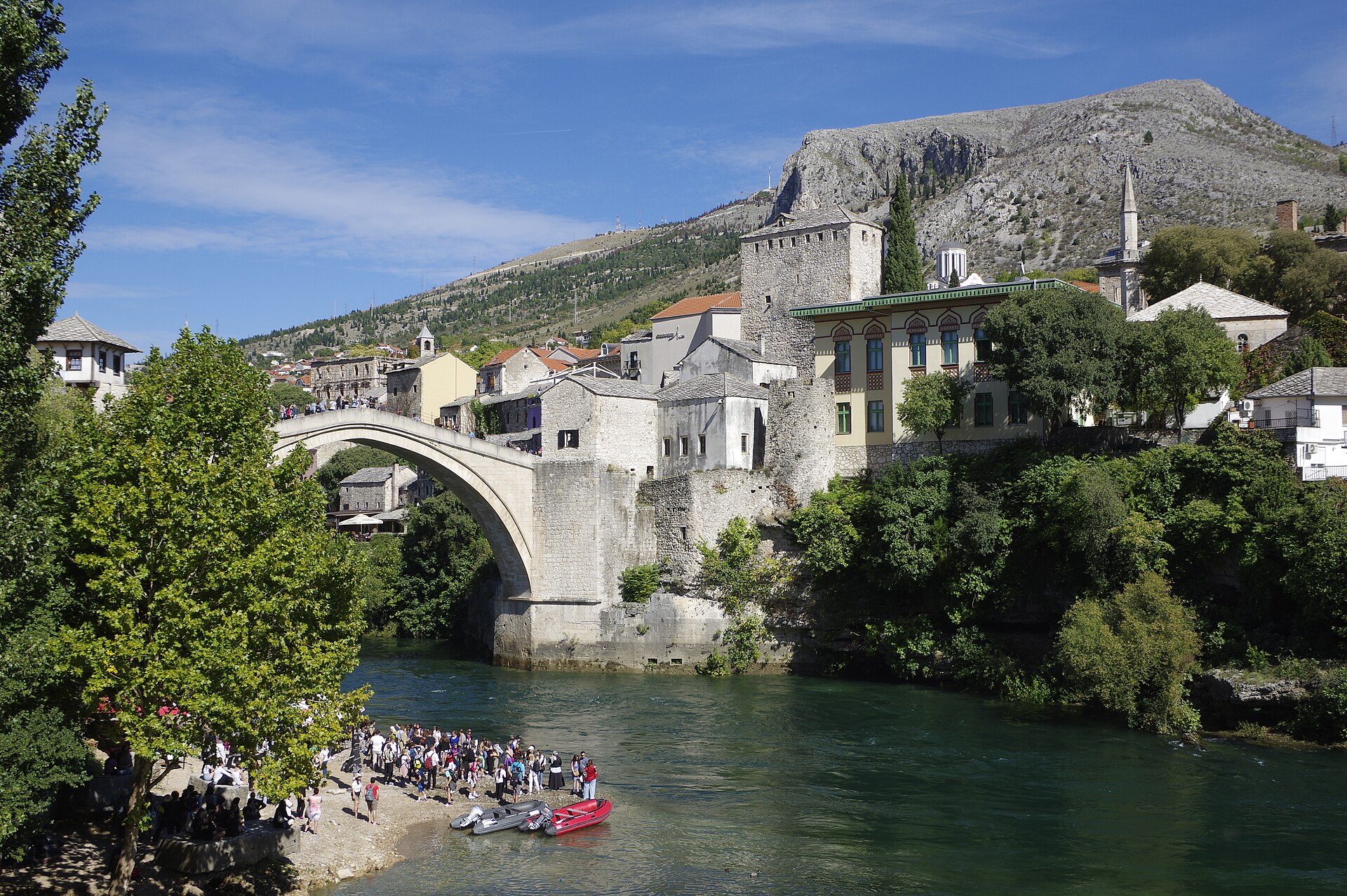
The first thing you notice in Mostar is the water. The Neretva cuts through the city in a deep ravine, emerald-clear, and the sound of the current follows you through the narrow alleys of the old town. It was right here, where the riverbanks draw closest to one another, that people once chose to cross. And it was here that the city got its name: mostari, the bridge keepers, were those who guarded the river crossing during Ottoman times.
The bridge, therefore, is older than the city's identity – or rather, it is its very origin.
A suspension bridge that terrified travellers
Before the stone bridge existed, a wooden bridge suspended by chains hung over the ravine. The Ottoman geographer Katip Çelebi described how it swayed so violently that people crossed it in mortal terror. As Mostar grew in importance as a trade and administrative hub within the Ottoman Empire, a permanent crossing became essential.
The commission went to the architect Mimar Hayruddin, a pupil of the famous court architect Mimar Sinan. Ordered by Suleiman the Magnificent, construction began in 1557. According to the inscription, the bridge was completed in the year 974 of the Islamic calendar, corresponding to 1566–1567. The result was a single humpbacked arch of light limestone, roughly 30 metres long and four metres wide, rising some 24 metres above the river. Guarding either side are two towers, Halebija and Tara.
Surprisingly little is known about the actual construction. What has survived is primarily the name of the master builder – and the legends. The most famous tells that Hayruddin, knowing what failure could cost him, prepared his own funeral for the day the scaffolding was to be removed. The arch held.
A century later, the travel writer Evliya Çelebi passed through, having seen more of the Ottoman world than most. He wrote that the bridge was like a rainbow rising to the heavens from cliff to cliff, and that in all his travels through sixteen countries, he had never seen so high a bridge.
From frontier town to meeting place
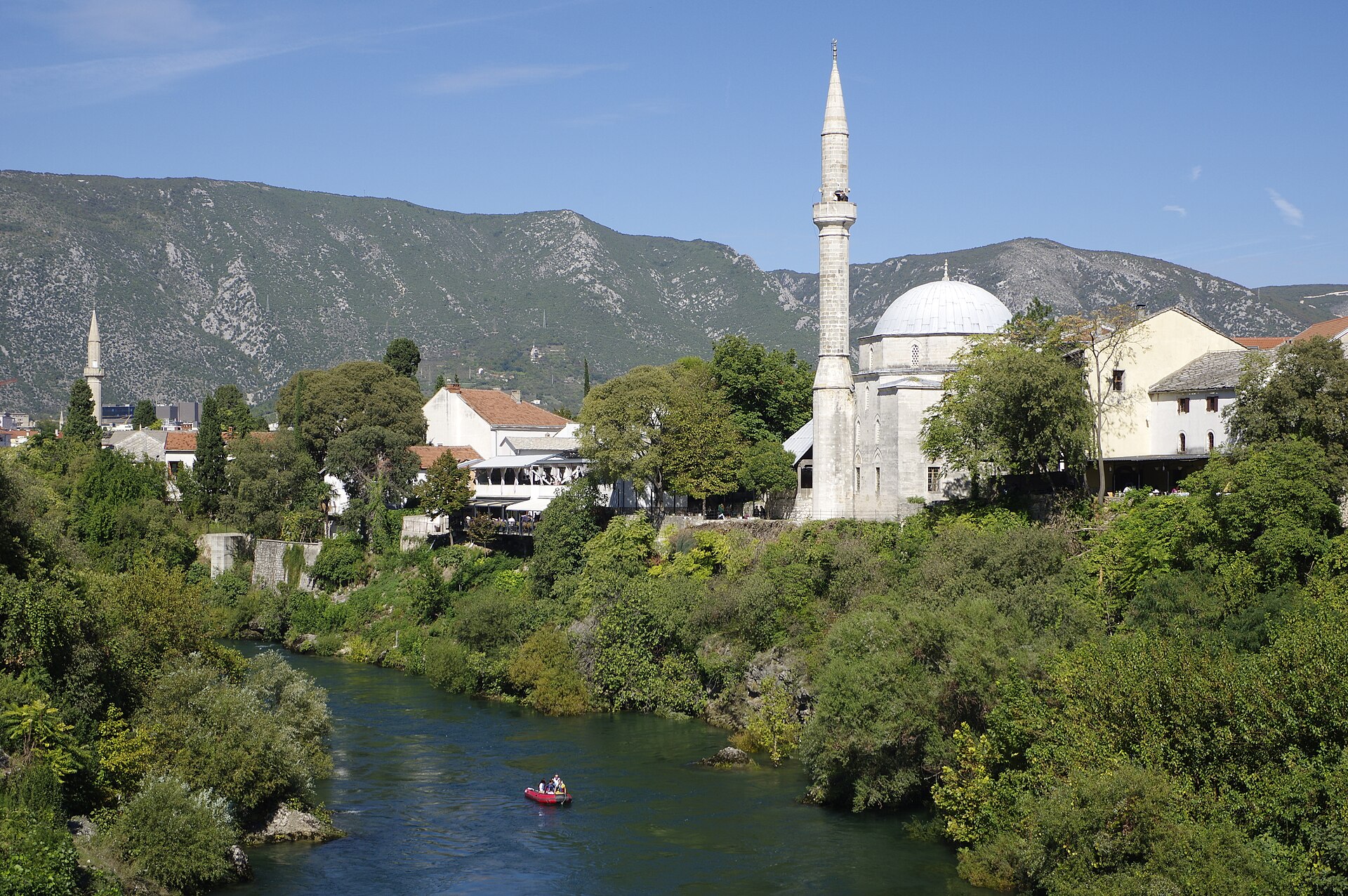
Mostar developed during the 15th and 16th centuries as an Ottoman frontier town and was later further shaped during the Austro-Hungarian period. In the old town, these layers are still visible: Ottoman houses and mosques, Mediterranean-influenced stone buildings, and 19th-century European facades. UNESCO describes the area surrounding the Old Bridge as an outstanding example of a multicultural urban settlement, where pre-Ottoman, eastern Ottoman, Mediterranean, and Western European features merge.
Along Kujundžiluk, the cobbled street leading to the bridge, craftsmen and traders have kept shop for centuries. The name derives from the coppersmiths, and today the street is the city's most visited thoroughfare. Here, the touristy and the everyday meet within just a few metres – souvenirs, coffee, and the view of the arch that everyone is waiting to see.
The November morning of 1993
During the war in Bosnia and Herzegovina, Mostar became one of the worst-hit cities. During the fighting between Bosnian Croat and Bosniak forces, the old town was shelled, and on 9 November 1993, the Stari most collapsed into the Neretva following bombardment by the Bosnian Croat HVO. Images of the empty ravine spread across the world, becoming one of the most famous symbols of the war.
For many, the loss was greater than the structure itself. For over four hundred years, the bridge had connected the two sides of the city – literally and figuratively. Scholars have described its destruction as an assault on shared memory, an attempt to erase the evidence that people of different backgrounds had lived side by side.
By late December of that same year, Spanish military engineers from the UN peacekeeping force had constructed a provisional bridge on the site. This was reinforced several times and served as a crossing for years.
Stone by stone
After the war, an international coalition was formed to rebuild the bridge and the historic city centre, including the World Bank, UNESCO, the Aga Khan Trust for Culture, and the World Monuments Fund. Several countries and the Council of Europe Development Bank contributed to the funding. An international committee of experts established by UNESCO in 1998 oversaw the work, and the decision was clear: the bridge was to be as close to the original as possible, using the same materials and the same techniques.
Hungarian army divers retrieved stones from the original bridge from the riverbed, but most proved too damaged to be reused. Instead, tenelija, a fine-grained limestone, was sourced from local quarries – the same type of stone from which the bridge had originally been built. Work began in June 2001, and on 23 July 2004, the reconstructed bridge was officially opened.
The following year, in July 2005, the Old Bridge area was inscribed on the UNESCO World Heritage list. The justification went beyond the architecture: the rebuilt bridge and the old town were described as a symbol of reconciliation, international cooperation, and the coexistence of diverse cultural, ethnic, and religious communities.
Diving from the arch
Anyone who pauses on the bridge on a summer's day will soon see why it is also a stage. Men in swimming trunks climb onto the railing, wait until enough people are watching – and dive.
The tradition is an old one. According to the Federal Ministry of Culture of Bosnia and Herzegovina, the first written mention of jumps from the older wooden bridge was recorded by Evliya Çelebi in the 17th century. Braving the Neretva's currents and then diving from the bridge was long a rite of passage and a test of courage for the city's young men. The river is cold even in the height of summer, and the dive requires both technique and training.
An organised competition has been held since 1968, and today it is an international event with two categories: feet-first jumps and the more spectacular head-first dive, known as the 'Mostar Swallow'. The diving club Mostari, registered under its current name in July 1994, organises the competitions and keeps the tradition alive. Since the mid-2010s, Mostar has also been a stop on the Red Bull Cliff Diving World Series, where the elite dive from platforms erected above the bridge.
A bridge still in use
It is easy to view the Stari most as a monument, but what makes it special is that it remains a working bridge. People cross it on their way to work and school, tourists pause in the middle of the arch to take photos, and in the evening, young people sit on the rocks down by the water as the lights of the old town reflect in the river.
The bridge does not resolve the city's divisions, nor does it make its history any simpler. But it is there again, in the same shape and made of the same stone, still carrying people from one bank to the other. Perhaps that is precisely why it means so much.
If you go
Mostar is located in southern Bosnia and Herzegovina, a few hours' drive from both Sarajevo and Dubrovnik. The old town is best explored on foot, ideally early in the morning or late in the evening once the day-trippers have departed. The annual diving competition from the bridge is traditionally held at the end of July.
Share the article
Translated from Swedish with AI assistance. Read the original.


