
The bacterium that became a national symbol – the story of Bulgarian yoghurt
In Bulgaria, yoghurt is not just breakfast – it is a living national symbol, a scientific sensation, and a bridge to the dream of eternal life. The story of how a Bulgarian clay pot in a Geneva laboratory changed our view of health spans turn-of-the-century research, Cold War monopolies, and an unexpected love affair with Japan.
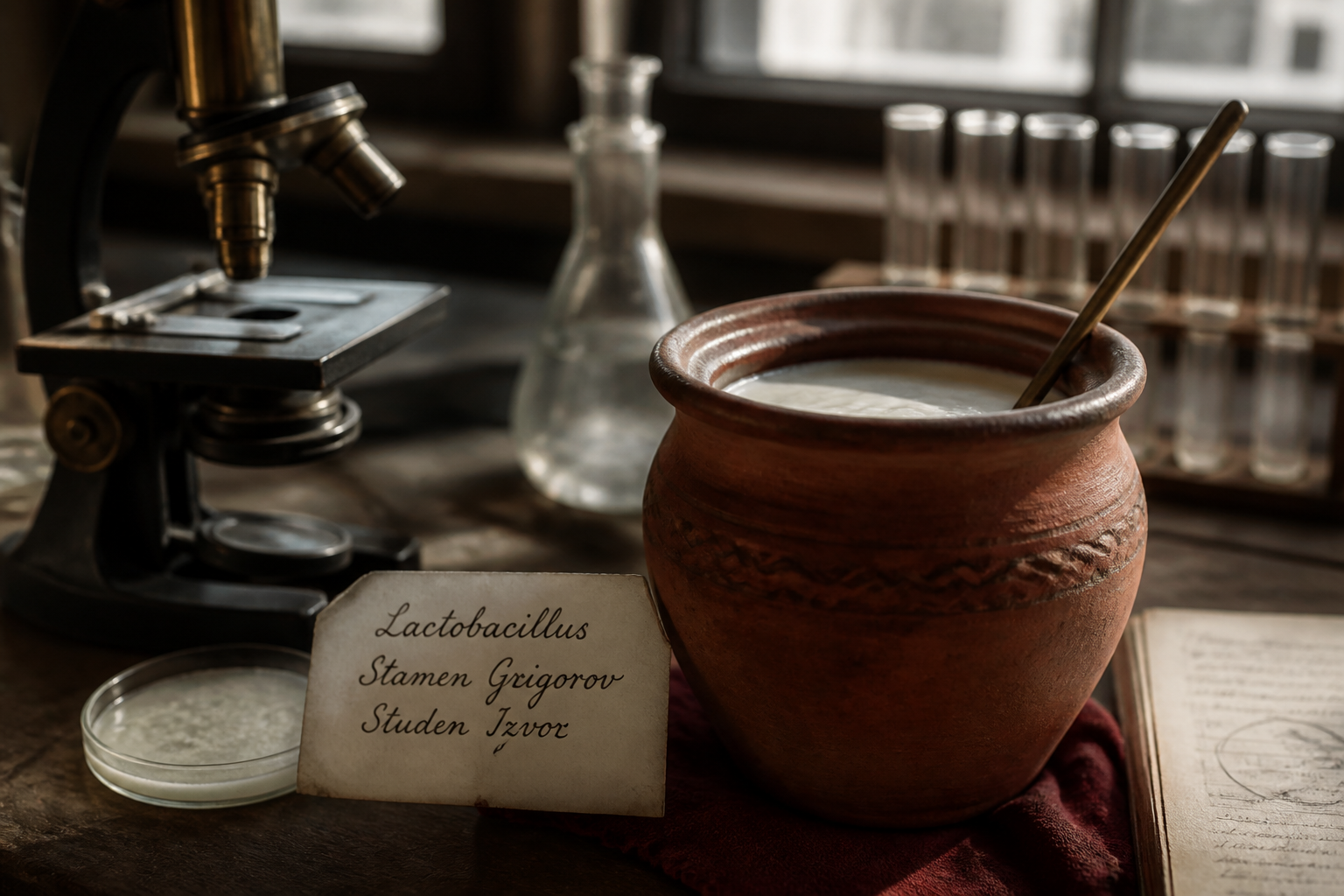
There is a particular kind of sourness that is hard to forget once you have encountered it. It is not sharp like lemon or vinegar, but round, full-bodied, and refreshing. When the first spoonful of authentic Bulgarian yoghurt – known at home as kiselo mlyako, which literally means sour milk – meets the palate, one quickly realises that this is something completely different from the sweet, gelatin-stabilised fruit yoghurts that dominate Western European fridges. It is firm, almost sliceable, and carries a clean, unpretentious freshness.
For Bulgarians, this sour milk is not just any foodstuff; it is part of the national identity, deeply intertwined with the country's history, geography, and self-image. But the story of how this simple peasant product became a global multi-billion-pound industry and a symbol of health begins with a young man's homesickness and a bacterium that took a whole country's name.
The clay pot that travelled to Geneva
The year was 1905. The 27-year-old medical student Stamen Grigorov had travelled from his small home village of Studen Izvor in the rugged mountainous regions of western Bulgaria to the University of Geneva. He was studying under the famous professor Léon Massol, but in his luggage, he had brought something that did not belong in sterile laboratories: a rukatka, a traditional, hand-painted Bulgarian clay pot filled with homemade kiselo mlyako.
Grigorov was fascinated by the unique properties of the milk. Why did Bulgarian sour milk stay fresh for so long, and what gave it its specific structure and sourness? Using the microscopes of the time, the young researcher spent countless hours in the laboratory until he finally succeeded in isolating the organism responsible for the fermentation. It turned out to be a hitherto unknown, rod-shaped lactic acid bacterium.
The discovery was confirmed by the scientific community, and the microbe was fittingly named Lactobacillus bulgaricus. In Grigorov's birthplace of Studen Izvor, near the Serbian border, there is today an unassuming but unique yoghurt museum (Yogurt museum in Trun) that tells the story of how this microscopic discovery put the region on the medical world map.
The Nobel laureate and the dream of eternal life
Grigorov's discovery landed in the middle of an era when the scientific community was feverishly searching for methods to extend human lifespan. At the Pasteur Institute in Paris, the Russian Nobel laureate Élie Metchnikoff was at work. He was convinced that ageing was caused by harmful bacteria in the large intestine producing toxins that slowly poisoned the body.
When Metchnikoff studied demographic data from around the world, he was struck by an unusual statistic: at the turn of the century, Bulgaria had a remarkably high proportion of centenarians, especially in the mountain villages. He linked this longevity to the Bulgarian population's enormous consumption of kiselo mlyako. Metchnikoff argued that Lactobacillus bulgaricus colonised the gut and displaced the harmful putrefactive bacteria.
His theories were published in the book "The Prolongation of Life" and sparked a veritable health trend in Europe. Suddenly, Bulgarian sour milk was sold in pharmacies in Paris, Geneva, and London as an elixir for a longer and healthier life.
Cold War standardised sour milk
In the decades that followed, production became professionalised, but it was during the post-war period and communist rule that Bulgarian yoghurt became a state prestige object. The state realised that this unique bacterial strain was a national asset and created the state monopoly LB Bulgaricum.
Researchers travelled around the country, collecting thousands of traditional sour milk cultures from old clay vessels in remote mountain villages to select the most robust and flavourful strains in a laboratory environment. The goal was to create a standardised, industrial product that still retained the traditional taste. LB Bulgaricum patented these specific cultures and began exporting them worldwide.
The most unexpected success story unfolded in Japan. During the 1970 World Expo in Osaka, representatives of the Japanese dairy company Meiji visited the Bulgarian pavilion. They were fascinated by the yoghurt, and after intense negotiations with the Bulgarian state, Meiji Bulgaria-yoghurt was launched on the Japanese market in 1973. Today, the brand is a giant in Japan, and millions of Japanese people start their day with a breakfast product whose licensed bacterial culture originates directly from the Bulgarian mountains.
The secret of the clay vessel
But how is authentic kiselo mlyako made? The secret lies in a specific and delicate symbiosis between two microorganisms: Lactobacillus bulgaricus and Streptococcus thermophilus. The former gives the yoghurt its distinct sourness and rich aroma, while the latter contributes to the thick, velvety texture.
Traditionally, the milk – which historically was often fatty sheep's or buffalo's milk during the summer and cow's milk during the winter – is boiled and then allowed to cool to about 43 degrees. In Bulgarian households, the temperature is still often tested with the classic "pinky finger test"; the milk should be warm but not burn. After that, a tablespoon of the previous day's sour milk is stirred into a little lukewarm milk and mixed into the vessel, which is traditionally a clay rukatka. The pots are then wrapped in thick woollen blankets to maintain the optimal temperature during the hours it takes for the bacteria to do their work.
The unique thing about Lactobacillus bulgaricus is its dependence on the local climate. If you try to cultivate the culture outside Bulgaria, the bacterial strain tends to mutate after a few generations and lose its specific properties. This is why most commercial producers worldwide must constantly import new starter cultures from Bulgaria to be able to call their product authentic Bulgarian yoghurt.
In the Bulgarian kitchen, sour milk is omnipresent. It is not just a breakfast item but an indispensable ingredient in cooking. It is thinned with cold water, cucumber, garlic, dill, and a splash of sunflower oil to become the refreshing summer soup tarator. It is also strained to a dense, creamy consistency and mixed with garlic and walnuts in the classic salad snezhanka (Snow White).
When the Balkans meet Nordic filmjölk
For a Nordic visitor, the encounter with Bulgarian sour milk culture offers an interesting contrast. The Nordic countries and the Balkans share a deep and ancient tradition of soured milk, born from the need to preserve the summer's surplus milk for the winter. But there is a fundamental difference in the chemistry of the microbes.
The Nordic filmjölk (soured milk) and sour milk culture (including historical variants such as tätmjölk and långmjölk) is based on mesophilic bacteria. These thrive best in cooler temperatures, around 20 degrees, reflecting the Nordic climate. The result is a milder, more viscous product with a softer acidity.
Bulgarian yoghurt, on the other hand, is thermophilic; its bacteria require heat (around 40–43 degrees) to activate. It is this heat-demanding process that gives Bulgarian sour milk its firm structure and its more pronounced, clean, and fresh acidity.
At a time when the Nordic kitchen is increasingly interested in fermentation, gut health, and genuine artisanal products, Bulgarian yoghurt stands out as a fascinating reminder that the future of food is often found in its history. A history which, in Bulgaria's case, is contained in a simple clay pot from a mountain village.
Facts
A quick guide to Lactobacillus bulgaricus
- The discovery: Isolated for the first time in 1905 by the Bulgarian doctor and microbiologist Stamen Grigorov.
- Scientific name: Today it is formally classified as Lactobacillus delbrueckii subsp. bulgaricus.
- The symbiosis: Always works in tandem with Streptococcus thermophilus in authentic Bulgarian yoghurt. The bacteria stimulate each other's growth during the souring process.
- Property: It is a thermophilic bacterium, meaning it requires temperatures around 40–44 °C to reproduce optimally, unlike the mesophilic bacteria in Nordic filmjölk (soured milk) which thrive best at room temperature.
Sources & further reading
- isappscience.orgBulgarian yogurt: An old tradition, alive and well
- yogurtathome.comFrom Bulgarian Tradition to Global Probiotic Hero
- visitmybulgaria.comBulgarian yogurt (kiselo mlyako) - Visit Bulgaria
- bbc.comThe country that brought yoghurt to the world - BBC
Share the article
Translated from Swedish with AI assistance. Read the original.


