
Sevdah in a New Era: How Bosnia’s Melancholy Longing Became Global Contemporary Music
Sometimes called the blues of the Balkans, sevdah is more than just a musical genre. It is a state of feeling: an ineffable longing, heartache and melancholy. Now a new generation of musicians is bringing Bosnia’s venerable singing tradition out of the archives, setting its historic stories to jazz, post-rock and electronic soundscapes.
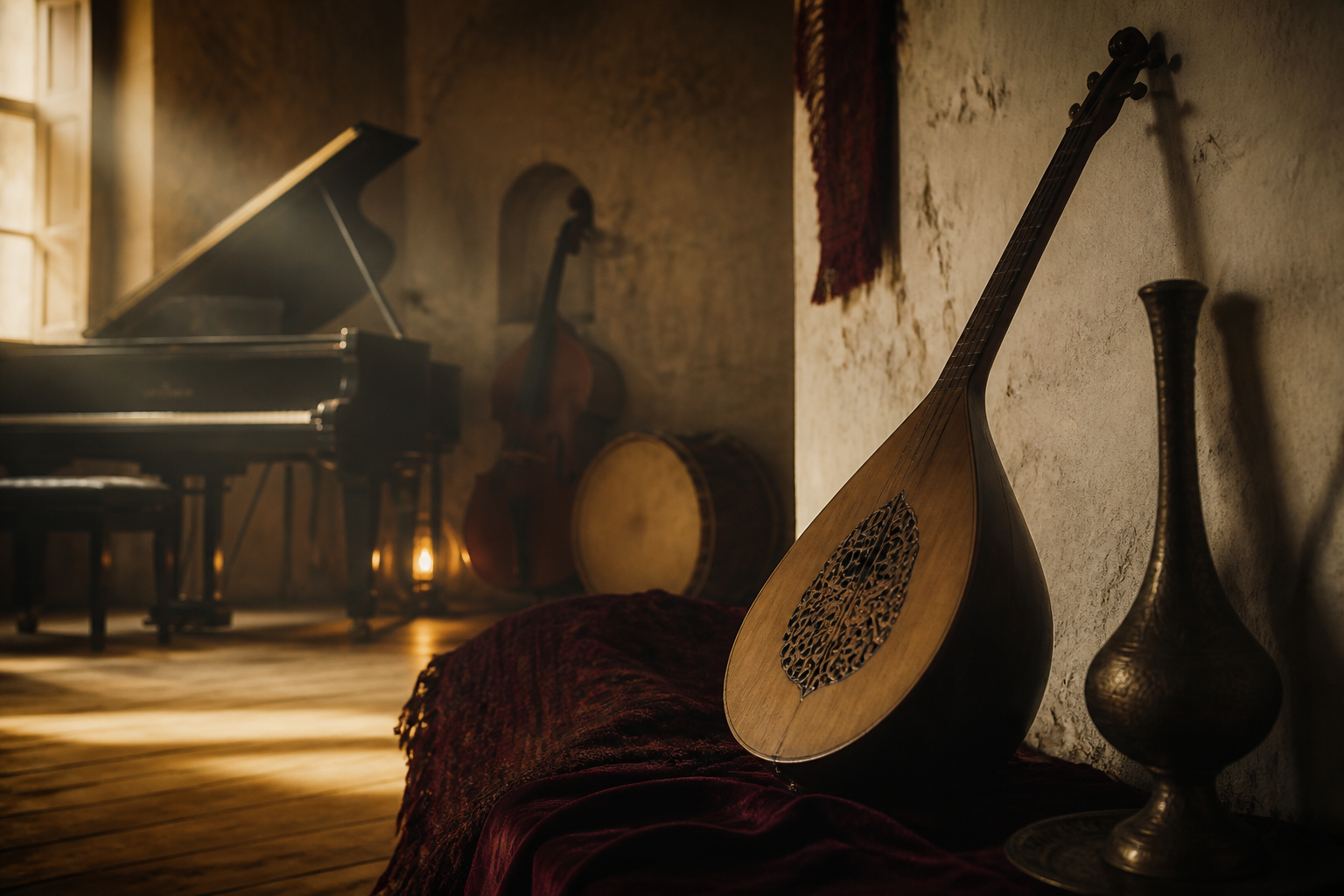
A lone voice cuts through the room. It slips between microtonal fissures, rises in an ornamented lament and settles into a whisper. Around it, a subdued pattern takes shape: brushed jazz drums and a double bass searching for a pulse. What we hear is not fado from Lisbon or blues from Mississippi, but sevdalinka – Bosnian folk song – in a form that feels entirely contemporary.
For centuries, sevdah (or sevdalinka, as the songs are called) was bound to stone-paved courtyards, known as avlijas, in cities such as Sarajevo, Mostar and Travnik. Traditionally, the songs were sung unaccompanied, or to the muted, almost meditative plucking of a saz, a long-necked lute of Ottoman origin. Today, the music is played in international jazz clubs, on avant-garde stages and in concert halls across the Nordic countries. By freeing themselves from rigid traditions, young Bosnian and regional musicians have managed to make the deeply local universal.
The Ottoman-Slavic heritage
To understand sevdah, you need to understand Bosnia’s geography and history. The genre was born where Slavic culture met the Ottoman Empire, which established itself in the region during the 15th century. As cities grew, a distinctive urban way of life emerged. It was in enclosed courtyards, behind high walls where fig and pomegranate trees blossomed, that sevdalinka found its form.
The word sevdah has travelled a long way. It derives from the Arabic “sawda”, referring to the black bile that ancient medicine believed caused melancholy. Via the Turkish “sevda” – which came to mean love, desire and passion – it arrived in Bosnia as a term for the painful yet beautiful longing for an unattainable beloved, or for a home one has been forced to leave.
During the 20th century, sevdah changed dramatically. The saz gave way to the accordion, and the genre moved from courtyards to radio studio orchestras and bustling kafanas (inns). Legendary interpreters such as Himzo Polovina – who, interestingly, was also a practising neuropsychiatrist and used the songs for therapeutic purposes – gave the genre an almost sacred status. But over time, the tradition risked becoming fixed in nostalgia. The official aesthetic of the Yugoslav state, and later the wars of the 1990s, meant that the music risked being reduced to a museum artefact or politicised.
World music pioneers who broke new ground
The turning point came in the early 2000s. A new generation of musicians began to question how sevdah was performed. The most influential was Damir Imamović, grandson of one of the last century’s greatest sevdah singers, Zaim Imamović. Damir chose to approach the genre as both a researcher and a revolutionary. By stripping away decades of heavy accordion arrangements and instead returning to the minimalist aesthetic of the saz, while drawing on modern jazz and improvisation, he showed that sevdah could breathe again.
At the same time, Božo Vrećo took to the stage and challenged every visual and cultural norm. With his androgynous appearance, flowing dresses, traditional tattoos and a voice spanning several octaves, he embodied sevdah’s inherent drama. By singing a cappella and blending the traditional with newly composed pieces, he showed that the genre’s emotional core knows no gender boundaries or historical limitations.
The contemporary pop-jazz wave
In the wake of the pioneers, the sevdah scene has exploded in stylistic breadth. One of the most successful bands in this wave is the Sarajevo collective Divanhana, formed in 2009 by students at the Sarajevo music academy. Divanhana approached sevdalinka with a musical toolkit full of jazz theory, classical training and pop sensibility.
By adding piano, sophisticated brass arrangements and a modern rhythm section, they managed to bring the music to a younger and broader audience without losing its melancholic edge. In 2012, the band performed at the influential WOMEX world music expo, opening the door to international tours. Musical forces such as Selma Droče have over the years helped develop the vocal and instrumental arrangements, while voices such as Nejla Dragonić, Azra Alihodžić and Taida Tabaković demonstrate the remarkable range of young female vocalists carrying the tradition forward today.
Minimalism and experimental sevdah
If Divanhana represents elegant, jazz-influenced pop sevdah, others are drawn to a rawer, more avant-garde sound. The Croatian-Bosnian duo Dunjaluk, comprising singer Dunja Bahtijarević and guitarist Luka Čapeta, is perhaps the clearest example.
Dunjaluk strips sevdalinka down to its very core. There are no accordions or grandiose melodic flourishes here. Instead, Dunja Bahtijarević’s intense, almost ritualistic voice meets Luka Čapeta’s distorted, atmospheric electric guitar. This is sevdah borrowing elements from post-rock, noise rock and free jazz. It is dark, urban and deeply affecting – a soundscape that feels more at home in a smoky basement club in Berlin than at a traditional folk festival.
The Nordic resonance
It is no coincidence that this new, searching sevdah has found an attentive audience in the Nordic countries. There is an almost direct spiritual link between Bosnian melancholy and Swedish wistfulness. Both cultures share a fondness for songs in minor keys, centred on nature, loss and the transience of life.
This bridge is explored not only by visiting artists on Nordic world music stages, but also through local initiatives. Different collaborations repeatedly show that the feelings held within sevdalinka – the sense of being divided between two worlds, of longing for something that may never return – are universal.
By daring to experiment, provoke and mix genres, the new sevdah musicians have saved their tradition from becoming a dusty relic. They have shown that sevdah is not a musical formula to be protected, but a living language. A language that continues to console, challenge and move people, far beyond Bosnia’s borders.
Facts
Sources & further reading
- hangtimeagency.comDIVANHANA – pop-jazz sevdah band from Sarajevo - Hangtime
- sevdalinkas.comDunjaluk: «In Sevdah there is rebellion that is often only subtly ...
- dailysabah.comBosnian Sevdalinka: Sound of a soul that endures | Opinion
- youtube.comSevdalinke - obrada
Share the article
Translated from Swedish with AI assistance. Read the original.


