
On Two Wheels Through History: How the Forgotten Parenzana Railway Became Istria’s Green Artery
Once, it connected the Austro-Hungarian Empire’s most important port city with Istria’s sun-warmed hills and olive groves. Then it was forgotten for decades. Today, the old narrow-gauge Parenzana railway has been reborn as one of Europe’s most spectacular cycling routes – a cross-border journey through time on two wheels, across three countries.
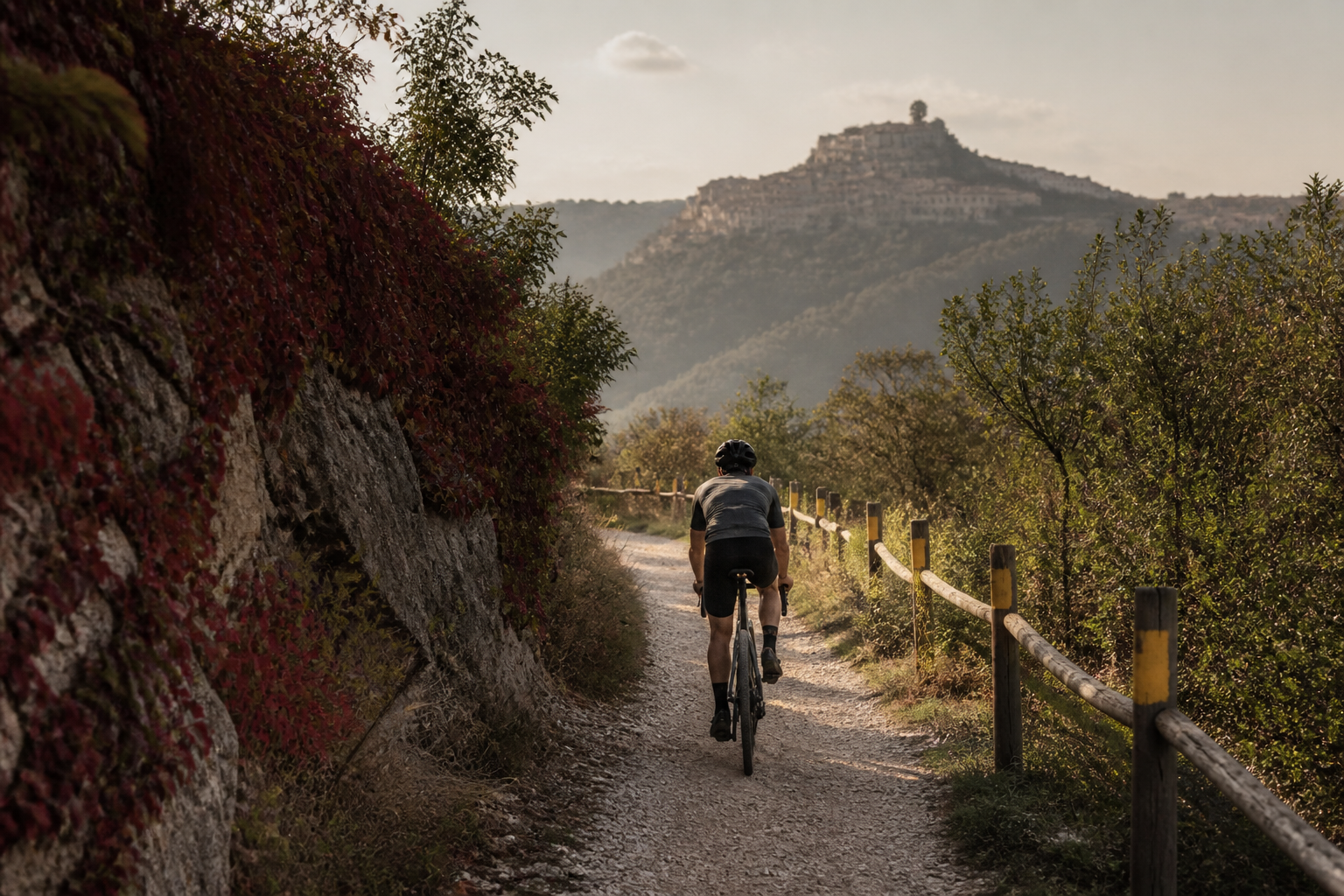
The darkness in the tunnel is absolute, and the air that greets you is suddenly cool and heavy with the scent of damp limestone, moss and earth. The contrast with the Istrian summer heat outside is total. As the bicycle’s headlight sweeps across the rough-hewn stone walls, it is easy to imagine the steam trains once puffing their way through here, laden with wine barrels, olive oil, salt and passengers bound for the empire’s great cities. A few seconds later, the tunnel mouth opens and the dazzling Mediterranean light hits you again. Ahead, a mighty stone viaduct stretches across a deep ravine like a bow, with sweeping views over the green forests of the Mirna Valley and the fortified medieval town of Motovun, perched on its high hill in the distance.
This is Parenzana. For just over three decades at the beginning of the 20th century, this narrow-gauge railway was a lifeline connecting Istria’s isolated interior with the outside world. Today, the forgotten railway bed has been transformed into one of Europe’s most storied and beautiful cycling routes. The 123-kilometre route offers not only a physical adventure, but also a journey through the history, culture and gastronomy of three nations.
The railway that connected an empire
The story of Parenzana begins in the late 19th century, when Istria was part of the Austro-Hungarian Empire. The interior was poor and the roads were dreadful, making it difficult for farmers and producers to transport their goods to the growing towns along the coast. It was decided that a narrow-gauge railway should be built, with a track gauge of 760 millimetres, a standard commonly used in the empire’s hard-to-reach mountain regions.
In 1902, the first train set off from the port city of Trieste (today in Italy), travelled through the short stretch of Slovenian coast and continued south through the Istrian interior to its terminus in Poreč (known as Parenzo in Italian, which gave the line its informal name). The railway was officially named TPC (Trieste-Parenzo-Canfanaro), although the final planned section to Canfanaro was never built.
For thirty-three years, the little steam trains chugged through the landscape at a leisurely speed of barely thirty kilometres an hour. The train carried not only people, but also vast quantities of Istria’s most valuable products: salt from the salt pans at Sečovlje, olive oil from Buje, fruit, vegetables and the dark, full-bodied Teran wine from the hills around Višnjan and Motovun. For local people, the train quickly became a symbol of progress and a connection to the wider world.
But after the First World War, Istria came under Italian rule. Road transport developed rapidly, and the small narrow-gauge railway suffered from falling passenger numbers and financial problems. In 1935, the fascist regime in Rome decided to close the line. The rails were dismantled and loaded onto a ship bound for Abyssinia (today’s Ethiopia), where Italy was planning new railway construction. But the ship sank in the Mediterranean, and Parenzana’s rails never reached Africa. What remained was an empty railway bed, abandoned station buildings, dark tunnels and stately viaducts, slowly being swallowed by Istrian vegetation.
From forgotten ruin to the Path of Health and Friendship
For almost seventy years, the railway bed lay dormant. Local farmers used parts of it as tractor tracks, and in some places it became completely overgrown. But in the early 2000s, as the idea of active and sustainable tourism began to take root in Europe, people recognised the unique value of the old railway line. An extensive project to clear the railway bed, secure bridges and tunnels, and mark the route got under way through a cross-border EU project involving Italy, Slovenia and Croatia.
Today, the railway bed has been reborn under the official name “Path of Health and Friendship” (Croatian: Put zdravlja i prijateljstva). It serves as a green artery connecting the region’s three countries and attracting cyclists, runners and walkers from around the world.
Cycling the entire Parenzana is best spread over two to three days, allowing time for both physical exertion and the many sights along the way. The route starts in the lively Italian port city of Trieste, initially following paved cycle paths out of the city and up towards the Slovenian border. The Slovenian section, which passes through the coastal towns of Koper and Izola and the elegant seaside resort of Portorož, is mostly paved, flat and easy to cycle. Here, the route passes through the illuminated Valeta Tunnel before reaching the historic salt pans at Sečovlje, near the Croatian border.
The adventure changes character when you cross into Croatia at Kanegra. Here, the asphalt gives way to coarse gravel, sand and, at times, stony dirt roads. The terrain becomes more demanding, but this is also where the true magic of Parenzana reveals itself.
The MTB adventure on Istrian gravel
The Croatian section of Parenzana stretches for around 78 kilometres and offers the most spectacular and dramatic cycling. The route climbs slowly but steadily towards the Istrian interior. As it follows an old railway line, the gradient rarely exceeds a couple of per cent, but the uneven surface makes a mountain bike or a sturdy gravel bike with wide tyres essential.
From Buje, once an important railway junction and known as the “Sentinel of Istria” because of its strategic position on a hill, the route winds deeper into the rolling landscape. It is in this area that you pass some of the route’s most impressive examples of early 20th-century engineering.
Highlights include the breathtaking viaducts at Završje and Antonci. Cycling across these narrow stone bridges, which span high above the green valleys with no guardrails at the sides, gives you a thrilling sense of freedom. The nine tunnels along the Croatian section are an experience in themselves, too. Some are short, with light from the far end showing the way, while others are longer, curved and completely dark, making a good bicycle light essential.
For those who want a break from the saddle, there are plenty of natural stopping points along the way. Just outside Nova Vas lies the famous Baredine Cave, an extraordinary underground landscape of stalactites and stalagmites where you may also catch a glimpse of the rare olm, a blind amphibian that lives in the cave’s deepest waters.
Medieval hilltop villages and culinary breaks
What elevates Parenzana from an ordinary cycling route to a lifestyle experience is the way it seamlessly weaves together nature, culture and gastronomy. The railway bed passes just below, or directly alongside, some of Istria’s most distinctive medieval hilltop villages.
One of the best known is Grožnjan, which came close to being completely abandoned in the 1960s but was saved when artists, musicians and sculptors moved into its old stone houses. Today, the village is a thriving cultural centre, with classical music spilling from open windows and galleries and craft shops lining its cobbled lanes. From here, the route continues towards Oprtalj and Završje, two villages that retain a rawer, quieter and more melancholy beauty, where the weight of history is palpable among the partly dilapidated stone houses.
Then you reach Motovun, which stands majestically on its steep hill above the Mirna Valley. Reaching the town itself requires a serious climb, but the reward of sweeping views and historic atmosphere is worth every drop of sweat. The forests below Motovun are world-famous for their underground treasures: white and black truffles.
This brings us to another important aspect of Parenzana: food. The region has developed a network of so-called “Bike & Bed” establishments: accommodation and restaurants specially adapted for cyclists. Here, you can rinse off your bike, lock it away safely overnight and get help with tools if anything breaks. Above all, though, they serve high-quality local food.
After a long day on the bike, few things compare to settling down at a local konoba (traditional tavern) and enjoying a generous plate of hand-rolled pljukanci or fuži (local types of pasta) with freshly grated truffle, locally grown asparagus or a hearty wild boar stew. A glass of malvazija, the crisp white wine that defines the region, or full-bodied, dark red Teran is the perfect accompaniment.
By the time you finally roll into the coastal town of Poreč, where the Roman Euphrasian Basilica awaits with its glittering gold mosaics, you will have put more than 123 kilometres behind you. You will have cycled through the story of an empire’s rise and fall, experienced three different countries from the inside and come close to Istria’s authentic, unhurried pace of life. Parenzana is more than just an old railway; it is proof that sometimes you have to slow down to truly discover a place.
Facts
Sources & further reading
- cyclingholidayscroatia.comParenzana Trail: Best of Istria Cycling - Cycling Holidays Croatia
- epicroadrides.comAn in-depth guide to cycling the Parenzana bike trail
- visiteurope.comCroatia's Parenzana: a path from the past - Visit Europe
- veloplanner.comParenzana Trail Map: Trieste to Poreč by Bike | VeloPlanner
Share the article
Translated from Swedish with AI assistance. Read the original.


