
On the trail of the truffle dog: The fight for white gold in Istria’s forests
Beneath the damp leaf litter of the Mirna Valley lies one of the world’s most sought-after delicacies. But in Buzet, Istria’s truffle capital, concern is growing among the families who have lived in symbiosis with the forest and their dogs for generations. Climate change now threatens the delicate white truffle – and is forcing a legendary tradition to adapt if it is to survive.
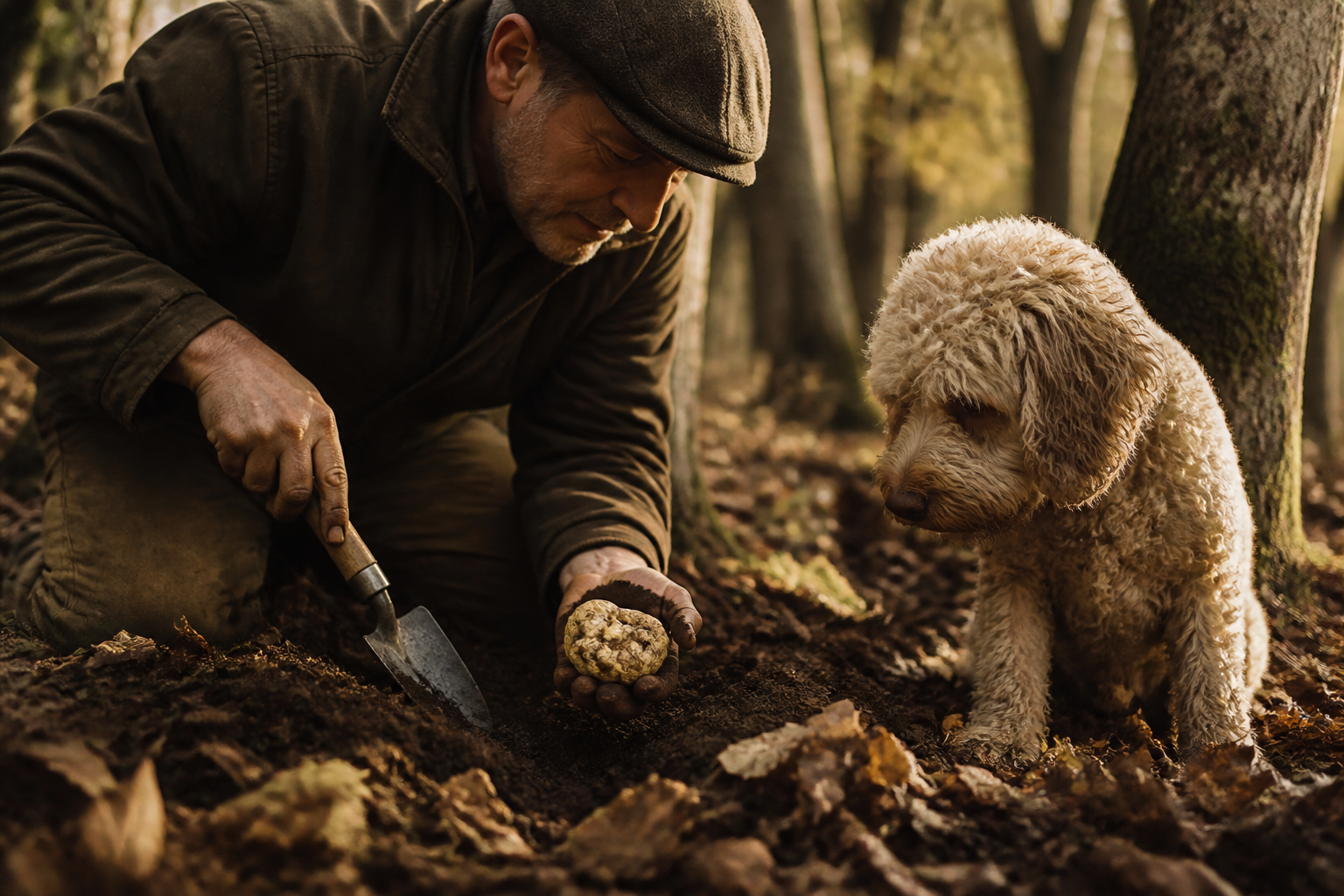
The autumn morning over the Mirna River is cold, shrouded in a dense, impenetrable fog that obscures the outline of the medieval hilltop town of Motovun. It is here, in the damp, lime-rich clay beneath the old oaks, that Istria’s best-kept secret lies. For the families around Buzet, one of the main towns in Istria’s so-called truffle triangle between Pazin, Buje and Buzet, this is not just a forest – it is a workplace, an inheritance and the setting for a quiet drama.
We follow a path to the edge of the forest, where the ground is covered in fallen leaves. Beside us stands the dog, a restless mixed breed with an intense gaze, searching for the scent of Tuber magnatum Pico – the white truffle – with its nose close to the ground. Unlike the black truffle, which can be cultivated under controlled conditions in oak plantations, the white truffle is entirely wild. It refuses to be tamed. It requires a complex microclimate, just the right level of moisture and a perfect interplay with the roots of oak, poplar or hazel trees.
Suddenly, the dog freezes. Its tail begins to wag furiously and its front paws start scratching rapidly at the dark, wet soil. The truffle hunter is quickly at its side, kneeling and murmuring soothing words as he carefully rewards the dog with a treat to stop it digging before its sensitive claws damage the fungus. With a small, specially designed spade – an otka – he gently loosens the soil. The scent rising from the ground is immediate, heady and intoxicating: a complex blend of damp forest soil, garlic, honey and gas. From the hole he lifts an irregular, pale ochre-coloured lump, no larger than a plum but worth more than its weight in silver.
The climate threat to white gold
The white truffle is the queen of autumn and winter. The harvest season traditionally runs from September to January, with the peak in autumn, especially in October. But in recent years, conditions in Istria’s forests have changed dramatically. What was once a reliable natural phenomenon has become an uncertain struggle against the elements.
Climate change has hit southern Europe hard, and Istria is no exception. The past few decades have brought increasingly long, hot and extreme dry spells during the summer months. When the soil dries out and temperatures in the forest floor rise in July and August, the growth of underground fungi is stunted. Without enough moisture during the summer, the autumn harvest fails to materialise, or is delayed until well into winter.
It is not just the quantity of truffles that is falling; their quality is also affected. The white truffle needs cool nights and damp mornings to develop the distinctive, elusive aroma that makes gourmet restaurants in Paris, Tokyo and New York willing to pay thousands of euros per kilo. As autumns grow warmer, truffle hunters are forced to venture deeper into shady ravines and along riverbanks that still retain moisture, but even these areas are becoming fewer. For family businesses in and around Buzet, it means constantly learning to read nature’s new patterns and recognising that what worked thirty years ago is no longer a guarantee of success.
Four-legged experts: Training a truffle dog
None of this would be possible without the dogs. The myth that truffle hunters use pigs lives on in popular culture, but in practice the pigs were retired long ago. A pig is not only difficult to transport in a car boot; it also has an innate and almost unstoppable desire to eat the delicacy itself.
Dogs are the truffle hunter’s most important partners by far. The Lagotto Romagnolo – the Italian water dog – is historically known for its exceptional sense of smell and natural aptitude for the task, but in Istria’s forests you can find all kinds of breeds. Many hunters swear by crosses between pointers, setters and Labradors, combining stamina, hunting instinct and a willingness to work with people.
Training begins when puppies are only a few weeks old. The idea is to associate the scent of truffle with security, play and reward. According to an old method, the mother’s teats are rubbed with truffle oil so that the puppies associate the scent with their mother’s milk. Later, small pieces of truffle cheese or toys scented with truffle oil are hidden in the garden. When the dog is around a year old, it is ready for its first real trip into the forest alongside an experienced dog that can show it the way. It takes years of patience and a deep bond between human and animal to train a dog that is not distracted by wildlife or other dogs in the forest, but focuses entirely on the faint scent molecules seeping up through the layers of soil.
From forest floor to fine dining: Buzet’s culinary heritage
Once the truffle has been dug from the ground, a race against time begins. The white truffle is highly perishable and quickly loses its aroma; after just a few days, some of its magic has evaporated. That is why local gastronomy in Buzet and the rest of Istria is so closely tied to the harvest.
In traditional Istrian taverns, known as konobas, truffles are served without fuss or unnecessary ingredients. Here, they understand that the fungus’s intense aromas are best brought out by simple, warm bases. The most classic dish is fuži or pljukanci – locally made, hand-rolled pasta – tossed in butter and pasta water before generous amounts of fresh white truffle are shaved over it at the table. The warmth of the pasta releases the truffle’s ethereal oils, filling the room. Another local favourite is fritaja, a creamy scrambled-egg dish made with farm eggs, in which the truffle takes centre stage.
For Buzet, the truffle has become part of the town’s identity. Every autumn, at the start of the white truffle season, a gigantic fritaja is cooked in the town square during the Subotina festival to celebrate the beginning of the harvest. But as tourism and interest in truffle-hunting trips grow, the region is grappling with how to preserve the balance. Taking visitors into the forest has become an important source of supplementary income for truffle-hunting families as harvests grow less predictable. It also offers an opportunity to educate the wider world about the fragile environment the white gold needs to survive. In the end, it is the forest itself that sets the terms.
Facts
WHITE VS BLACK TRUFFLES
White truffle (Tuber magnatum Pico):
- Harvested: September to January.
- Habitat: Entirely wild, in damp clay soil, mainly beneath oak and poplar trees.
- Characteristics: Pale yellow to ochre-coloured, with an intense aroma of garlic and gas. Eaten only raw, shaved directly over warm dishes.
Black truffle (Tuber aestivum / Tuber melanosporum):
- Harvested: Different varieties are harvested almost all year round.
- Habitat: Can be cultivated in symbiosis with trees in controlled oak plantations.
- Characteristics: Dark, warty surface, with a milder, nuttier aroma. Can be heated in sauces and dishes.
Sources & further reading
- Istriens officiella turistorganisation (istra.hr)Truffle Days in Istria
- Istriens officiella turistorganisation (istra.hr)Istrian White Truffle Days 2026
- Istriens officiella turistorganisation (istra.hr)Opening of the white truffle season, Motovun Forest
Share the article
Translated from Swedish with AI assistance. Read the original.


