
Jazz Fest Sarajevo celebrates 30 years – four nights from sevdah to world jazz
From 4 to 7 November, two of Sarajevo's stages will be filled with musicians from the Balkans and across the globe. As Jazz Fest Sarajevo celebrates its 30th anniversary, Damir Imamović's sevdah, emerging jazz ensembles, and international names meet in a programme that moves freely between tradition and improvisation.
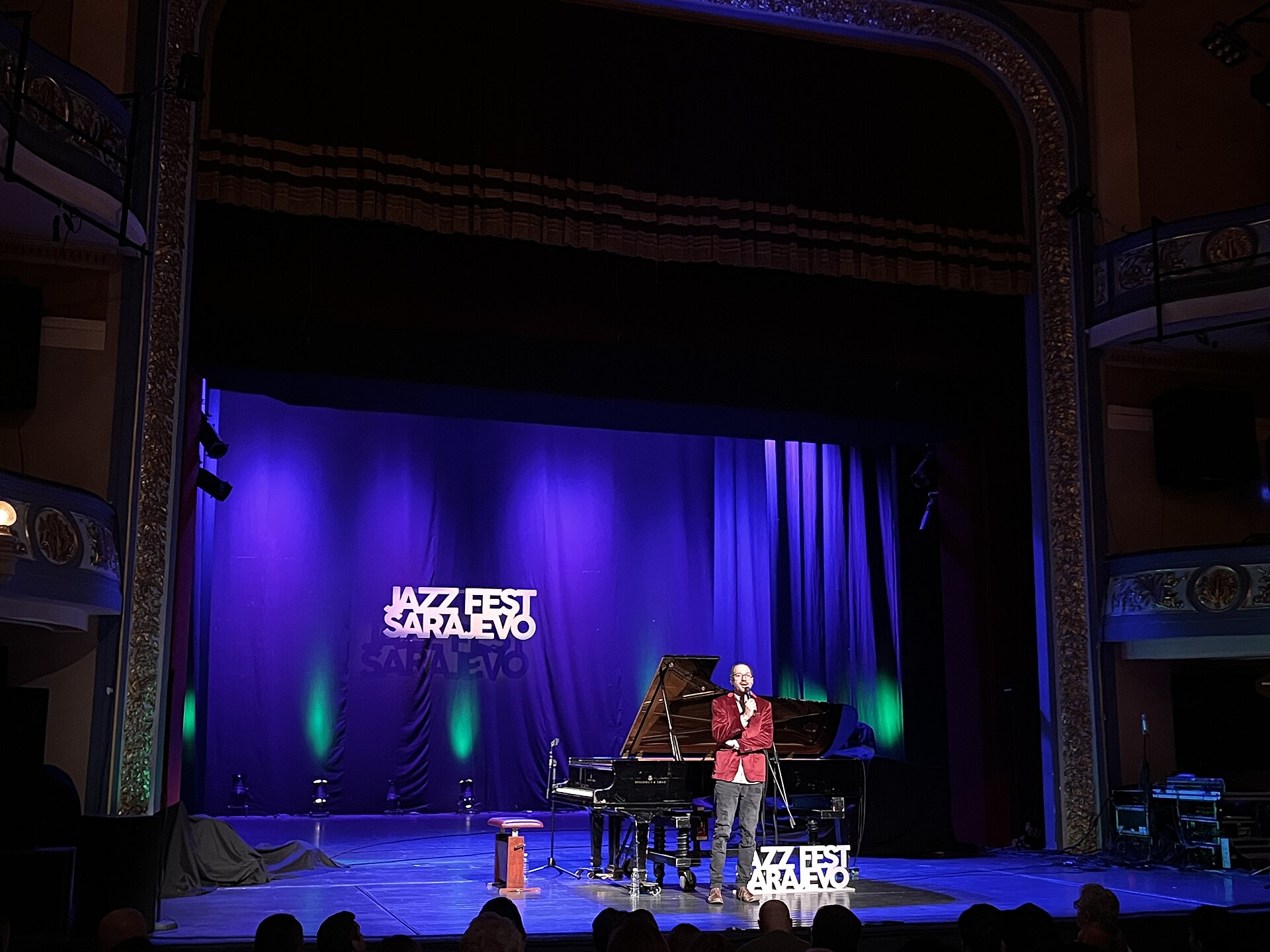
A song can carry the memory of a city. A new arrangement can change how we hear it. Somewhere in that encounter lies the entry point to this year’s Jazz Fest Sarajevo: a festival where music from the region takes its place alongside expressions from other parts of the world.
Over four November nights, musicians will gather at Narodno pozorište and Pozorište mladih. The programme features large ensembles, trios, and duos, leaving room for both the human voice and instrumental dialogue. For the visitor, this offers several entry points. One can come for a familiar name, for sevdah, or simply out of curiosity for something not yet heard.
A festival that opened the city to the world
The inaugural edition took place in the summer of 1997, when Sarajevo was still in the midst of post-war reconstruction. Establishing an international music festival under those conditions meant creating a meeting place: between musicians and the audience, between the city and the wider world.
The Europe Jazz Network has highlighted the festival’s significance for Sarajevo's cultural life and its work with new musical expressions. In 2019, Jazz Fest was awarded the network’s EJN Award for Adventurous Programming. The accolade placed Sarajevo in a context alongside other previously recognised events, such as Finland's Tampere Jazz Happening and Slovenia's Jazz Festival Ljubljana.
The festival's activities have also encompassed workshops, discussions, and education for young musicians. The concerts are thus part of a larger story of how a music scene is kept alive: by listening, learning, and giving space to new voices.
Damir Imamović and the song that continues to change
For many readers, Damir Imamović will be a natural entry point to the anniversary. On 5 November, he performs with a group where his vocals and tambur meet Eric Vloeimans' trumpet, Derya Türkan's kemenche, Bojan Z's piano, and Žiga Golob's double bass.
The instrumentation itself points to an encounter between different musical backgrounds. Strings, brass, and keys come together, leaving space for both the melody and everything that happens around it.
Sevdalinka, the traditional urban song form of Bosnia and Herzegovina, was inscribed in 2024 onto UNESCO's Representative List of the Intangible Cultural Heritage of Humanity. Storytelling is at its heart: the voice conveys a narrative, with or without instruments.
On a festival stage, this tradition also becomes a question of how music can be passed on. What happens to a familiar melody when other instruments respond? What does a new listener hear that someone raised on the song might take for granted? Imamović's international ensemble makes the concert a compelling venue for exploring these questions.
From seven musicians to three
Friday 6 November offers two distinctly different ensemble formats at Narodno pozorište.
First is the Patricia Brennan Septet. Brennan plays the vibraphone, surrounded by trumpet, saxophones, double bass, drums, and percussion. Seven musicians provide a wealth of potential combinations: a melody can shift between instruments, a rhythm can acquire multiple layers, and a solo section can be met with a broader sound.
Later that evening, the Moses Yoofee Trio takes the stage. The group consists of Moses Yoofee on keys, Roman Klobe on bass, and Noah Fürbringer on drums. The smaller format focuses attention on the interplay between three musicians, where every shift in rhythm or touch becomes significant to the whole.
For anyone wishing to discover the breadth of the festival, these two concerts offer an excellent starting point. The contrast lies in how the groups are constructed, even before the first note has sounded.
Tradition that continues to change
At Pozorište mladih, the North Macedonian duo Dobrila & Dorian will perform. Dobrila Grašeska's vocals and loops are combined with Dorian Jovanović's oud and electronics. They present traditional songs and material from the album Wind to Blow.
This is yet another way of allowing older repertoire to meet contemporary tools. A voice can return in a loop, a stringed instrument can meet electronic sounds. For the listener, it serves as a reminder that tradition also lives on through new interpretations.
On the same stage, the Croatian-French Obradović–Tixier Duo will perform, featuring drummer Lada Obradović and keyboardist David Tixier.
The anniversary is opened by the Macedonian National Jazz Orchestra. Other featured names include Alfredo Rodríguez with Pedrito Martínez, Harold López-Nussa, and Faraj Suleiman. Together, they make the programme an invitation to journey across several musical worlds during a single festival.
Four nights to choose from
You do not need to recognise every name to find your evening. Start with an artist, an instrument, or a musical tradition that sparks your curiosity. The organiser's programme pages also feature links to music that you can listen to before your visit.
Tickets are sold via the festival website. Be sure to check the specific time and venue for each concert, as the programme is split between two theatres.
For those in Sarajevo in early November, the anniversary offers a chance to experience the city through its music scene. And perhaps it is the unexpected concert, the one you knew least about beforehand, that becomes the greatest discovery of the evening.
Facts
Sources & further reading
- Jazz Fest SarajevoObjavljen program Jazz Festa Sarajevo 2026
- Jazz Fest SarajevoProgram och biljetter
- Jazz Fest SarajevoDamir Imamović Group
- Jazz Fest SarajevoPatricia Brennan Septet
Share the article
Translated from Swedish with AI assistance. Read the original.


