
Hoofbeats Across the Highlands: Meeting the Wild Horses of the Kruzi Plateau
On the windswept mountain steppes beneath Mount Cincar, over 800 wild horses live in one of Europe's most distinctive landscapes. The story of how these abandoned working animals became a free, wild herd is a tale of nature's adaptability – and of a growing, sustainable ecotourism that attracts conscious travellers from across the Nordic region.
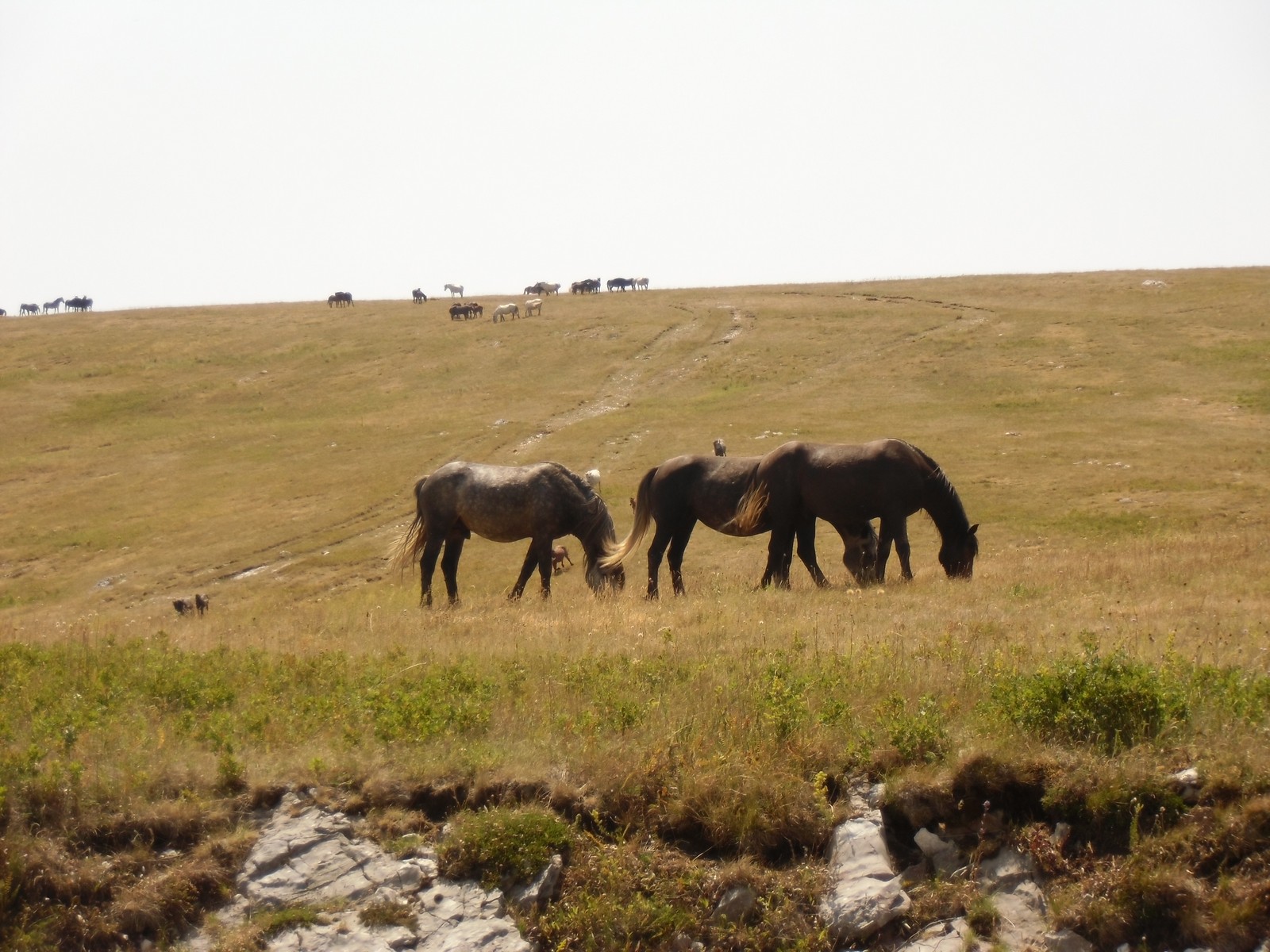
The morning air over the Kruzi Plateau is crisp, carrying the scent of dry thyme and cold stone. Here, at just over 1,200 metres above sea level beneath the barren limestone peaks of Mount Cincar in western Bosnia and Herzegovina, the horizon seems endless. It is a landscape shaped by karst and wind, where the silence is broken only by the steady roar of the gale and the low, rhythmic sound of hooves against the stony ground.
To suddenly stand eye to eye with a herd of fifty horses moving freely across the open expanses is an almost surreal experience in modern Europe. Chestnuts, piebalds, and greys move with an innate dignity across the rolling hills, seemingly unfazed by human presence yet constantly alert. These are not fenced animals in a reserve; they live entirely on their own terms in one of the continent's last great, contiguous mountain landscapes.
Meeting on the High Plains: The Unique Natural Phenomenon of the Kruzi Plateau
This unique population of wild horses, often called the wild horses of Livno after the nearby town, has a history stretching back just over fifty years. They are not wild in the strict biological sense – like the Asian Przewalski's horse – but rather feral domestic horses. During the 1970s, local agriculture in the Hercegbosanska županija region underwent rapid mechanisation. Tractors replaced traditional horsepower, and many farmers in the villages around Mount Krug planina had neither the financial means nor the practical possibility to keep their working horses over the winter.
Instead of sending the animals to slaughter, many chose to release them onto the high plains. Nature quickly took over. Over five decades, the horses have undergone a remarkable adaptation to the harsh alpine climate. They have developed harder hooves to cope with the sharp limestone, a denser and more insulating winter coat, and a strict social hierarchy. Today, the herd is divided into several smaller bands of mares, each led by a dominant stallion whose primary task is to protect the group from predators like wolves. They have survived both harsh winters with deep snow and the ravages of war in the 1990s.
Ecotourism as a Lifeline: Local Guides Lead the Way
For a long time, the horses of Cincar were a local matter, known mainly to shepherds and hikers. But as the herd grew, so did the challenges. With no natural predators except wolves, the population skyrocketed, leading to feed shortages during the coldest months. The horses often ventured down to the roads at the Borova Glava mountain pass to lick the road salt spread to prevent icing, which resulted in severe traffic accidents.
Salvation came through local commitment. Members of the environmental organisation Borova Glava Mountaineering and Ecological Society (Planinarsko-ekološko društvo Borova Glava) realised that the situation required active intervention. They began driving up tonnes of hay and placing large salt blocks at sheltered feeding stations high up on the mountain to keep the horses away from the roads during winter. They also built simple water troughs to secure the animals' water supply during the dry summer months.
This work laid the foundation for a new form of ecotourism in the region. By offering guided tours in specially equipped four-wheel-drive vehicles, local entrepreneurs have built businesses that both fund the protection of the horses and provide jobs for young people in the Livno area. For travellers seeking close-to-nature, authentic experiences far from the beaten tracks of mass tourism, meeting the horses of Cincar has become a major draw. Tourism takes place on the horses' terms – visitors move quietly on foot under the guidance of leaders who can read the animals' body language and maintain a safe, respectful distance.
A Scientific Preservation Plan: The New Collaboration with the University of Split
However, managing a growing population of large herbivores requires more than just voluntary efforts. In recent years, the need for a long-term, scientifically grounded strategy has become increasingly clear. A crucial step was taken recently when the authorities of Hercegbosanska županija initiated an official collaboration with Sveučilište u Splitu (the University of Split) in Croatia.
The initiative is driven at the regional level by, among others, the canton's Prime Minister Ivan Vukadin and the Minister for Agriculture, Water Management, and Forestry Božo Perić. Through the agreement with the university, where Rector Dragan Ljutić plays a central role, academic experts will help map the horses' genetic status, monitor their health, and study how intensive grazing affects the sensitive alpine flora of the Kruzi Plateau. The goal is to find a scientific equilibrium where the survival of the horses is secured without depleting the area's biodiversity, while providing the region with tools to regulate tourist flows sustainably.
Balancing the Mountain: Challenges Between Wild Herds and Local Farmers
Despite these positive strides, life on the mountain is a constant balancing act. The Kruzi Plateau is not an empty wilderness, but a vital resource for local agriculture. During the summer half of the year, local shepherds release their sheep and cattle to graze on the same pastures used by the wild horses. It is the milk from these grazing animals, saturated with aromatic mountain honeysuckle and thyme, that forms the basis of the famous livanjski sir – an award-winning hard cheese with a long tradition in the Livno region.
When resources become scarce, especially during dry spells, conflicts can arise over pastures and water sources. The horses, with their size and strength, tend to dominate the natural watering holes, which can leave the farmers' livestock without water. The ongoing collaboration between environmental organisations, researchers, and local farmers aims to resolve these conflicts of interest. By restoring old water reservoirs and constructing separate watering holes for wild and domestic animals, they hope to ensure coexistence.
Furthermore, many farmers have discovered that horse tourism offers synergy effects; visitors drawn to the mountain to see the horses often stop by the farms to buy local cheese to take home, creating direct economic benefits for the entire local community.
Visiting Cincar is a reminder of what Europe once was – a landscape where the boundaries between culture and wilderness are fluid, and where animals have reclaimed their place under the sky. By combining local pride, scientific expertise, and gentle ecotourism, Livno shows that the future of the region's wild heritage lies in learning to live side by side with it.
Facts
:::las-aven FURTHER READING Read more: How to navigate the train and bus maze in the Balkans – practical tips for getting to Sarajevo or Split before continuing towards Livno.
Explore more: Nature, hiking & national parks in the Balkans :::
Sources & further reading
- jutarnji.hrLivno pokreće veliku studiju za spas divljih konja i razvoj turizma
- globalvoices.orgNorth America has mustangs, Bosnia and Herzegovina has the wild ...
- lukaesenko.comWild Horses of Bosnia-Herzegovina • Luka Esenko
- go-bosnia.comWild Horses of Livno - GoBosnia
Share the article
Translated from Swedish with AI assistance. Read the original.


