
Darkness beneath Grmeč: The search for the Bosnian cave olm
Deep beneath the Balkans’ dramatic limestone mountains, icy-clear water flows through endless cave systems. Here, in one of Europe’s last unexplored wildernesses, lives one of the world’s most enigmatic animals: the olm. Following a groundbreaking scientific discovery in Bosnia and Herzegovina, attention is now turning to the underground lakes and springs where this blind creature reigns in total darkness.
When mist rolls over the slopes of Mount Grmeč in north-western Bosnia, the forest falls silent. But beneath our feet, deep in the porous bedrock, there is constant movement. The Dinaric karst landscape is like a giant sponge, riddled with cracks, shafts and underground rivers. It is in this hidden world that one of nature’s strangest evolutionary stories leads us to a new scientific discovery.
The olm (Proteus anguinus), locally known as čovječija ribica or “human fish” because of its pale, skin-like colour, has fascinated biologists since the 17th century, when local people believed that they were washed out of caves as dragon hatchlings. Now a group of researchers, including herpetologist Adnan Zimić from the National Museum of Bosnia and Herzegovina in Sarajevo (Zemaljski muzej Bosne i Hercegovine), have presented new findings in the scientific journal Amphibia-Reptilia that redraw the map of our understanding of this underground predator.
Bobijaško oko: The breathing eye at Mount Grmeč
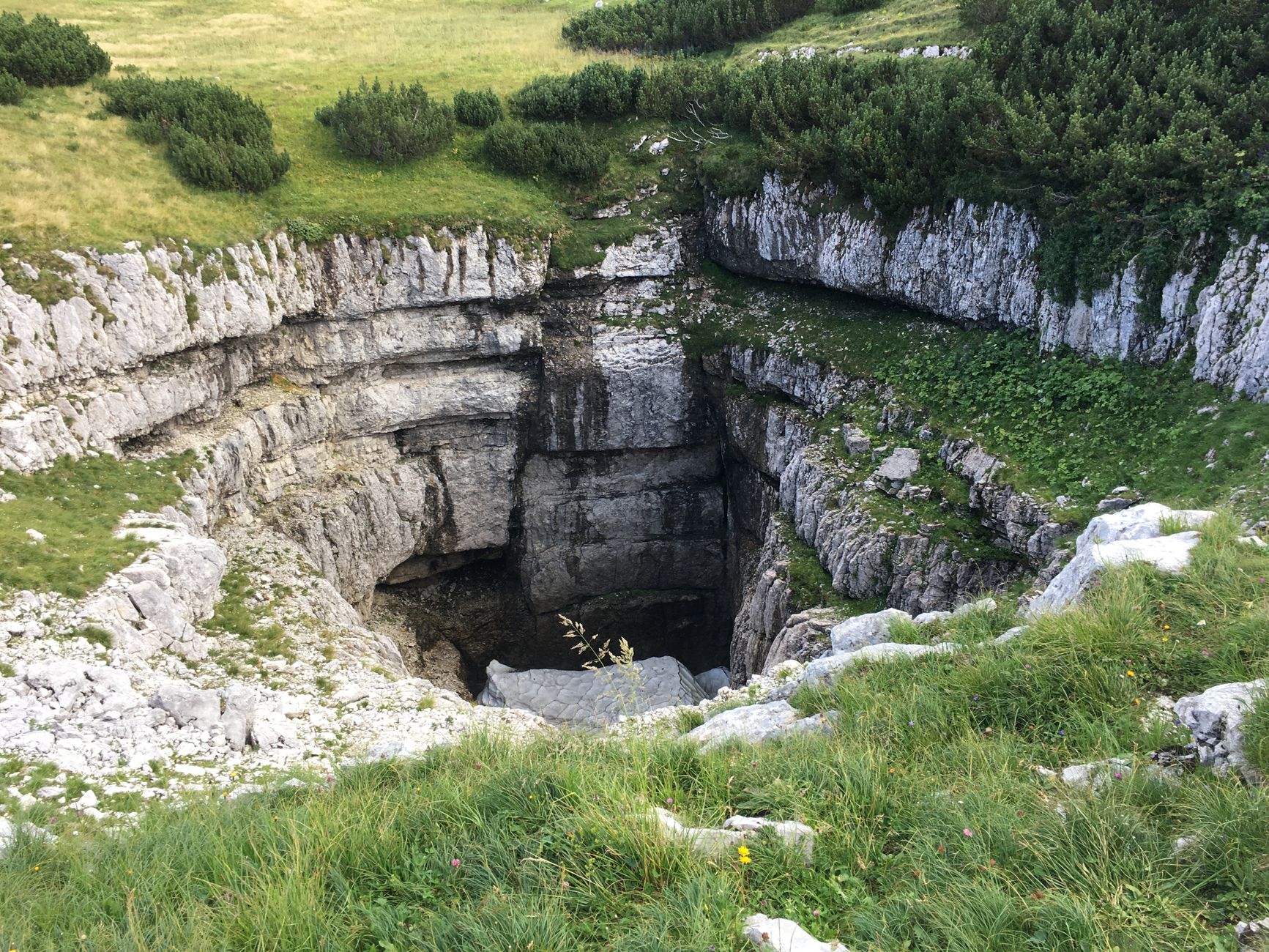
A few miles outside the town of Sanski Most lies Bobijaško oko, a place where the boundary between the world above and the underworld fades away. It is an estavelle—a rare karst feature that functions as both a spring and a sinkhole. During periods of heavy rain, underground pressure pushes up enormous volumes of water, filling the chasm and creating a deep, turquoise-blue lake. In drier periods, the flow reverses and the water sinks deep into the mountain, as if the earth were taking a deep breath.
Reaching the water’s edge at Bobijaško oko requires care. The steep rock walls are covered in moss and damp greenery, and the air down here is noticeably cooler than on the plateau above. For cave divers, this is one of the most challenging and alluring places in the Balkans. It is in these icy, seemingly lifeless depths that the olm has been documented in its natural habitat.
Here the creature moves slowly, almost as if floating. Without eyes or pigment, it is perfectly adapted to a life without light. Instead of sight, it relies on an extremely sensitive system of electroreceptors and chemical sensory organs to detect vibrations and find its prey—small cave crustaceans and damselfly larvae.
Science in the dark: The discovery of a Bosnian distinction
For a long time, the olm was considered a relatively uniform species found from southern Slovenia, through Croatia’s coastal region, to Bosnia and Herzegovina. But life in isolation and darkness has created distinct populations that have evolved independently of one another over millions of years.
The new study, in which Adnan Zimić took part, shows that the Bosnian populations have unique genetic and morphological characteristics. By analysing the DNA and physical traits of olms from different parts of the region, the researchers have identified a distinct evolutionary lineage unique to the Bosnian cave systems. This discovery highlights not only the Balkans’ biological richness, but also how much remains hidden in the unexplored parts of the continent’s underground.
Mapping these animals is, however, a painstaking task. The olm can live for more than a hundred years, and its metabolism is so slow that it can survive without food for several years. It is reluctant to move unnecessarily; researchers have documented individual animals lying completely still in the same spot on a cave floor for several years.
Krušnica: Where the river emerges from the mountain
A few hours’ journey north, just outside the town of Bosanska Krupa, we find another of the olm’s habitats. Here the river Krušnica gushes out of a gigantic rock face in a dramatic spring flow. The water that meets daylight here has travelled through dark channels beneath Mount Grmeč for mile after mile.
At the spring, the water is so clear that the bottom is visible at depths of more than ten metres. It is a quiet, almost sacred place, shaded by high, forested cliffs. Visitors can board traditional wooden boats and glide silently towards the dark cave entrance where the river begins. Underground surveys show that the cave system behind the spring extends deep beneath the earth, and on several occasions olms have been observed near the spring’s mouth when the water flow has been stable.
The area around the Krušnica and the nearby Una River shows how closely interconnected the Bosnian landscape is. What happens on the surface—in forestry, agriculture and towns—inevitably seeps down into the underground rivers and the sensitive ecosystems they support.
Vjetrenica: The underground cathedral in the south
To understand the extent of the Balkans’ underground biodiversity, we must travel south to the region of Herzegovina. Near the village of Zavala, in the dry Popovo Polje, lies Vjetrenica Cave, which was recently added to the UNESCO World Heritage List.
Vjetrenica means “wind cave”, a name it gets from the strong, cool wind that blows from its entrance on hot summer days. It is one of the most species-rich caves in the world. More than two hundred different underground species live here, many of them endemic to this particular system.
Inside Vjetrenica, visitors walk along paths flanked by monumental stalactites and stalagmites, while underground streams murmur in the darkness. It is here, in the deep, still cave lakes far from the tourist routes, that the olm has been studied for the longest time in Bosnia. Seeing a pale shadow move through the perfectly clear water in the beam of a torch is a reminder of a world that has existed untouched by sunlight for millions of years.
Protecting the invisible life
The discovery of the genetic distinctiveness of the Bosnian cave olm is about more than scientific curiosity. It is an important argument for protecting the underground water systems of the Balkans. The Dinaric karst system is extremely vulnerable: because water runs quickly through cracks in the limestone without being filtered through sand or soil, pollution from the surface can spread to the deepest habitats in just a few hours.
Researchers such as Adnan Zimić hope that the newfound attention around Proteus will lead to stronger environmental protection in Bosnia and Herzegovina. Protecting the olm also means safeguarding the country’s most important drinking-water reserves, all of which originate in these underground rivers.
As the sun sets over Mount Grmeč and darkness settles over Sanski Most, life underground continues just as it has for millennia. In the eternal darkness beneath the limestone, the Bosnian olm swims on, a living link to a time the earth has almost forgotten.
Facts
FACTS: THE CAVE OLM (PROTEUS ANGUINUS)
- Name: Olm, also called human fish (čovječija ribica) in local languages.
- Appearance: Pale, pigmentless skin; no functional eyes; breathes through external gills (which look like red tufts on its neck) but also has lungs.
- Lifespan: Can live for more than 100 years, with an average lifespan of around 70 years.
- Range: Endemic to the Dinaric karst region along the Adriatic Sea.
- Current research: A new study in the journal Amphibia-Reptilia, involving researchers from, among others, the Zemaljski muzej in Sarajevo, identifies unique evolutionary and genetic characteristics in populations living in the cave systems of Bosnia and Herzegovina.
Sources & further reading
- Zemaljski muzej Bosne i HercegovineNova vrsta čovječije ribice opisana u Bosni i Hercegovini, među autorima i naš kolega Adnan Zimić
- radiosarajevo.baPrirodni fenomen u BiH: Jeste li čuli za Bobijaško oko u kojem je otkrivena čovječija ribica?
- en.wikipedia.orgVjetrenica Cave - Wikipedia
- poslovnenovine.baŠta posjetiti u Sanskom Mostu? Kamengrad, Bobijaško oko, prašumu, pećine... | Poslovne novine
Share the article
Translated from Swedish with AI assistance. Read the original.


