
Between Concrete and Balcony Life: How Athens’ Iconic “Polykatoikia” Found Its Modern Soul
In the post-war years, Athens was built quickly, densely and in concrete. The result was the polykatoikia – the apartment building with deep balconies that came to define the city’s skyline. Long dismissed as a monument to urban overcrowding, this modernist heritage has now become a testing ground for a new generation of architects and creatives returning to its materials, light and vertical neighbourhood life.
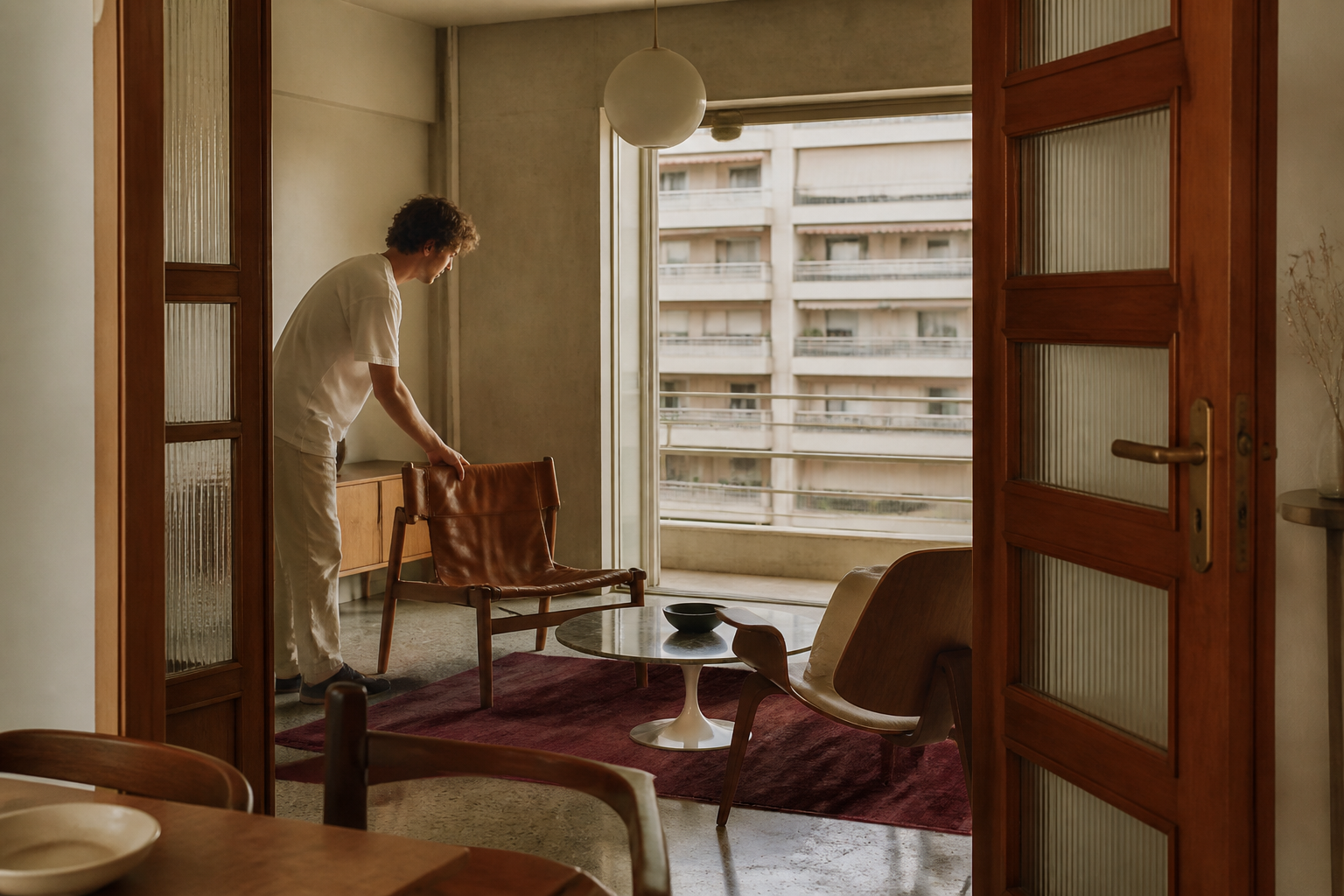
Stand on a balcony in Athens in the early evening and you are met by an almost endless landscape of grey-white concrete façades, shaded by extended awnings and lined with green potted plants. At first glance, it is an urban landscape that can seem chaotic and monotonous. But look closer and you will see the outlines of one of Europe’s most radical housing experiments.
This is the polykatoikia, the Greek apartment building born out of the acute housing shortage of the post-war years. For decades, these buildings were seen as symbols of failed, unregulated urbanisation – cramped, hot and uncompromising in their aesthetics. But today, a quiet revolution is under way behind their deeply recessed façades. Progressive architects, local designers and international creatives have begun peeling away layers of plastic paint and plasterboard to reveal the inherent beauty of Athens’ modernist soul.
From post-war overcrowding to the vertical neighbourhood
To understand the polykatoikia, we need to go back to the 1950s. After the Second World War and the subsequent Greek Civil War, hundreds of thousands of people flocked to the capital. The state lacked the resources to build large-scale housing estates. The solution was a unique legal and economic system called antiparochi (which loosely translates as ‘mutual exchange’).
The principle was ingenious in its simplicity: a private landowner handed over their small plot, with its older single-storey house, to a builder. In exchange for the land, the owner received a number of ready-to-move-into flats in the new apartment building the builder put up on the site. No banks were involved and no state subsidies were needed. Within twenty years, Athens had been transformed from a quiet city of neoclassical stone houses into a dense, vertical concrete metropolis.
Panos Dragonas, an architect and professor, has long studied this phenomenon. He points out that, despite its lack of central planning, the polykatoikia served as a powerful social leveller. Unlike many Western European cities, where the working class was relegated to outlying suburbs, Athens retained a mixed demographic in its inner city. Its vertical structure reflected social classes: the top floors, with their roof terraces and views of the Acropolis or Mount Lycabettus, were home to the affluent middle classes. The lower floors, which were darker and noisier, housed students, craftspeople and newly arrived migrants. But everyone shared the same entrance, staircase and street life.
When Greece was hit by the deep economic crisis of 2010, many of these flats were left empty. They were considered old-fashioned, difficult to heat in winter and unbearably hot in summer. But it was also then that young creatives recognised the potential of these empty, raw spaces.
The return of materials: New terrazzo and local Kokkinarás marble
Today, renovating the polykatoikia is not about erasing history, but refining it. The raw concrete frame, based on Le Corbusier’s famous Dom-Ino column system, offers enormous structural flexibility. Since the exterior walls are not load-bearing, the interior can be opened up almost completely.
When architecture practices such as Local Local and Outline Practice take on these flats, materials are at the heart of their work. In the post-war years, terrazzo – called mosaiko in Greek – was by far the cheapest flooring material. It was poured on site using leftover marble chips from the city’s stonecutters and mixed with cement. During the 1990s, these floors were often hidden beneath vinyl flooring or cheap laminate.
Now the terrazzo is being brought back to light, carefully repaired and allowed to shine as it once did. It is a living, mottled material bearing the traces of the hands that laid it seventy years ago. The same reverence is shown to local stone. Instead of imported, uniform granite, today’s designers are turning to Greek quarries. The deep grey and red-toned Kokkinarás marble, quarried in the mountains just north of the city, is once again being used to create weighty, sculptural kitchen islands and bathroom basins. Even classic green Cipollino marble, with its dramatic, wave-shaped veining, has been uncovered and incorporated into minimalist bathrooms, where it contrasts with raw, untreated concrete.
Soft lines redraw Exarchia’s modernist floor plans
The classic polykatoikia flats were originally strictly divided up. The middle-class lifestyle demanded a clear boundary between public and private. The entrance led into a dark hall, which in turn led to a formal sitting room facing the street. The kitchen and the small bedroom for the maid were tucked away at the back, facing the cramped inner courtyard known as the akalyptos.
In neighbourhoods such as artistic Exarchia and multicultural Kypseli, these floor plans are now being completely redrawn. The Australian-Greek design collective Molonglo, led by its founder Nectar Efkarpidis, has taken a comprehensive approach to several post-war buildings in the city. In collaboration with London- and Athens-based architecture practice Royffe Flynn, it has created homes that breathe new life into southern European modernism.
Rather than tearing down every wall and creating sterile open-plan lofts, they work with soft, curved transitions. By using dark wooden sliding doors, lightweight textiles and strategically placed columns, they manage to create rooms that feel both spacious and sheltered. In its project in Exarchia, architecture studio another[architecture]office has shown how old sliding glass-and-wood doors can be retained while moving the kitchen to the heart of the flat. This transforms cooking, once a dark and isolated activity, into a social one, bathed in Athens’ distinctive, sharp light.
The new role of light and balconies in the urban landscape
But the most important element of polykatoikia architecture is, after all, the balcony. It is no coincidence that they run in continuous bands along the façades. In a climate where summer lasts from May to October, a balcony is not a luxury – it is an extra room, a social stage and protection from the climate.
In the post-war years, balconies helped keep the sun off the glass doors and windows, often with the help of heavy green or beige awnings. In today’s renovated flats, the boundary between indoors and outdoors has become even more blurred. With the installation of minimalist steel frames and large sliding glass doors, the living room can be opened completely onto the balcony during the summer months.
From these elevated platforms, residents are in direct contact with street life. They look out over the treetops, perhaps towards the small park Pedion tou Areos, while the scent of jasmine and fried squid rises from the tavernas below. The balconies become hanging gardens, filled with olive trees, rosemary and bougainvillea, together creating a welcome microclimate in the dense city.
What was once built as a quick and cheap emergency solution for a growing population has proved enormously adaptable. Athens’ polykatoikia was never perfect, but in the hands of a new generation of creatives it has proved to be exactly what the city needs: robust, flexible and deeply human architecture that allows Athens to change without losing its soul.
Facts
Sources & further reading
- thegreekfoundation.comAnother [Architecture] Office redefines flow and function in Athens ...
- dragonas.studioAfter the Apartment Block - dragonas
- yellowtrace.com.auMithimnis Apartment by Molonglo and Royffe Flynn | Yellowtrace
- monocle.comAthens Polykatoikia: A Modern Renovation of a City Icon - Monocle
Share the article
Translated from Swedish with AI assistance. Read the original.


