
Winter on the islands: The quiet Greece attracting new northerners
When the charter flights stop and the last souvenir shops close for the season, the Greek archipelago is transformed. As young Greeks head for Athens and the isolation of winter tests the smaller villages, a new group of year-round residents is emerging. Nordic remote workers, creatives and pensioners are drawn to the Greece that exists only outside the tourist season – and become part of the islands’ survival.
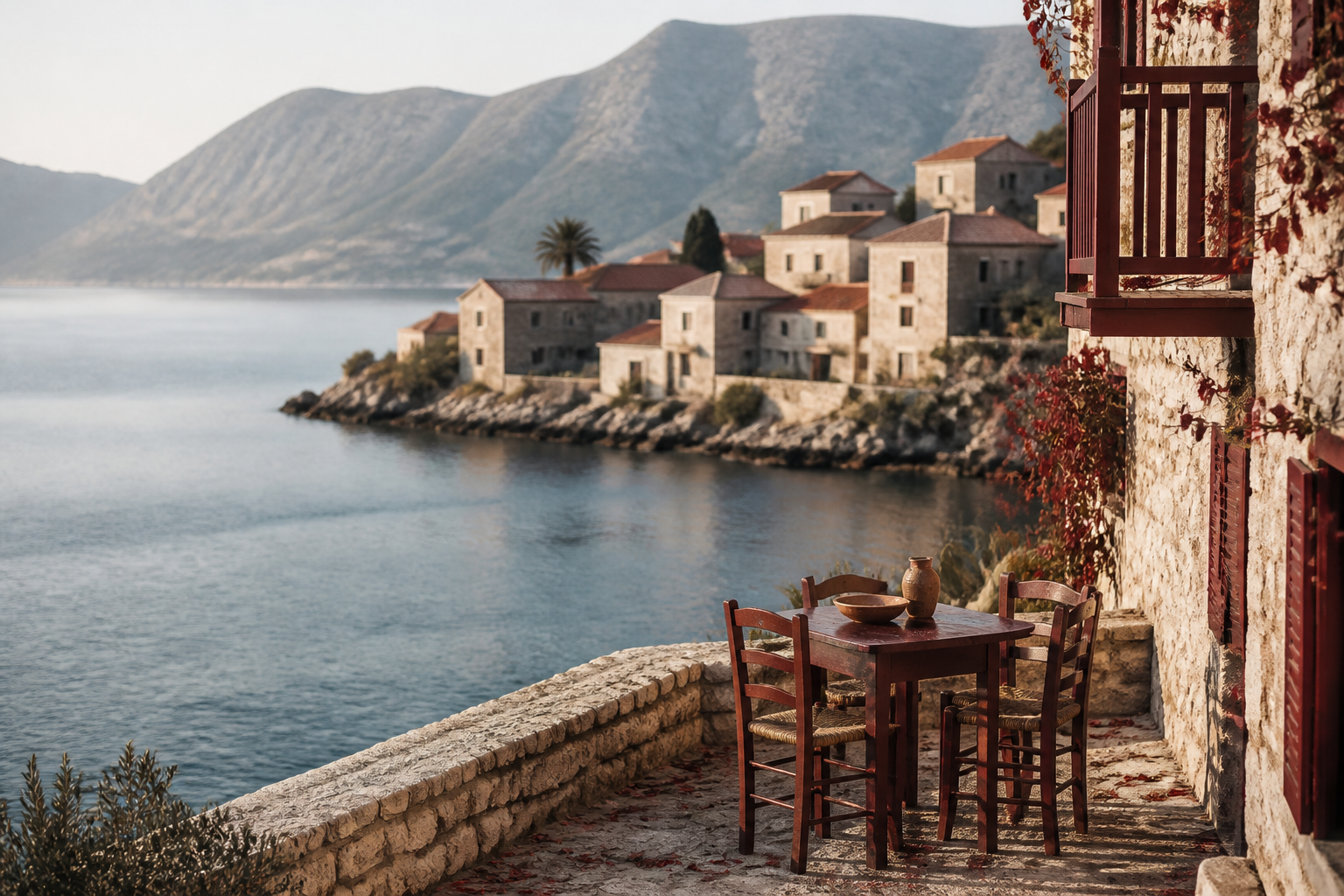
The northerly wind, the cold north wind that Greeks call voriás, sweeps through the empty alleys of the Cyclades. The whitewashed houses, which reflected the scorching sun during the summer months, now stand silent against a steel-grey sky. At the taverna by the harbour, plastic chairs have been stacked beneath a tarpaulin, and the only sound is the waves beating monotonously against the quay.
This is a Greece most tourists never see. It is a time when the islands return to their own rhythms, but also a time of very real challenges. Rural Greece, particularly its smaller islands, is struggling with a quiet demographic crisis. Young people move to the mainland in search of work, schools face closure because of falling pupil numbers, and local healthcare is put under severe strain when storms isolate the islands for days, sometimes weeks.
But amid this winter silence, a new dynamic has begun to take shape. Increasing numbers of northerners are choosing to swap the dark Scandinavian winter for life on the Greek islands and in the Peloponnese – not as temporary summer visitors, but as permanent or long-term winter residents.
When silence falls over the Cyclades
On smaller islands such as Kythera and the more remote outposts of the Cyclades, winter brings an extreme change. Once the last scheduled summer ferry has left, you are reliant on the local community. Living here year-round requires a particular mindset. It means accepting that the local pharmacy may be open for only a few hours a day, and that an emergency visit to the doctor may require a helicopter transfer if the sea is too rough.
For the older Greeks who stay behind, winter is a time to rest after the intense pace of summer, but also a time of isolation. This is where Nordic newcomers play an unexpected role. These are not the superficial encounters of tourism, but neighbourliness in its most fundamental form. Real connections are made in the grocery shop that stays open all year, or around the only working stove in the village’s local kafenio.
Foreign newcomers bring purchasing power during the months when the local economy would otherwise lie dormant. They shop at the local butcher’s, buy firewood from a neighbour and hire local craftspeople to renovate old stone houses. In this way, winter newcomers become an economic lifeline, helping services and shops to stay open even during the darkest months.
Ermoupoli – the city that never closes
Not everyone, however, seeks complete isolation. On Syros, the Cyclades’ administrative centre, winter life is quite different. The island’s main town, Ermoupoli, is a lively city with magnificent neoclassical architecture, a university, courts and a cultural life that continues throughout the year. The city does not die when the summer season ends; on the contrary, this is when local theatres, film clubs and galleries really come to life.
This has made Syros a magnet for Nordic remote workers and creatives. With modern fibre broadband and daily ferry connections to Athens, the island has become a base for people who can do their jobs in Stockholm, Oslo or Copenhagen from a desk overlooking the Aegean Sea.
In Ermoupoli’s alleys, Greek students mingle with Nordic programmers, writers and designers. Here, integration is not about adapting to a backdrop, but becoming part of everyday life in a functioning Greek community. Unlike those on neighbouring islands, schools on Syros have stable pupil numbers, and international influences in the classroom are seen as an asset rather than an exception.
In the footsteps of the philhellenes: the Peloponnese and the olive harvest
Further south, in the Peloponnese and on Crete, winter is less about isolation and more about intensive work. November and December are the months of the great olive harvest. Around Kalamata and Nafplio, the air fills with the bitter, fresh scent of newly pressed olive oil.
Foreigners seeking a simple life close to nature in this part of Greece is nothing new. As early as the 1960s, the British writer and war hero Patrick Leigh Fermor settled in Kardamyli on the Mani Peninsula in the southern Peloponnese. Leigh Fermor, who served as an SOE agent on occupied Crete during the Second World War alongside his companion Billy Moss and the local resistance, found a home for the rest of his life in the Peloponnese. His beautiful stone house in Kardamyli still stands as a symbol of his deep love for the Greek landscape and its people.
Today, it is not only writers and academics who are drawn here. Many of the northerners moving to the Peloponnese and Crete today get directly involved in local agriculture. They buy abandoned olive groves, restore old stone houses using traditional methods and set up small craft businesses. By combining Nordic approaches to sustainability and marketing with Greek tradition, they are creating new export opportunities for locally produced honey, olive oil and crafts.
Everyday encounters in the new island life
On car-free islands near Athens, such as Spetses and Hydra, winter life takes on an almost meditative quality. Here, where the donkey is still the main means of transporting heavy goods, winter brings absolute calm. The northerners who choose these islands are often seeking just that – silence and space to create.
Cultural exchange between the traditional island population and the new residents takes place in small ways. It might mean language lessons over a cup of Greek coffee, joint efforts to clean the beaches after winter storms, or working together to keep local traditions alive during the carnival in February.
Sharing the challenges of winter – the biting, raw cold indoors in houses that are not always built for below-zero temperatures, cancelled ferries and empty streets – creates a strong bond. Northerners discover that Greece is not just a summer paradise, but a country with a deep and complex inner life. And for Greeks who have chosen to stay on their ancestral islands, their new neighbours from the north are proof that their home communities still have an appeal reaching far beyond the last charter flight of summer.
Facts
PATRICK LEIGH FERMOR (1915–2011) The British writer and travel author Patrick Leigh Fermor is one of the best-known foreign figures to have chosen to settle in Greece. During the Second World War, he served as an intelligence officer on Crete, where, together with William Stanley "Billy" Moss, he led the famous kidnapping of German general Heinrich Kreipe in 1944 – an event later portrayed in the book and film "Ill Met by Moonlight". After the war, Leigh Fermor built a house in Kardamyli in the Peloponnese, which today operates as a museum and a guesthouse for writers.
Sources & further reading
- patrickleighfermor.orgproverbs6to10 | Patrick Leigh Fermor
- thegreekvibe.comLiving in Greece for Half a Year - The Ultimate Guide
- immigrantinvest.com11 Best Countries to Move from Canada
- en.wikipedia.orgCrete
Share the article
Translated from Swedish with AI assistance. Read the original.


