
When 3D Printers Meet Thousand-Year-Old Stone: How Albanian Craft Is Becoming a Career of the Future
In cities such as Gjirokastra and Korça, traditional stonework and textile art are now meeting digital design and circular business models. Through the newly launched CRAFT-VET vocational training project and strong Nordic partnerships, Albania’s cultural heritage is being transformed from a threatened memory into a driving force for tomorrow’s green jobs.
The sound of chisels against limestone has echoed between Gjirokastra’s Ottoman stone houses for centuries. Today, however, the rhythmic hammering is increasingly accompanied by the whirr of 3D scanners and the clicks of CAD software. A craft long regarded as dying, carried on by an ageing generation, is being fundamentally redefined.
Albania faces a challenge shared by many countries in the Balkans: how to preserve a deeply rooted cultural heritage while creating attractive career paths for a younger generation drawn to digitalisation and modernity. The answer is not to turn it into a museum exhibit, but to consciously fuse traditional techniques with modern technology.
Through the newly launched regional initiative CRAFT-VET, which recently got under way at Mother Teresa University in Skopje, led by Diturije Ismaili among others, a comprehensive approach is now being taken to vocational training in the craft sector. The aim is to make crafts a viable, high-tech industry of the future.
Where tradition meets digital manufacturing
At the heart of the new wave of craft education is a desire to break down the traditional boundaries between handcraft and technology. Through initiatives such as Smart Craft Labs, young Albanian craftspeople and designers have the opportunity to experiment with modern technology to scale up and develop their products.
For example, 3D scanning can be used to document and recreate intricate wood carvings or details from historic buildings. By digitising patterns previously preserved only in the muscle memory of older craftspeople, designs can be adapted to modern manufacturing methods without losing their aesthetic and historical connection.
This digital toolkit also allows young creators to visualise their ideas more quickly and produce precise prototypes. The journey from a sketch on paper to a finished product that can be sold internationally has consequently become much shorter.
Building conservation as a certified career of the future
In Gjirokastra, whose historic centre is on UNESCO’s World Heritage List, the need for skilled craftspeople is urgent. Restoring its unique fortress-like houses requires specialist skills in traditional stonework, lime mortar and carpentry—knowledge that has been at risk of disappearing entirely for decades.
Swedish-Albanian cooperation has played a decisive role here. Cultural Heritage without Borders (CHwB) Albania has worked for many years to promote building conservation in the region, with support from Sida among others. Bosse Lagerqvist, a researcher and cultural heritage expert at the University of Gothenburg, has been an important voice in this work, long emphasising the need to integrate conservation with local community development.
By structuring training and creating formal certifications, building conservation has gone from being informal seasonal work to a recognised and sought-after career of the future. For young students, it is not just about learning old methods, but understanding how sustainable materials and historic building techniques outperform many modern, plastic-based materials in terms of energy efficiency and longevity. This insight is entirely in keeping with the green transition in Europe’s construction sector.
Renewing textile heritage and the circular economy in Korça
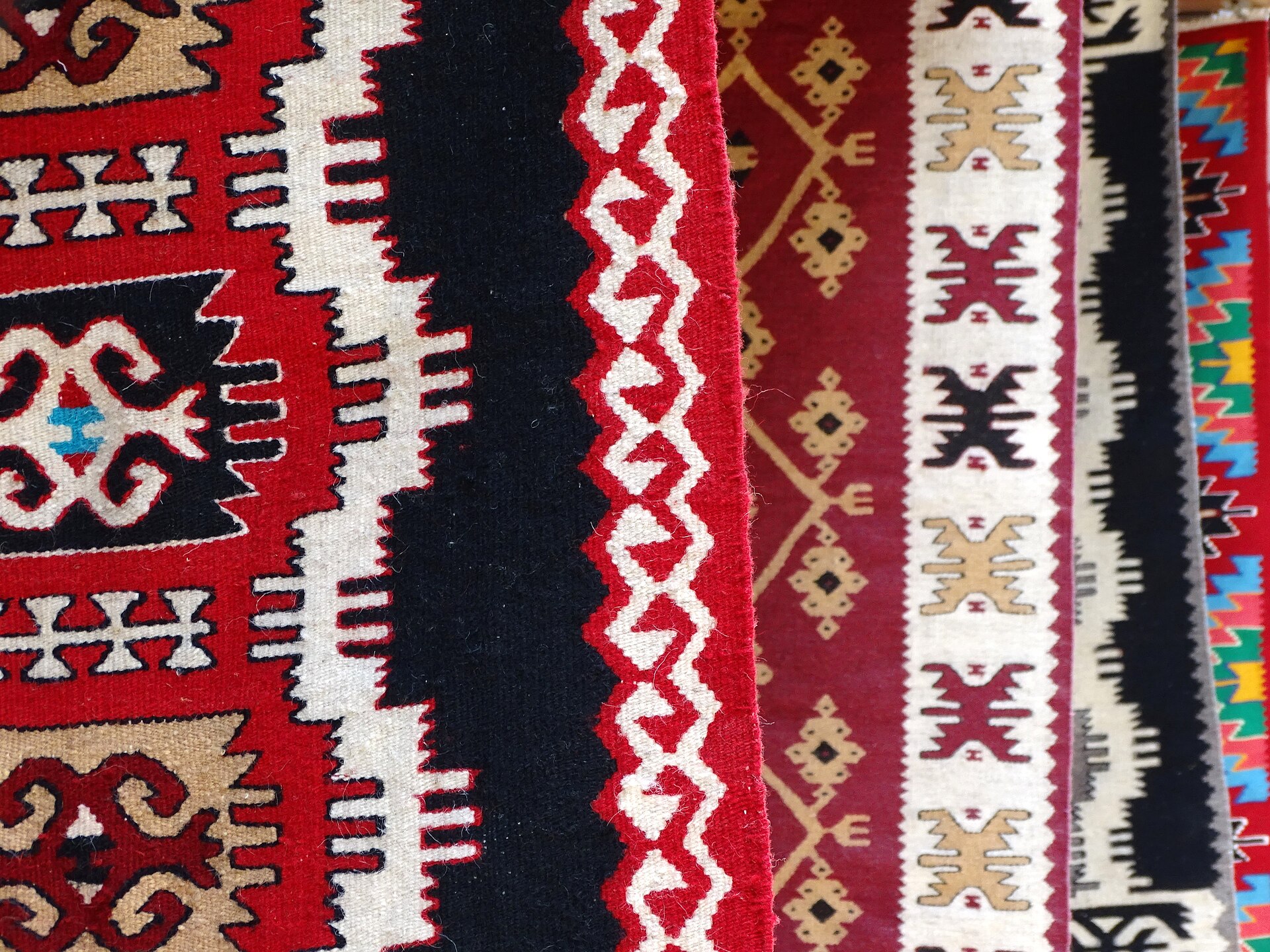
Further east, in the cultural and university city of Korça, it is textile heritage that is at the heart of renewal. The city, historically a centre for trade and crafts, has a rich tradition of carpet weaving and embroidery. But for these techniques to survive in a modern market, new business models are needed.
Training in Korça now focuses strongly on the circular economy. By using by-products from the local textile industry and reusing old textiles, students are creating new and distinctive design products. Traditional patterns and weaving techniques are applied to modern cuts and functions, making the products attractive to a discerning international audience.
But creating a beautiful product is only half the challenge. For craftspeople—most of whom are women—to make a living from their work, digital skills are essential. Through partnerships with consultancies such as A & I Services & Consulting, craftspeople are trained in e-commerce, digital marketing and pricing. This cuts out intermediaries, allowing a weaver in Korça to sell products directly to design shops in Stockholm, Oslo or Berlin.
Passing knowledge between generations
One of the most critical parts of the “Skills of Employability of Tomorrow” project is making knowledge transfer a reality. Tacit knowledge—the kind held in the hands of a master who has worked with stone or wool for fifty years—cannot be learned from a textbook.
By pairing young students with older masters on joint projects, a natural bridge is created between generations. It is a unique exchange that works both ways: older craftspeople share their knowledge of materials and practical skills, while younger people contribute their understanding of digital tools, social media and modern design processes.
This intergenerational exchange is also changing how craftspeople are viewed in Albanian society. Once associated with the past and low status, the craftsperson has become a key figure in the green and digital transition. The ability to make something lasting with your own hands, supported by modern technology, has become a symbol of both sustainability and forward thinking.
With growing interest in authentic crafts, building conservation and slow fashion, developments in Albania represent an exciting opportunity for exchange. As craft heritage is professionalised and digitalised, doors are opening to new creative collaborations across borders—partnerships in which historical knowledge becomes the foundation for tomorrow’s sustainable design.
Facts
CRAFT-VET AND REGIONAL COOPERATION
CRAFT-VET is a vocational education and training project (VET) that aims to modernise and professionalise the craft sector in the Western Balkans.
By integrating digital manufacturing, the circular economy and modern business models into traditional craft training, the project aims to create new green jobs and improve young people’s employability.
The initiative involves academic institutions such as Mother Teresa University in Skopje, organisations such as Cultural Heritage without Borders (CHwB) Albania, and local businesses and experts from both the Balkans and the Nordic countries.
Sources & further reading
- Mother Teresa UniversitySuccessful kick-off meeting of CRAFT-VET project
- aisc.alCRAFT-VET Revitalizing Albanian Artisanal Heritage Through Smart ...
- chwbalbania.orgABOUT US - CHwB
- timemachine.euCrafting routes to a circular economy - TimeMachine.eu
Share the article
Translated from Swedish with AI assistance. Read the original.


