
Vlašić cheese from Bosnia: the Mehić family’s 150-year tradition
On Mount Vlašić in central Bosnia and Herzegovina, the Mehić family is carrying on a centuries-old legacy. Through Mehić Eko, Mersudin Mehić makes traditional cow’s and sheep’s cheese entirely by hand – showing how an old mountain-pasture culture can become a driving force for modern ecotourism.
As the morning mist lifts over the Vlašić plateau, it reveals a landscape that seems made for a bygone era. Here, just over a thousand metres above sea level in central Bosnia and Herzegovina, rugged limestone cliffs meet rolling alpine meadows rich in herbs. These vast pastures are where the foundations are laid for one of the region’s most distinctive delicacies: salty, white Vlašić cheese.
In the small village of Mudrike, scattered across the mountain slopes just below the winter resort of Babanovac, the air smells of smoke, wood and sour whey. This is where Mersudin Mehić lives and works. He belongs to a generation that has chosen to stay on the mountain and preserve a legacy stretching back more than 150 years. Through the family business Mehić Eko, he makes cow’s and sheep’s cheese using exactly the same methods as his ancestors did in the final days of the Ottoman Empire.
The terroir on Bosnia’s green roof
To understand why Vlašić cheese has achieved near-legendary status in the Balkans, you have to understand the mountain itself. Vlašić acts as a giant climate barrier in the middle of the country. Here, the continental climate from the north meets the milder winds from the Adriatic Sea to the south. This creates a unique flora on the plateau. More than 160 different plant and herb species grow in the high-altitude meadows, many of them unique to this area.
When the animals graze at these heights during the summer months, the wild herbs leave a distinct mark on the milk. The traditional sheep breed here is the pramenka, a hardy and robust sheep that can withstand Vlašić’s rapid changes in weather and rugged terrain. Watching over the flocks are the tornjak dogs – large, majestic shepherd dogs that have protected livestock from wolves and bears for centuries, and are themselves a symbol of Bosnian mountain pastoralism.
It is the combination of pramenka sheep’s milk, aromatic herbs and fresh mountain air that forms the basis of the local terroir. It is a flavour profile that cannot be replicated in a modern, industrial dairy.
150 years of hands-on knowledge
Mersudin Mehić now runs the business with his family, but the knowledge has been passed down through the generations. His parents, Esad and Seada Mehić, spent their lives herding animals and making cheese on the mountain, and it was from them that Mersudin learned the craft’s precise touch. It is about knowing exactly when the milk is at the right temperature, how firmly the curds should be pressed and how much salt is needed for the cheese to keep through the winter.
Although the family business Mehić Eko was only formally registered ten years ago, Mersudin stresses that nothing has changed in the production itself. The work is done entirely without modern technology or mechanised processes. Everything is done by hand, from milking to ageing.
Making a living from traditional farming in the Balkans is no easy option. It requires hard work seven days a week, all year round. But for Mersudin, it is about more than simply preserving a tradition; it is about his family’s survival and future. Cheese-making has enabled him to support his family and fund the education of his three children. It is concrete proof that traditional cultural heritage can offer a sustainable economic path forward, even in a modern Bosnia where rural areas often suffer from depopulation.
The process: from warm milk to wooden casks
Making authentic Vlašić cheese (historically often called Travnički sir because it was once taken down to the market in the town of Travnik at the foot of the mountain) is an art that requires patience. The process begins immediately after milking, while the milk is still naturally warm.
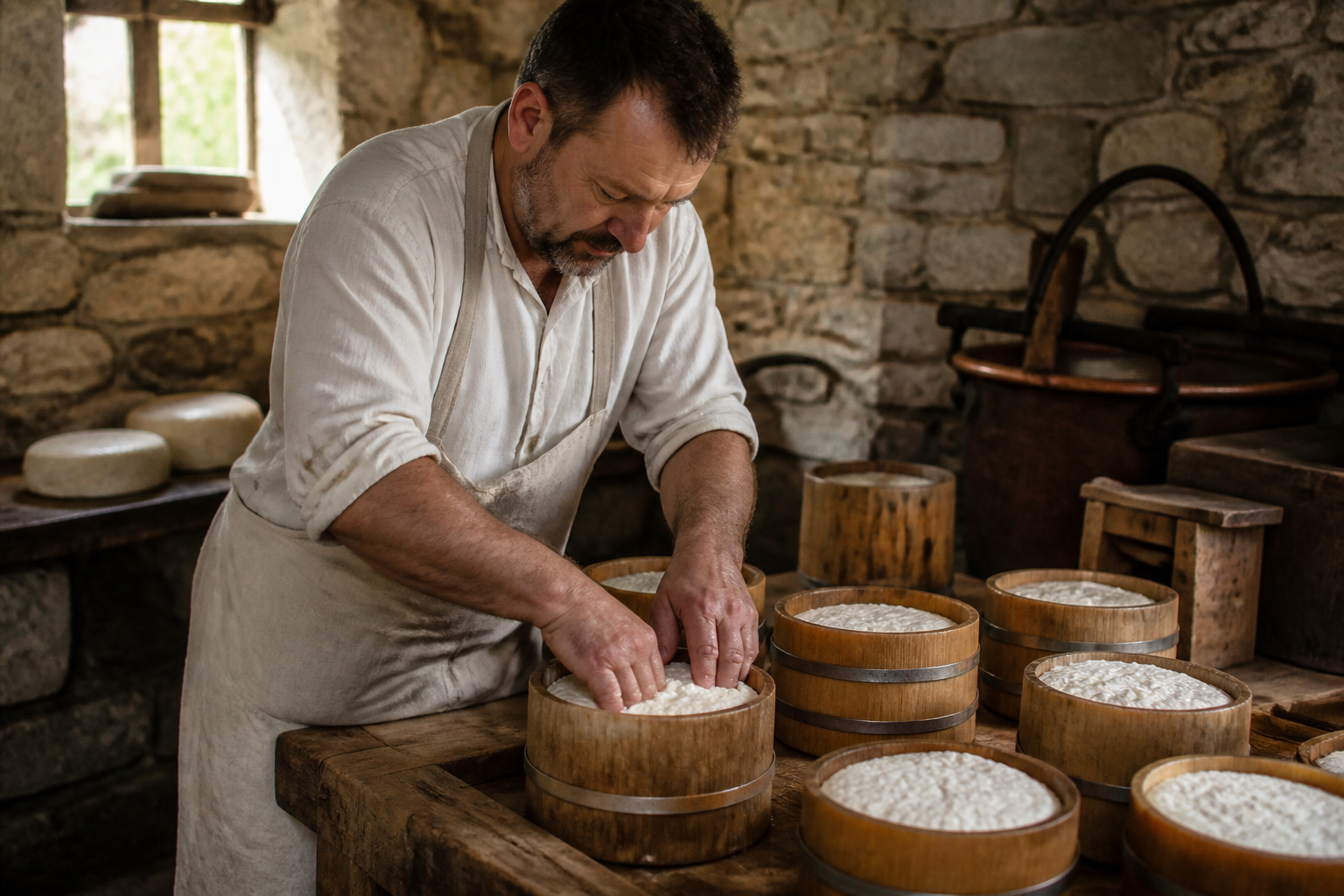
The milk is curdled with rennet in large vats. Once the curds have formed, they are gently broken up and gathered in special cloths known as cijedilo. The whey drains away under its own weight before the curds are placed in wooden moulds, kalupi, where they are pressed under heavy stones to remove the last of the liquid. This gives the cheese its characteristic firm texture.
Once the cheese has been pressed, it is cut into large, square blocks. The blocks are carefully salted by hand with coarse salt and then layered in deep wooden casks known as kace. The cask is then filled with brine, salamura, and the cheese is left to mature. The ageing time is crucial: the cheese must mature in the brine for at least two to three months to develop its characteristic flavour. During this time, its texture changes from rubbery to deliciously crumbly, while the saltiness balances the rich, fatty flavour of the sheep’s milk.
Babanovac and a new era of mountain-pasture tourism
In the past, shepherds on Vlašić were isolated for much of the year. They lived in simple wooden huts on the mountain and took their cheese down to the markets in Travnik only a few times each season. Today, the reality is different, and geographical isolation has become an advantage.
The proximity of the winter resort of Babanovac, which attracts large numbers of both domestic and foreign visitors during the ski season, as well as hikers in summer, has changed the game for the Mehić family. Instead of transporting the cheese to town, customers now come straight to the farm in Mudrike.
By combining cheese-making with ecotourism, Mehić Eko has become a popular stop for travellers seeking authentic local experiences. Visitors can taste cheeses aged for different lengths of time, learn about the production process and take home a piece of the mountain’s food history. This direct contact with consumers not only gives the producer better margins, but also creates a deeper understanding of the work and tradition behind every kilo of cheese.
Vlašić cheese is more than just a food. It is a living archive of the nature, history and human resilience of central Bosnia. In the hands of the Mehić family in Mudrike, that archive is safe, and the scent of brine and well-honed craft continues to drift across the mountain, just as it has for 150 years.
Facts
VLAŠIĆ CHEESE (TRAVNIČKI SIR)
- Type: Brined cheese made from sheep’s or cow’s milk (or a mixture of both).
- Origin: Mount Vlašić in central Bosnia and Herzegovina.
- Tradition: Historically made by shepherds on the mountain and sold at the market in the nearby town of Travnik, giving rise to both names.
- Character: White, semi-firm to crumbly in texture, with a distinct salty and sour flavour that deepens with age.
- Ageing: Matures in wooden casks (kace) filled with brine (salamura) for at least 60 to 90 days.
Sources & further reading
Share the article
Translated from Swedish with AI assistance. Read the original.


