
Visoki Dečani – the Middle Ages told in frescoes
A church that fits in a king’s hands, heavenly bodies with human faces and a sword that demands more than a passing glance. At Visoki Dečani in Kosovo, the frescoes become easier to understand once you learn their visual language. Biblical stories, theology and royal self-image meet on the same walls.
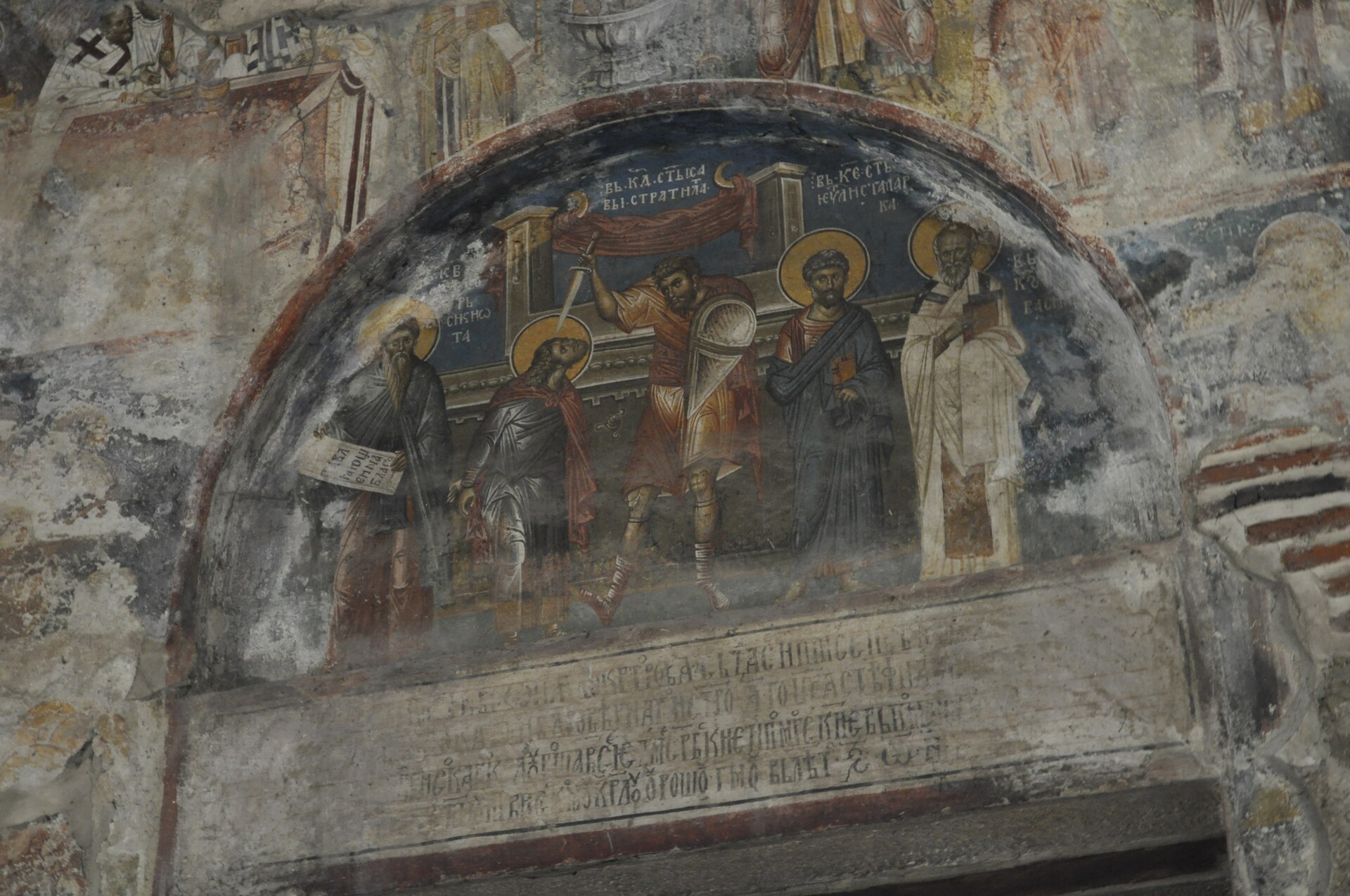
There is also a small church inside the church. In the founder portrait of Stefan Dečanski and Stefan Dušan, the building becomes a model, something that can be carried forward as a gift. Anyone standing in front of the painting is therefore inside the gift itself.
That is a good place to begin at Visoki Dečani. The images here do more than depict events. They also show how people wanted to understand their place in the world: before God, in the eyes of posterity and in relation to the power that had the church built.
The Serbian Orthodox monastery lies in western Kosovo, below the Prokletije mountain range. The church’s pale stone façades and carved details make a very different first impression from the dense paintings inside. Outside, it is easy to follow the lines of the building. Inside, the eye has to choose.
The 14th-century frescoes are not intended as a collection of separate works of art. Together they form a programme in which stories, saints and theological connections are distributed throughout the church. Understanding a few of its conventions makes the difference between seeing a splendid surface and actually beginning to read it.
Find the story on the wall
Start with a sequence of scenes, not the whole room. The life and Passion of Christ, stories about Mary and depictions of saints are among the recurring subjects of Orthodox church painting. A narrative cycle uses several events together to develop a theme.
That does not mean everything can be followed like a comic strip, from left to right. The architecture divides up the picture surfaces. A story may continue on another wall or appear in a different register, that is, a horizontal band of images. The subjects have also been placed to work with the church’s liturgical life, not simply to depict events in chronological order.
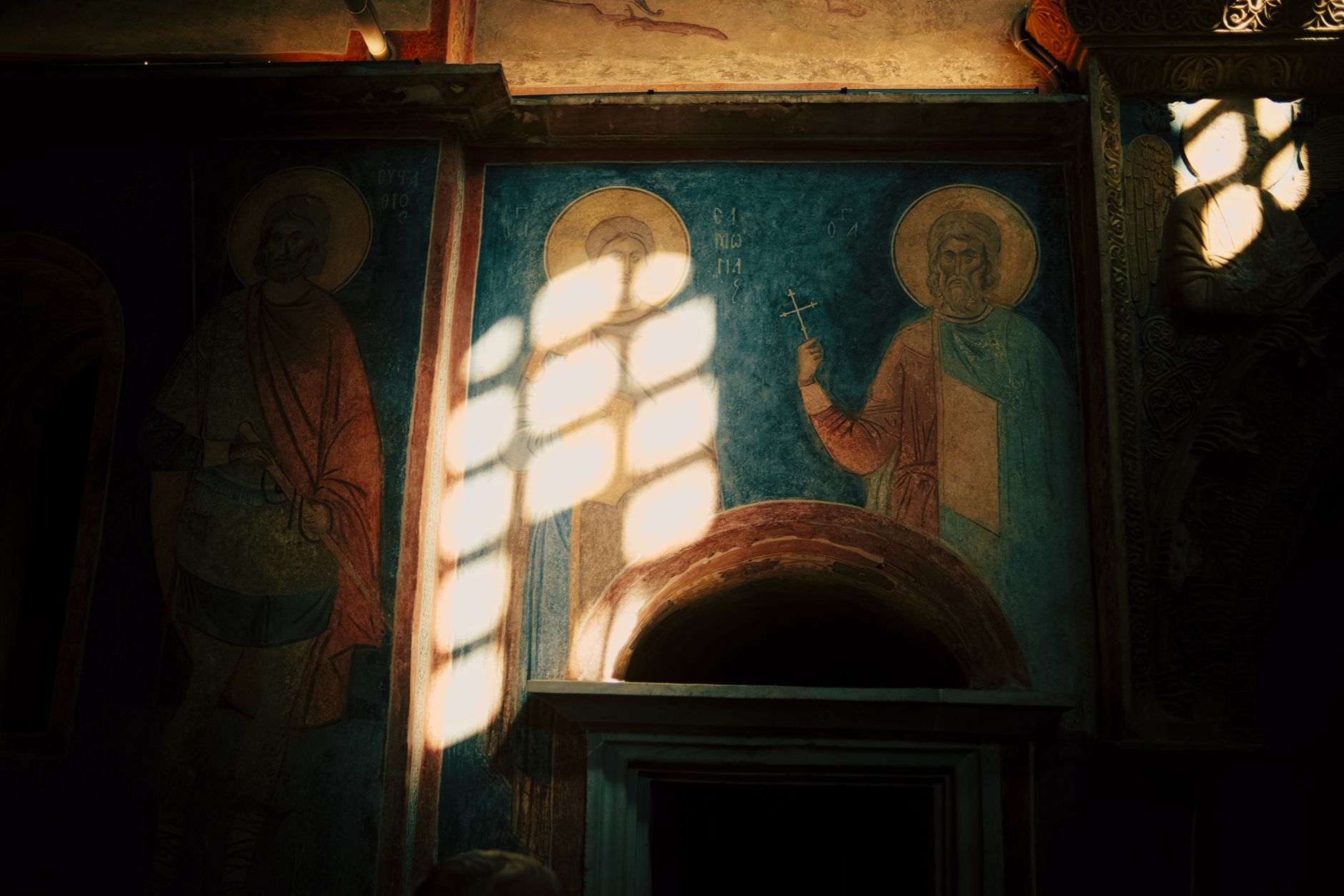
Look for the figure who appears more than once. Clothing, facial features and name inscriptions help hold the reading together. A halo marks a sacred or elevated status; the cross in Christ’s halo is a distinctive feature. Letters near a head often serve to identify the figure, while longer inscriptions may name an event or carry a theological message.
Hands are just as important. An outstretched hand can point to the centre of the story. A blessing gesture establishes authority. A hand against the cheek can express grief. Figures also communicate through the way they turn their bodies and direct their gaze towards one another.
At the same time, distinguish the wall paintings from the icons on the iconostasis. The fresco is painted on plaster and belongs to the surfaces of the building. The iconostasis is the screen that separates the sanctuary, with icons that belong to a different spatial and liturgical order. Both are religious images, but they should not automatically be read as parts of the same narrative cycle.
The Crucifixion and a participating heaven
In the Crucifixion fresco, the cross gives the composition a clear centre. Christ’s body is at the heart of the story; the figures around him show how the event is received. Mary and the disciple John are among the central witnesses to the Crucifixion. Grief is expressed through hands, bowed heads and the bodies’ relationship to the cross.
It is worth pausing first at the main scene. Otherwise, the small figures in the upper corners of the image risk stealing all the attention.
They represent the sun and moon as personifications: heavenly bodies depicted with human features. To a modern viewer, the forms around them may look unfamiliar. But this visual language has an art-historical background, not a technical one. The sun and moon appear in earlier Crucifixion images and are part of a long tradition of giving human form to natural forces and heavenly bodies.
Here it helps to distinguish between what a form looks like to us and what it means in its context. The small figures are not isolated illustrations. They belong to a Christian image of an event with cosmic significance. Heaven takes part in what happens on earth, and the Gospel account of the darkness at the Crucifixion provides further context for the motif.
Read the image on two scales. Close to the cross are the body, death and human grief. In the corners, the perspective widens to encompass creation. The small figures do not change the main story; they show how far-reaching its significance was understood to be.
Christ with the sword demands a different way of looking
The motif of Christ with the sword raises a different kind of question. A sword does not readily fit the image of Christ many visitors bring with them: the child in Mary’s arms, the teacher or the suffering figure on the cross.
But church art shows several sides of Christ. He can be depicted as a teacher and healer, but also as a ruler and judge. The sword introduces ideas of power, judgement and division. It is an attribute that must be read alongside the rest of the image, not proof that the scene depicts a battle.
A relevant biblical context can be found in the tenth chapter of the Gospel of Matthew. There, Jesus speaks of coming not to bring peace but a sword. The words are followed by an account of how faith and discipleship can cause division even within a family. This is a far more demanding context than a simple contrast between a peaceful and a warlike Christ.
For anyone looking at the motif, the posture and the inscription are therefore crucial. Carrying an object is not the same as using it. Is the figure facing the viewer or caught up in an unfolding event? What is the hand’s relationship to the weapon? What text accompanies the image?
These are questions that prevent the attribute from taking over the whole interpretation. The biblical association offers a way in, but it does not replace reading the individual painting. In medieval church art, text, gesture and object work together.
The kings present their church
Then return to the founder portrait of Stefan Dečanski and his son Stefan Dušan. The task now is not primarily to recognise a biblical event, but to understand how royal power presents itself in a sacred space.
The splendid robes and royal headwear distinguish the rulers from the other figures. They are markers of status, not decorative additions. The inscriptions also anchor the image in the identities of named individuals. This is not a king in general who appears, but a particular dynasty with a claim to be remembered.
The church model makes the founder’s role visible. It shows what the ruler has given and connects him to the religious life of the place. Stefan Dečanski founded the monastery in the 14th century, and the establishment of the complex is also associated with Dušan. In the image, this royal monastic foundation takes a form that can be understood without knowing its full history.
But the model should not be treated as an exact architectural drawing. Its purpose is to identify the gift and explain the relationship between giver and recipient. A building that in reality encloses people becomes an object in their hands.
There is both self-assertion and submission in this. The king has his wealth, rank and contribution depicted. At the same time, he appears before a higher authority. Secular power does not vanish at the church door; it is given a place within a religious order.
See fewer images, understand more
Visoki Dečani rewards not only those who try to see everything. It is better to choose a few images and ask different questions of them. In the narrative cycle: what happens before and after? At the Crucifixion: how do people and heaven take part? Before the sword: how do text and gesture guide the interpretation? At the founder portrait: what do the kings want posterity to remember?
The church becomes less overwhelming without losing its richness. A halo identifies. A hand explains. A church model makes a royal claim visible. The Middle Ages are present here not simply as the age of a wall, but as a way of telling stories through images that can still be read.
Sources & further reading
- en.wikipedia.orgVisoki Dečani - Wikipedia
- sprezzatura.itART and UFO - Part 2 - Sprezzatura
- 381info.comArtistic freedom or a medieval mystery: space aliens in a Visoki Decani fresco?!
- alamy.com. English: Stefan Dečanski and Dušan with church model, fresco from Visoki Dečani,Serbia. mmiddle of XIV century. XIV century serbian painter 502 Stefan i Dusan ktitorski portret Decani2 Stock Photo - Alamy
Share the article
Translated from Swedish with AI assistance. Read the original.


