
Viorica Cortez – a stage life in fabric, paper and sound
A stage costume preserves the role, a letter the connection and a recording the voice. At the anniversary exhibition Viorica Cortez 90 in Bucharest, the mezzo-soprano’s international career takes several forms. Together, the objects raise a question that reaches beyond opera: how much of a performance can really be preserved?
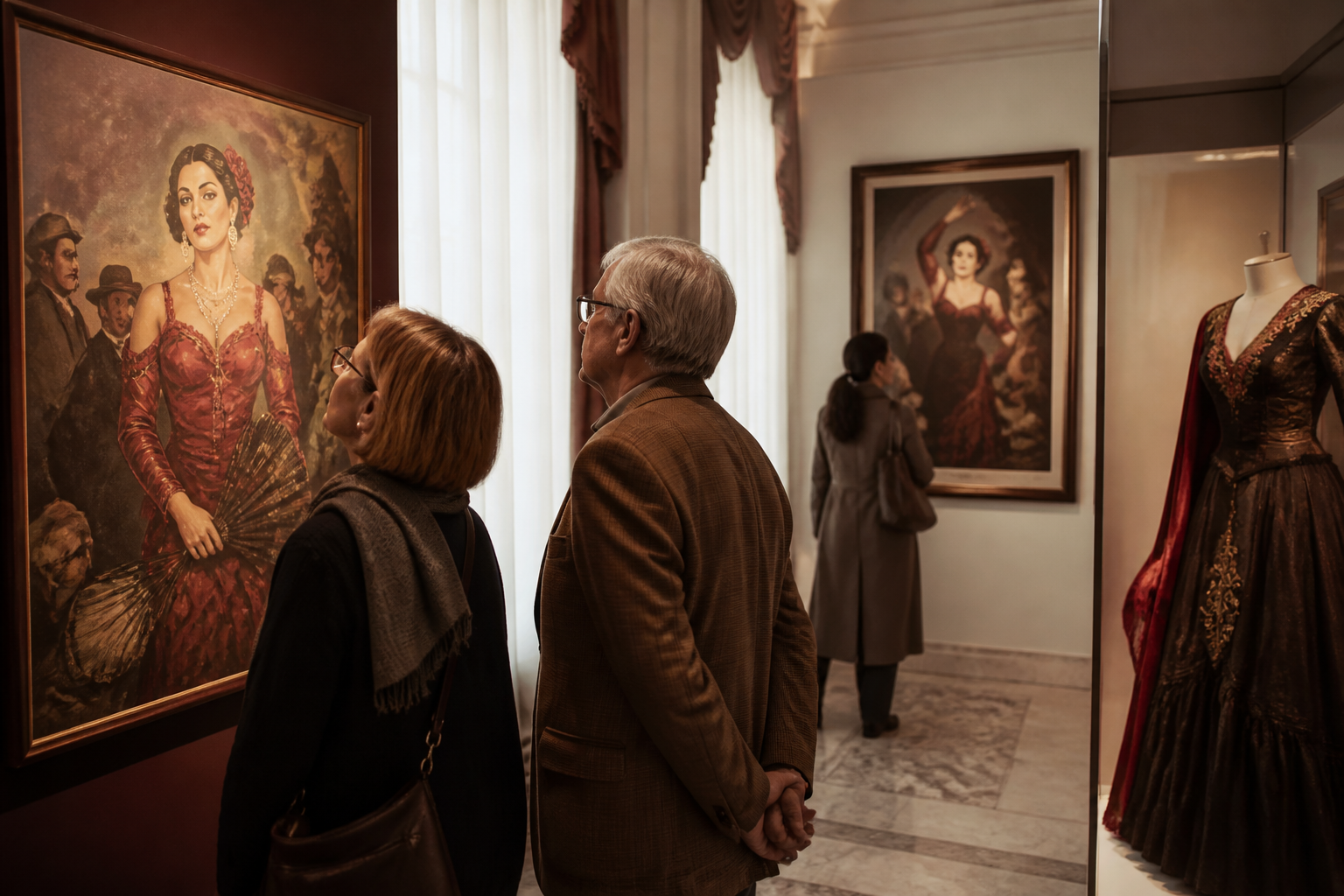
A stage costume without its singer is missing something essential: movement. The fabric remains, but not the step across the stage, the turn of the body or the breath before a phrase. It is this distance that makes opera costumes interesting in a museum. They are tangible traces of an art form that exists in the moment.
At the anniversary exhibition Viorica Cortez 90 at the Muzeul Național de Istorie a României in Bucharest, costumes and personal objects are displayed alongside original posters, stage photographs, letters, and audio and video recordings. The curator is Mihaela Simion. There are several ways into the stage life of Romanian mezzo-soprano Viorica Cortez here, not just the story of a successful voice.
The fact that the exhibition is housed in a history museum is significant. At Calea Victoriei 12, opera’s fleeting work becomes part of the shared memory. A poster once intended to sell tickets has a new purpose: to bear witness to those who stood on stage.
Costume is part of the performance
Carmen is a useful way into Cortez as a performing artist. Georges Bizet’s opera calls for a singer who can give both musical and dramatic form to a role that is easily reduced to a few familiar attributes. A skirt or a flower is not enough. The character must emerge through the interplay of voice, posture, gaze and movement.
The stage costume is part of that work. A garment’s cut affects the silhouette; its volume and weight influence how a movement is perceived from the auditorium. Costume helps the audience read a situation even before the words arrive. But it does not, on its own, determine who the person on stage becomes.
That is why the exhibited garments need to be viewed alongside the stage photographs. In a photograph, the relationship between clothes and body comes into view: how the singer stands, holds their arms or turns towards a fellow performer. The image restores some of the context that disappears when a costume leaves the theatre.
At the same time, a stage photograph is a selection, not a complete interpretation of a role. An intense expression may belong to a moment that lasted only briefly. It is worth bearing that distinction in mind when looking at opera photographs, which often compress a long dramatic sequence into a single striking pose.
Carmen is a way into the craft of performance here, not a label for all the costumes in the exhibition. The role associated with an individual garment must be established from its documentation. Keeping the roles distinct also makes Cortez’s career richer than a single famous character.
The poster shows the work behind the name
Viorica Cortez’s international stage career included the Royal Opera House in London. The name places her in an operatic world where singers move between theatres, languages and artistic teams. But a theatre on a list of credits tells us very little about what the work actually involved.
This is where the original posters have a particular strength. A performance poster is made for a specific occasion. Through the information it contains, it connects a work and an ensemble to a place and a time. It reminds us that an international career is built from individual engagements, not from an uninterrupted state of fame.
The poster’s typography also tells us how the theatre presented the performance to its audience. What was given prominence: the work, the composer or the singers’ names? This is a different kind of information from that conveyed by a portrait photograph. The poster shows the public offering; the stage image shows something of its artistic form.
Where there is a documented link between a poster and a photograph, it is possible to get closer to a particular production. But the connection needs to be established. A photograph of Carmen and a poster for the same opera do not automatically belong to the same performance.
This attention to detail is precisely what makes archival material compelling. It resists the simplified artist biography, in which cities and triumphs can easily be stacked one on top of another. The question instead becomes what Cortez sang, in what context and with whom. The posters offer reference points for that story rather than a ranking of achievements.
The letters bring the life of the stage closer
The letters shift attention from the auditorium to the connections surrounding the work. On a poster, a singer is a public name. In a letter, she is the sender or recipient, part of a conversation that was not necessarily intended for an audience.
That does not mean every letter reveals a private secret. Correspondence can be formal, practical, warm or concerned with artistic ideas. Its value lies in what it actually says, and in the possibility of connecting the words to an identifiable person and situation.
For a singer with an international working life, these connections are an essential part of the profession. Opera is built on collaboration: with conductors, directors, fellow performers and theatre organisations. Letters can offer access to that network in a way that a list of engagements cannot. They can also show the difference between how a production was presented to the public and how it was discussed by those involved.
Here, it is important to distinguish between the letter and the museum’s explanation. A date places the document in time. A sender gives it a voice. The exhibition text can then add background, but that background is not automatically a claim made by the letter writer.
That is also why handwriting and personal address should not be allowed to stand in for the content. The sense of intimacy is appealing, but a letter becomes genuinely revealing only when it is possible to understand what the correspondence concerned. Then the professional emerges from behind the stage portrait.
The recording brings time back
The audio and video recordings bring back something the other objects lack: duration. A phrase has a beginning and an end. A pause changes a scene. A response from a fellow performer affects how the next line lands.
Carmen offers clear examples of what to listen for in a performance of a role. The Habanera and the Seguidilla make different demands on rhythm, address and phrasing. In the short scene, the drama takes on a different weight. The role requires not just a particular tone of voice, but the ability to change the expression without losing the character.
This is musical context for the role, not a claim about which numbers are included in the exhibition’s selection of recordings. Any assessment of Cortez’s interpretation must be based on an identified performance. The production, performers and recording conditions all affect what we hear.
The technology also sets its own conditions. Microphone placement and sound balance affect the relationship between voice and orchestra. A video camera chooses the frame for the viewer, while the audience in the auditorium can direct its own gaze. The recording therefore preserves a performance through a medium; it does not leave the entire theatre experience unchanged.
Even so, it can make the objects around it easier to understand. A body in motion shows what a garment allows. A sung phrase gives the expression in a stage photograph a continuation. The name on the poster becomes audible once more.
It is in the meeting of these different traces that the central idea of Viorica Cortez 90 lies. The costume, letter and recording do not need to tell the same story. Instead, they allow us to approach different parts of a working life: the role before the audience, the connections behind it and the voice that can still be heard.
Sources & further reading
- Muzeul Național de Istorie a RomânieiExpoziția aniversară Viorica Cortez 90, la Muzeul Național de Istorie a României
- en.wikipedia.orgViorica Cortez - Wikipedia
- tele7abc.roViorica Cortez 90: expoziție aniversară la Muzeul Național de Istorie a României
- radioromaniacultural.roExpoziția aniversară VIORICA CORTEZ 90 la Muzeul Național de Istorie a României | Muzică-Dans-Arte | Radio România Cultural
Share the article
Translated from Swedish with AI assistance. Read the original.


