
The Thin Leaves of Mountain Cheese and the Scent of Linden Honey: A culinary journey through northern Montenegro
In the Montenegrin mountain regions around Kolašin and Sinjajevina, flavours are shaped by harsh winds, alpine meadows, and centuries-old artisan methods. Here, along the country's winding cheese and honey roads, lives a culinary culture where every bite tells the story of life on the high plateau.
As the morning mist clears over the Lipovo Valley outside Kolašin, dew-kissed herbs glisten on the steep mountain slopes. It is here, in the borderlands between the mild winds of the Adriatic Sea and the harsh mountain climate of the interior, that the foundation is laid for some of Montenegro's most distinctive flavours. The mountain grass grazed by cows and sheep on the Sinjajevina high plateau is rich with wild herbs, giving the milk a character entirely its own – rich, aromatic, and perfectly suited for local food craftsmanship.
In recent years, Montenegro has systematically mapped and highlighted its culinary traditions through official food trails. By following the cheese and honey roads in the northern mountain region, you venture off the beaten tourist track and straight into the kitchens of family farms that have, for generations, refined the art of surviving on what the mountains provide.
The Art of Folding Cheese: The unique craft behind lisnati sir
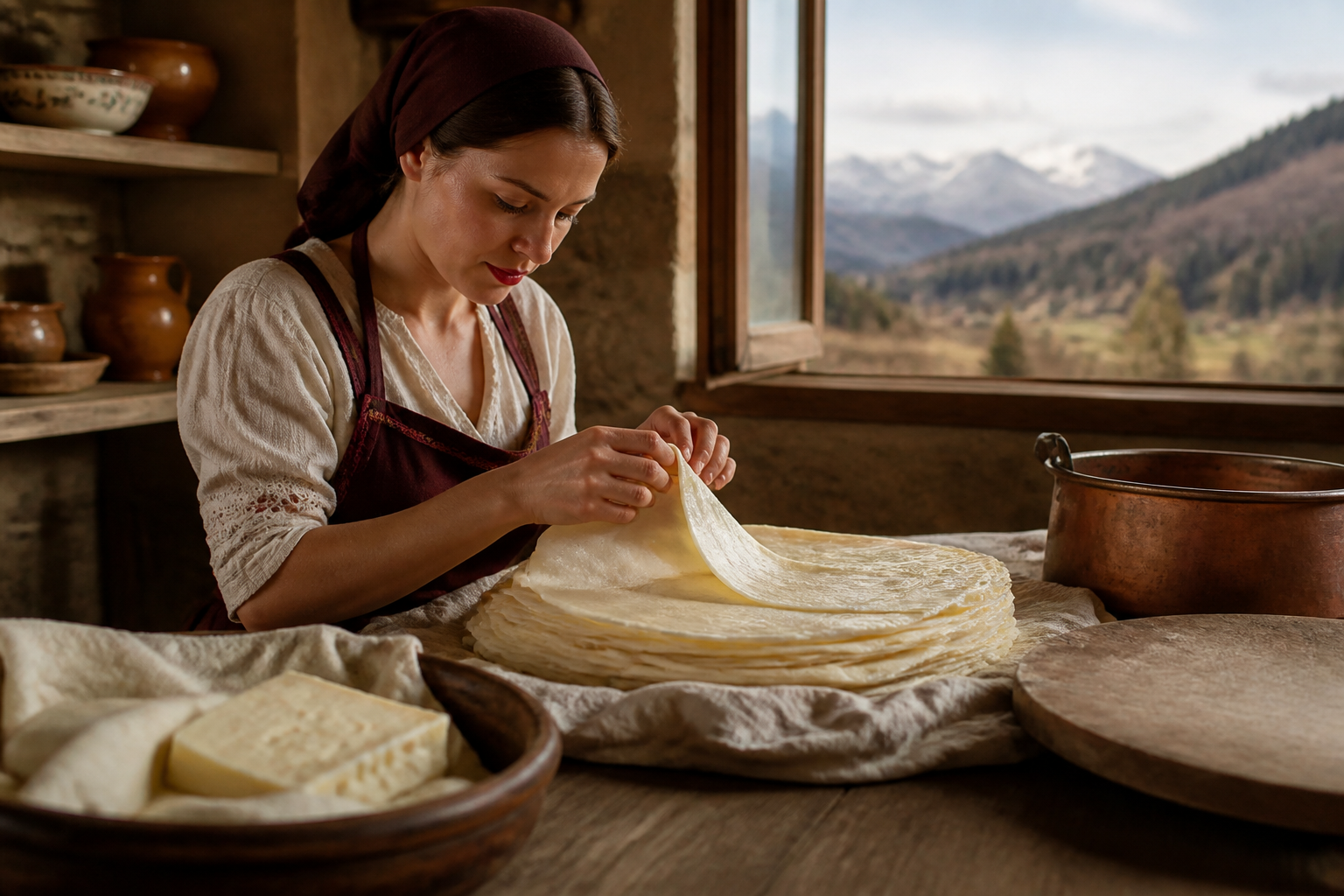
At the heart of the region's gastronomic identity stands Kolašinski lisnati sir – a leaf-thin cheese whose production process is so unique that it has been awarded a national protected geographical indication. To call it sliced cheese would be a sacrilege; rather, it is a cheese consisting of dozens of paper-thin, almost translucent layers that can be peeled off one by one.
The craft is extremely time-consuming and requires an intuitive touch that cannot be measured by machines. Svetlana Milošević, one of the local producers in the scenic Lipovo Valley, explains that the secret lies in the precise temperature and the skilful handling of the whey. Milk from the morning and evening milkings is blended, gently warmed, and coagulated. Once the curd has formed, the critical process begins where the cheese is pressed, rolled out, and folded repeatedly.
It is this stretching and folding technique that creates the characteristic leaves ("lisnati" literally means leafy or layered). Another legendary producer in the region, Milijanka Puletić, has for decades demonstrated how this method demands both physical strength and a deep understanding of the milk's changing properties throughout the year. The result is a mild, slightly acidic cheese with an elastic texture that melts on the tongue.
Along the Honey Roads: Mountain beekeeping and wild flora
Running parallel to the cheesemaking are Montenegro's honey roads, stretching from historic Cetinje in the south to the mountain towns of Mojkovac, Bijelo Polje, and Kolašin in the north. The Montenegrin landscape, with its dramatic elevation changes and rich flora, offers perfect conditions for beekeeping. Here, bees gather nectar from wild thyme, sage, heather, and the dense forests of linden trees.
Linden honey from the mountain regions is known for its light colour and distinct, almost mint-like freshness. In Cetinje, the annual event "The Scent of Linden and Honey" has been held on Balšić Square for over twenty years, bringing together beekeepers from across the country to showcase their harvests. But it is up in the northern mountain villages, at small-scale producers like PG Rakočević in the village of Drijenak, where one can experience the everyday reality of beekeeping first-hand. Here, they work in harmony with the short but intense mountain summers, and each hive provides a unique reflection of that particular season's wild blooms.
Encounters on the Katun: Family farms carry the tradition
To understand Montenegrin mountain food, one must understand the concept of katun. These are the traditional summer settlements up on the high mountain plateaus where shepherds have, for centuries, driven their livestock at the beginning of summer to graze on the fresh alpine meadows. Although fewer people live on the katuns for the entire summer today, it is still here that the soul of Montenegrin culinary culture remains.
When visiting the family farms along the cheese roads, which wind through villages like Trebaljevo, Gornji Pažanj, and Blatina, you are met with a hospitality deeply rooted in isolated mountain life. Here, visitors are always invited to the table. Declining a piece of lisnati sir, freshly baked bread, and a glass of homemade juice or rakija is considered almost an insult.
It is small-scale, family-oriented, and entirely free of industrial methods. Most farms have only a few cows, and production rarely extends beyond what the family can manage by hand. This also means that each farm's cheese has its own personality, subtly influenced by whether the cows have grazed on the rocky slopes of Sinjajevina or in the greener valleys around Kolašin.
At the Rustic Table: How Montenegrin mountain food is served
When mountain food is laid out, simplicity and heartiness take centre stage. The most famous example of this is kačamak (especially the local variety smočani kačamak). This is a comforting, heavy dish made from boiled potatoes and wheat flour, beaten vigorously with a special wooden pestle until it becomes completely smooth and elastic. Generous amounts of lisnati sir and kajmak (a creamy, slightly soured dairy product) are then stirred in, so the cheese melts and forms long, glistening strings.
Kačamak is the ultimate comfort food after a day of hiking in the mountains, a dish that takes time to prepare and time to digest. It is often served alongside sour milk or jardum.
Jardum is another almost forgotten delicacy that is only found in these mountain areas during late summer and early autumn. It is a thick, salted beverage made from sheep's milk, boiled under constant stirring over a very low heat. It is a drink with an intense, rich flavour that acts as a natural energy boost and provides a perfect contrast to the mild layered cheese.
Travelling along Montenegro's food roads is not just about eating; it is a journey through a landscape shaped by geography and tradition. By buying cheese directly from the cellar in Lipovo or a jar of dark forest honey from a beekeeper in Mojkovac, you contribute directly to the survival of these ancient crafts in a modern world. It is a taste of the authentic Montenegro – wild, generous, and deeply personal.
Facts
Share the article
Translated from Swedish with AI assistance. Read the original.


