
The Tears That Built Fortresses: The Story of Chios' Fragrant Gold
In the southern part of the Greek island of Chios, the trees weep. Since antiquity, the rare mastic resin has been shaped into one of the Mediterranean's most sought-after commodities – a fragrant treasure that built impregnable fortress villages, enticed sultans, and is still harvested today in the exact same artisanal manner as in the Middle Ages.
Anyone approaching the southern slopes of the island of Chios in late summer is met by a very special scent. It is a heavy, aromatic, and fresh fragrance of pine needles, incense, and damp earth. The source of this scent is the gnarled, shrub-like trees Pistacia lentiscus var. chia, better known as mastic trees.
Even though this species of the pistachio genus grows wild in many places around the Mediterranean, it is only here – on the southern half of this specific Aegean island – that the tree secretes the thick, amber-coloured resin colloquially known as "mastic tears". Attempts to transplant the trees or cultivate them in other regions have historically failed; without Chios' unique soil, dry summers, and mild winters, the trees remain mute and yield no resin. It is a botanical mystery that has shaped the island's destiny for over two thousand years.
The Ritual Harvest of Tears: The Ancient Craft
Extracting mastic is a patient and physically demanding job that has remained largely unchanged since antiquity. The process follows a strict ritual schedule that spans the entire year. In early summer, the ground around the tree trunks is meticulously cleared of weeds and debris. The ground is then covered with a fine-grained, white lime clay. The clay serves a practical purpose: it ensures that the falling drops of resin remain clean and do not mix with the dark earth.
In July and August, the harvest work begins. Using a small, sharp, and curved iron tool, the farmers make careful incisions in the tree's bark. The cuts must be made with precision; if they go too deep, the tree is damaged, and if they are too shallow, no resin is yielded. From these wounds, the tree slowly begins to secrete its translucent tears. They seep along the trunk, gradually solidifying in the dry summer wind, and finally fall onto the whitewashed ground.
After a few weeks, the solidified droplets are collected for the next phase, which dominates village life during autumn and winter. Here, the work moves from the fields into the narrow alleys. On benches in front of the tightly packed stone houses, the village women gather to clean the harvest. It is a deeply social craft. Each individual mastic tear must be cleaned by hand of bark residue, dust, and clay, using small, pointed knives or needles. The work, which often continues well into January, is based on mutual aid, moving from house to house until everyone's harvest is secured. It is the purity of the delivered resin that ultimately determines how much the producer is paid.
Mastichochoria: Pirate-Proof Fortress Villages and Patterned Facades
The immense value of mastic has left a deep mark on the island's geography and architecture. During the Middle Ages, when Chios was ruled by the Genoese mercantile republic, the resin was an extremely valuable raw material used in medicine, cosmetics, and as an exclusive chewing gum for the courts of both Europe and the Ottoman Empire. To protect this lucrative monopoly against pirate raids, the Genoese built a network of fortified villages in the south of the island, known as Mastichochoria (the mastic villages).
Villages like Mesta, Pyrgi, and Olympoi functioned as impregnable fortresses. Mesta is the best-preserved example of this defensive architecture. From the outside, the village looks like a closed stone fortress; the outer walls of the houses form a continuous curtain wall with no ground-level windows. Inside the walls, a labyrinth of extremely narrow, cobbled alleys spreads out, covered by arches and dead ends. The system was designed to confuse and trap pirates who managed to breach the city gates. If danger threatened, the villagers could also escape across the rooftops, which were all at the same height and interconnected.
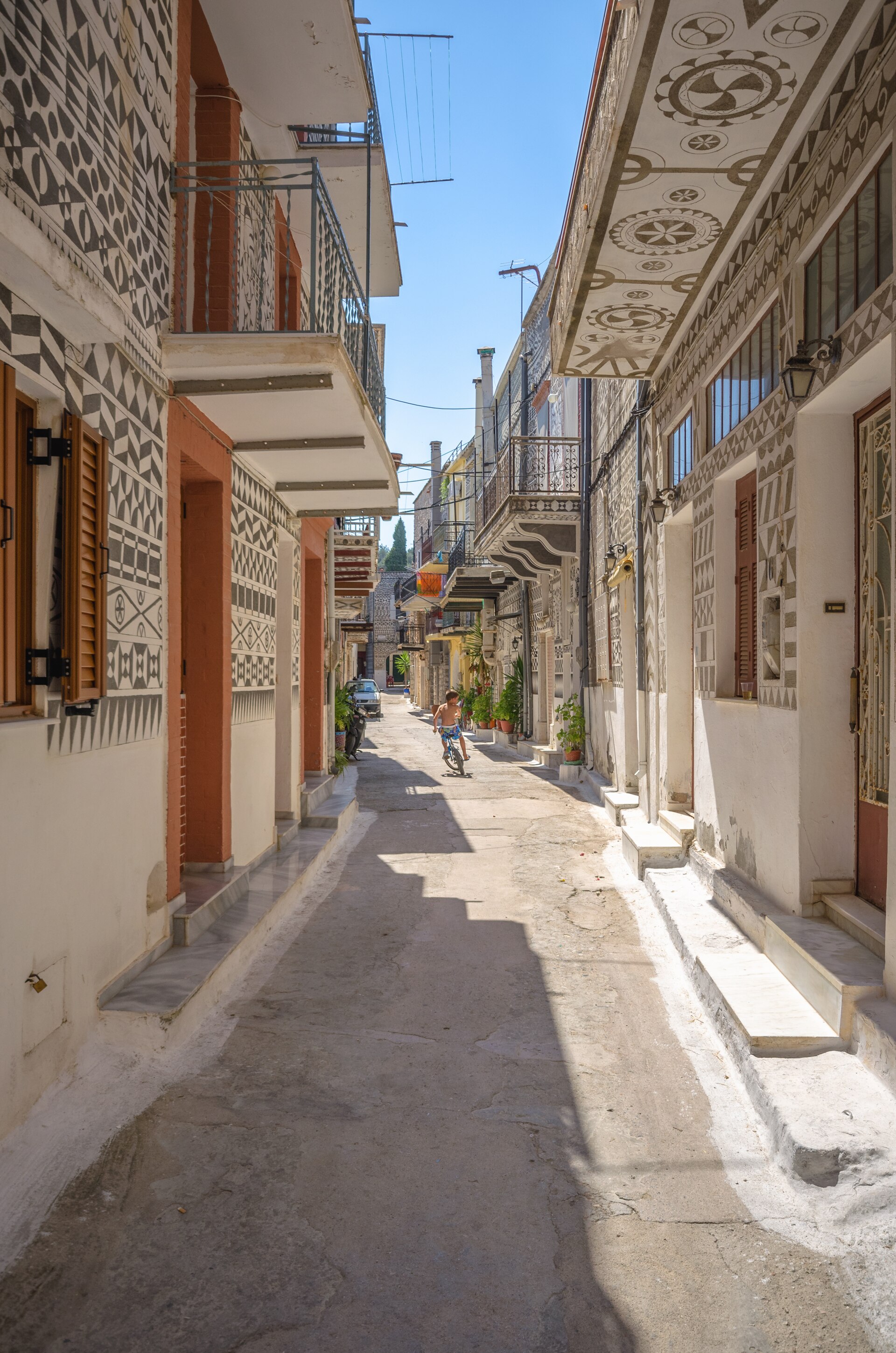
The neighbouring village of Pyrgi offers a completely different, almost psychedelic visual experience. Here, the facades of the houses are covered in xysta or kentitiria, complex geometric patterns in black and white. This unique decorative technique is achieved by plastering the walls with a mixture of volcanic sand and lime, and then carving out the patterns by hand using small tools. It creates a striking optical contrast that gives the village an almost graphic character, contrasting sharply with the more rustic stone houses in Mesta. In Armolia, another of the mastic villages, a strong pottery craft developed early on, where local clay vessels were used specifically to store and transport the precious resin.
Chios Mastic Museum: A Modern Perspective on Cultural Heritage
To understand how deeply this simple resin has shaped the island's identity and economy, a visit to the Chios Mastic Museum in the south of the island is essential. The museum, which opened in 2016 and is run by the Piraeus Bank Group Cultural Foundation, is situated on a windswept hill overlooking the plantations and the sea.
The building's modern architecture of wood, glass, and raw concrete blends harmoniously into the barren landscape. Through interactive exhibitions, historical documents, and old industrial machinery, it tells the story of how this small drop of resin was shaped by empires, trade monopolies, and local cooperatives. It shows how vital the mastic monopoly was to the Ottoman Empire, where Chios' farmers enjoyed special privileges and tax reliefs in exchange for supplying the Sultan's court in Constantinople with the finest resin. The museum masterfully weaves together botany and social history, demonstrating how the craft has survived earthquakes, fires, and shifting political rule.
The Power of the Cooperative: From Hand-Sorting to Global Export
The modern playing field for Chios mastic was redrawn in 1938 with the founding of the Chios Gum Mastic Growers Association cooperative. Before then, farmers were often at the mercy of middlemen and speculators. Today, the cooperative unites all of the island's growers and controls the entire chain, from reception and quality control to processing and global export. It is the cooperative that ensures individual farmers receive a fair share of the profits, which has been absolutely crucial in keeping the ancient craft tradition alive.
In 2014, the craft and culture surrounding mastic cultivation were recognised by UNESCO, which inscribed it onto its Representative List of the Intangible Cultural Heritage of Humanity. This was a confirmation that the harvest is not merely an agricultural method, but a living social structure sustained by the collective knowledge of generations.
Today, mastic is experiencing a renaissance. It is used not only in the traditional Elma chewing gum or the sweet liqueur mastiha, served as a digestif after Greek meals. Modern medical research has confirmed what ancient physicians like Hippocrates and Dioscorides already knew: that the resin has strong anti-inflammatory and antibacterial properties. It is now in high demand globally by the pharmaceutical and cosmetic industries for treating stomach issues and in skincare products.
As the evening sun paints the geometric patterns in Pyrgi in a warm, golden glow and the women once again sit on their doorsteps with their small knives, it becomes clear that mastic is more than just a raw material. It is the cement – both literally and figuratively – that binds together the history, landscape, and people of southern Chios.
Facts
FACTS: MASTIC FROM CHIOS
- Botanical name: Pistacia lentiscus var. chia, an endemic variety of the mastic shrub that only produces the unique resin in southern Chios.
- Harvest period: The incisions in the bark are made during July and August. The cleaning is done by hand during the autumn and winter months up until January.
- Protected designation: Chios mastic has Protected Designation of Origin (PDO) status within the EU.
- UNESCO heritage: The harvest and associated culture were inscribed on UNESCO's Representative List of the Intangible Cultural Heritage of Humanity in 2014.
- Uses: Liqueur (mastiha), cosmetics, medicine, chewing gum (Elma), and as a flavouring in Greek pastries such as tsoureki.
Sources & further reading
Share the article
Translated from Swedish with AI assistance. Read the original.


