
The red plastic kiosk that conquered the world
With its rounded corners, glossy polyester surfaces and bright colours, it brightened up cold concrete environments from Ljubljana to Gdańsk. Saša J. Mächtig's modular K67 kiosk was the Swiss Army knife of Yugoslav daily life. Now, this retro-futuristic plastic bubble has moved from street corners to the world's finest design museums.
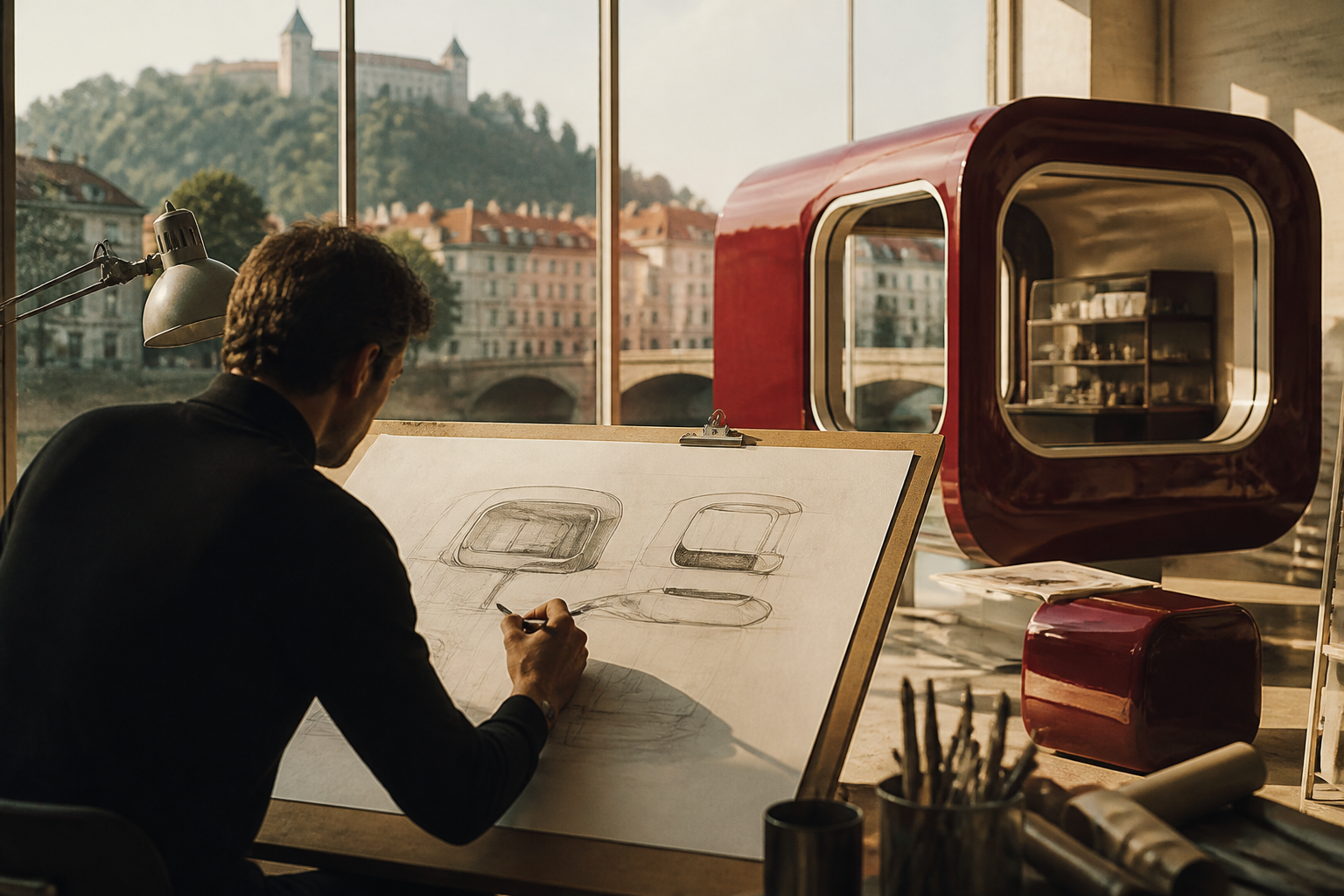
Imagine an autumn day in Ljubljana, Zagreb or Belgrade in the early 1970s. Between grey, monumental concrete blocks and the screech of trams, a splash of intense red suddenly catches your eye. It looks almost like a landing capsule from an utopian space voyage, but as you walk closer, you see it is filled with daily newspapers, cigarette packets, tickets, or smells of freshly grilled sausages.
This was the K67 – an ingenious, modular design in glass-fibre reinforced plastic that for a few decades became a natural part of the Yugoslav streetscape. But the story of this red plastic kiosk is about much more than just nostalgia. It is the story of how a young Slovenian architecture student challenged the rigid town planning of the era and created a piece of global design history that today sells for staggering sums at international galleries.
The vision at Kavarna Evropa
It all began in 1966 in Ljubljana. The young Saša J. Mächtig, who was studying under the legendary Slovenian architect Edvard Ravnikar, sat at the classic café Kavarna Evropa and watched the street life outside. He noticed how the city's street furniture – everything from newspaper stands to ticket kiosks – was heavy, clumsy and completely impractical. They blocked the pavements and did not fit into the growing, modern city.
Mächtig realised that the city did not need more permanent buildings for small-scale services, but a flexible system. Inspired by industrial design, car manufacturing and the budding plastic revolution, he began sketching a modular unit. It had to be easy to move, adaptable to different needs and, above all, suitable for mass production.
The result was the K67. The letter stood for kiosk, and the number for the year the design was patented and presented to the world: 1967.
Mass production in Ljutomer
What made the K67 unique was its construction. Instead of a traditional wooden or metal frame, the kiosk consisted of a self-supporting shell made of fibre-reinforced polyester. It was a material associated with the space-age optimism of the future – lightweight, extremely durable and malleable in a way that made it possible to create the characteristic, softly rounded corners.
Production was based at the Imgrad factory in the small town of Ljutomer in north-eastern Slovenia. Getting the large moulds right was a technical challenge, but once production started in 1968, it was an immediate success. The kiosks were manufactured in a range of bright, bold colours – yellow, green, blue, white and, above all, the iconic, deep red colour that came to dominate the cityscape.
The genius lay in its modularity. A single K67 unit could function as a small telephone card booth. But thanks to the special rubber connection profiles, several modules could be linked together like Lego blocks. Two, three or even ten kiosks could be assembled into larger units – flower shops, police stations at border crossings, or even small cafés. The system could grow and shrink in line with the city's needs.
The Swiss Army knife of daily life
During the 1970s and 1980s, tens of thousands of K67 kiosks spread across Yugoslavia and further into the former Eastern Bloc, to countries like Poland, Czechoslovakia and East Germany. They popped up at railway stations, outside Plečnik's stadium in Ljubljana, in public squares and in residential areas.
For generations of people who grew up in the region, the K67 is associated with childhood smells and routines. This was where you bought your first comic books, your tram tickets, and above all, where you bought viršle – the classic Yugoslav hot dog served in a soft bun with plenty of mustard, straight from a custom-adapted K67 sausage kiosk.
The kiosk represented a kind of democratic design. It was accessible to everyone, around the clock, and functioned as a daily social hub. It softened the often austere and grey socialist architecture with its colourful and optimistic aesthetic.
From street corners to MoMA
It did not take long before the international design world took notice of Mächtig's creation. As early as 1970, just a couple of years after production started, the K67 caught the attention of Emilio Ambasz, the legendary design curator at the Museum of Modern Art (MoMA) in New York. The museum acquired a red K67 kiosk for its permanent design collection – a massive feather in the cap for a young Yugoslav designer.
But with the break-up of Yugoslavia in the 1990s and the subsequent economic transition, the kiosks began to disappear. Many were left to decay, rusting away in forgotten back alleys, or were replaced by anonymous, cheap structures of corrugated sheet metal and glass. For a period, they were seen mostly as worn-out relics of a bygone era.
Today, however, the K67 is undergoing a massive renaissance. Retro enthusiasts, architects and design galleries worldwide have launched a feverish hunt for surviving specimens. They are tracked down on industrial plots in Kromberk, at abandoned bus stations in North Macedonia, or in small Polish towns.
When the Museum of Architecture and Design (MAO) in Ljubljana hosted a major retrospective of Saša J. Mächtig's life's work, it sparked a new wave of appreciation. Kiosks are now meticulously restored to their original, glossy condition. They are popping up as trendy espresso bars in Berlin, information desks at design biennales in Venice, or as pure art objects in New York courtyards.
Saša J. Mächtig himself, now a professor emeritus, has lived long enough to see his early work transformed from a practical piece of street furniture into a design icon worth millions. K67 shows that truly great design is not about exclusivity, but about solving everyday problems with beauty, functionality and a healthy dose of colourful optimism.
Facts
Kiosk K67
- Designer: Saša J. Mächtig (born 1941 in Ljubljana).
- Design: Patented in 1967. Mass production started in 1968 at the Imgrad factory in Ljutomer, Slovenia.
- Materials: Glass-fibre reinforced polyester and polyurethane insulation.
- Number produced: A total of around 7,500 units were produced until production ceased in the early 1990s.
- Accolades: Included in the permanent design collection of the Museum of Modern Art (MoMA) in New York since 1970.
Sources & further reading
- outsider.siSaša Mächtig: Med arhitekturo in oblikovanjem - Outsider
- outsider.siKiosk K67: Oživljanje ikone – Outsider – revija, ki presega meje
- metropolismag.comThe Enduring Lives of Sasa Machtig's Modular Creations - Metropolis
- ausstellungen.arch.ethz.chgta exhibitions – Kiosk K67 - gta Ausstellungen - ETH Zürich
Share the article
Translated from Swedish with AI assistance. Read the original.


