
The monks’ food philosophy – Diane Kochilas reveals the world of Greek monastery food
Greek food is deeply woven into Nordic holiday dreams, but beyond the tavernas’ grilled souvlaki and Greek salads lies a hidden culinary heritage. It is a food philosophy that has been nurtured for a thousand years behind the monastery walls of the holy Mount Athos. Greek-American star chef Diane Kochilas guides us through a timeless world of fasting, self-sufficiency and unexpected richness of flavour – a tradition that feels more modern than ever today.
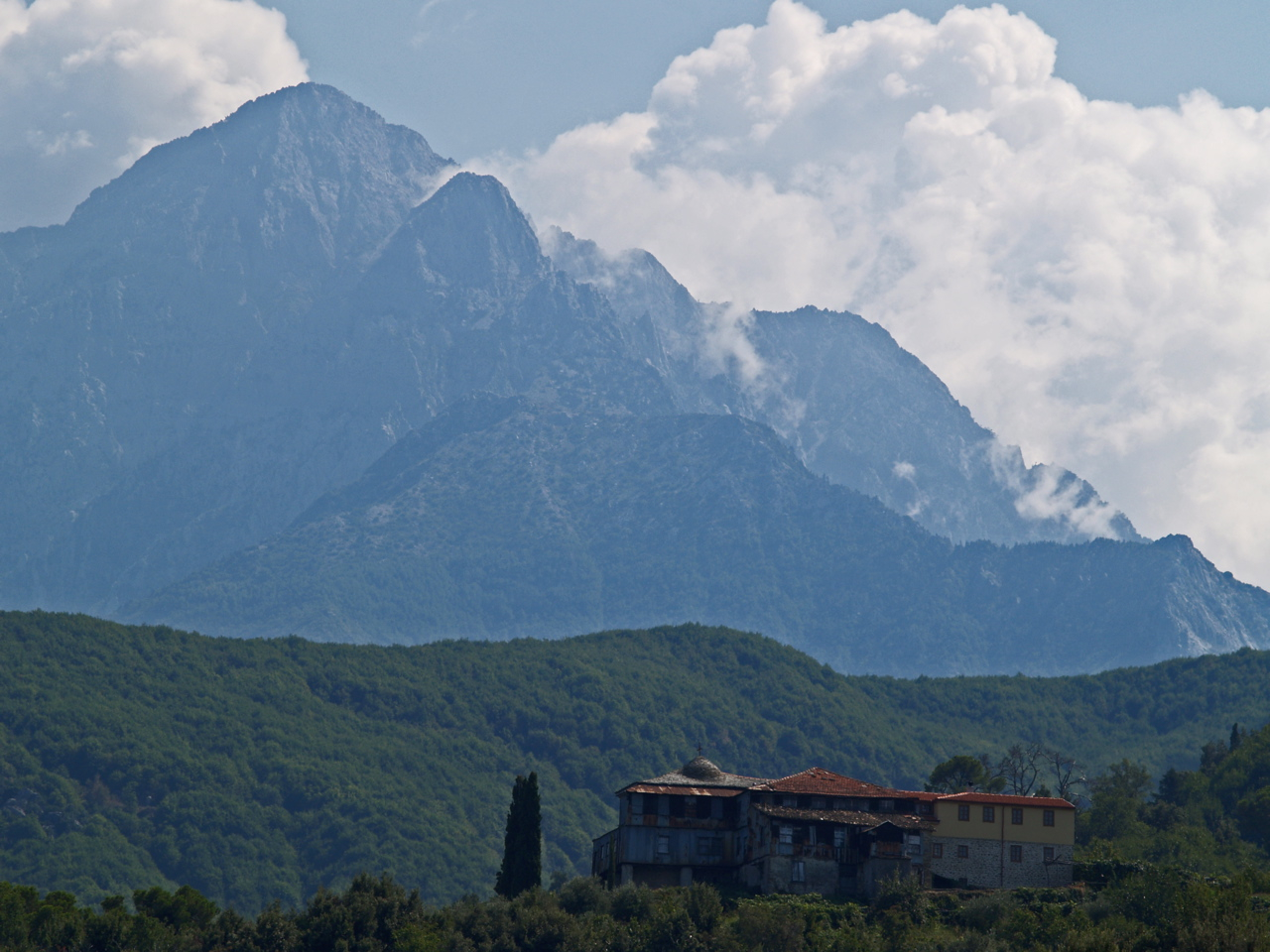
It often begins with a longing for simplicity. For Greek-American chef, cookbook author and television personality Diane Kochilas, Greek food is about a deep connection to the land. She remembers the summers of her childhood on the island of Ikaria, where the scent of a sun-warmed tomato changed her understanding of food for ever. But to understand the essence of Greek cuisine, you sometimes have to look beyond the sunlit holiday islands and seek out one of the most isolated places in Christendom: Athos, the autonomous monastic republic in northern Greece.
Here, on the forested peninsula that reaches out into the Aegean Sea, time has largely stood still since the Byzantine Empire. But behind the heavy walls of monasteries such as Vatopedi and Iviron, a daily, quiet activity is under way that is anything but stagnant. It is about food. The monks’ approach to growing, preparing and consuming food is not just a spiritual discipline – it is one of the world’s oldest and most considered food philosophies.
A three-part rhythm: fasting, moderation and feasting
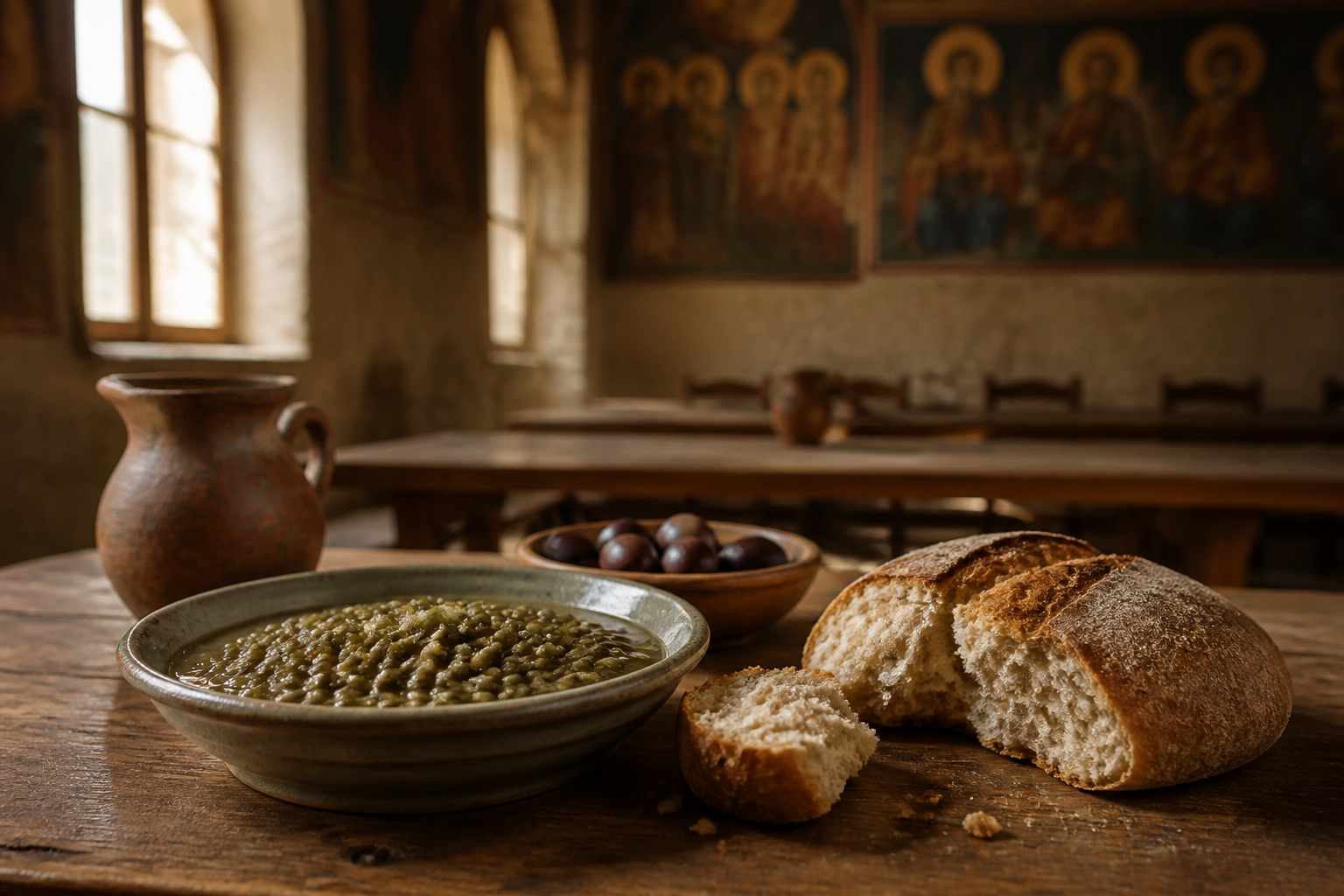
Anyone who thinks monastery food is synonymous with monotonous starvation is quite wrong. The cornerstone of the monks’ diet is a dynamic three-part rhythm that moves between strict fasting, everyday moderation and grand celebratory meals. Over the course of a year, a monk on Athos fasts for almost two hundred days. During these periods, which culminate in Great Lent, not only meat but also fish, dairy products, eggs, olive oil and alcohol are excluded.
Fasting is not about punishing the body, but about purifying the soul and sharpening the senses. When the restrictions are at their strictest, the cook in the monastery kitchen has to be creative. Days without olive oil bring slow-cooked dishes of beans, chickpeas and wild herbs, with the flavour instead lifted by lemon, garlic and dried spices.
When the fast ends, the diet shifts to moderation, with olive oil and a glass of wine allowed once more. And during the great religious feasts, meals become culinary celebrations. Fish is often served, slowly baked in the oven with tomatoes and onions, or as a hearty fish stew made with the day’s fresh catch from the sea beyond the monastery walls. It is a cycle that gives the body a natural chance to recover and ensures that every ingredient is appreciated to its fullest.
Creativity born of restrictions: the legacy of Father Epiphanios
The fact that monastery food on Athos has reached beyond the peninsula’s closed borders is largely thanks to one person: Father Epiphanios of Mylopotamos. He was a monk at Iviron Monastery but later settled at the Mylopotamos hermitage, where for decades he restored the old vineyards and created a modern winery in collaboration with the well-known Greek wine producer Tsantalis.
Father Epiphanios, who died in 2020, became known throughout Greece and internationally through his cookbook on monastery food. He showed that monastic cooking is not about luxurious ingredients, but about mastering the simplest ones. With onions, olive oil, lemon and tomatoes, he created dishes celebrated by star chefs around the world.
His philosophy lives on. By combining strict tradition with a deep understanding of balance in flavour, he proved that restrictions give rise to the greatest creativity. There are no modern kitchen appliances or convenience foods in the monastery kitchen. Food is cooked over an open fire in enormous copper cauldrons, a process that gives the dishes a subtle smokiness that cannot be recreated in an ordinary kitchen.
The monastery garden’s larder: self-sufficiency and tahini
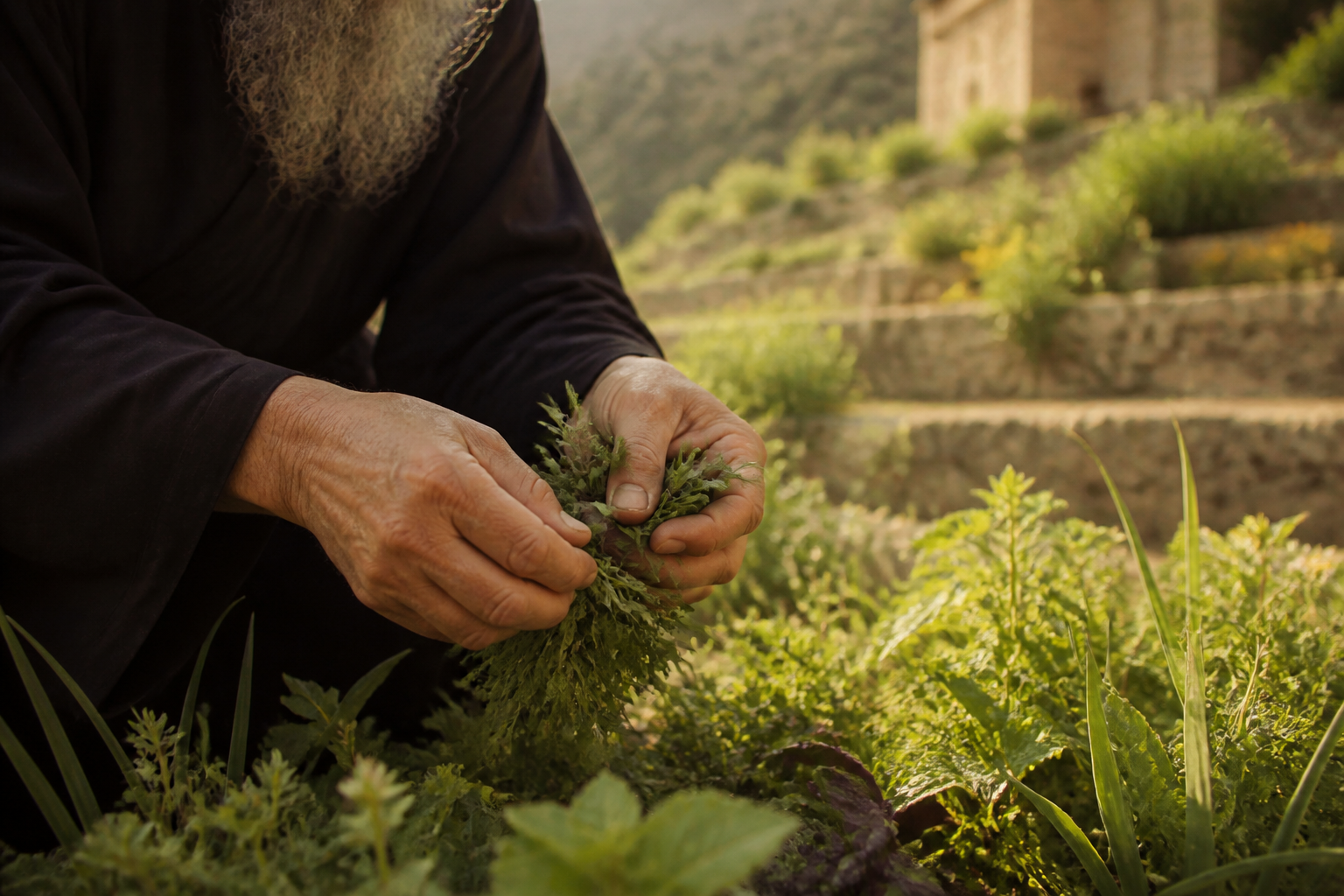
Self-sufficiency is central to life on Athos. Every monastery, from monumental Vatopedi to the smaller settlements around the administrative centre of Karyes, is surrounded by terraced gardens, olive groves and orchards. Everything that ends up on the plate is organic, locally grown and harvested at exactly the right time.
During the fasting months, when dairy products are forbidden, tahini becomes one of the monastery kitchen’s most important staples. The rich, nutritious sesame paste is used to add body and creaminess to soups and sauces that would otherwise seem thin without oil or butter. It is mixed with honey to make an energy-rich spread or stirred into oven-baked vegetables.
In the monastery kitchens, Saint Euphrosynus, the patron saint of cooks in the Eastern Orthodox tradition, keeps watch. His icon often hangs near the hearth as a reminder that cooking is an act of loving service. Olive oil is also pressed from the monasteries’ own groves, while grapes from their vines become both table wine and the sweet, aromatic communion wine Nama, used in the liturgy but also sometimes found in the monastery’s simple desserts.
Food as spiritual medicine: longevity and moderation
For a Nordic audience, often swamped by passing diet trends and complicated health advice, the Athos monks’ food philosophy offers a liberating simplicity. It is not about counting calories, but about approaching food as a form of spiritual medicine.
Father Moses, another of the peninsula’s well-known voices, has often emphasised that moderation is the key to both physical and mental health. The monks eat in silence while a brother reads from holy texts. There is no time for hurried eating or distractions from screens. One eats to nourish the body, not to pass the time or soothe emotions.
Scientific studies of the monks on Athos have attracted considerable international interest over the years. Researchers have found that the monks have exceptionally low rates of cardiovascular disease and that their life expectancy is significantly higher than the average for the rest of Europe. The key is thought to be the constant alternation between fasting and moderation, the high proportion of fibre, the antioxidant-rich wild herbs, and the complete absence of processed food.
When Diane Kochilas introduces the principles of monastery food to a modern audience, it is not about us all having to move to an isolated monastery. It is about bringing that awareness home: letting the ingredients speak, accepting periods of simplicity and understanding that the best food is often the food that takes the least fuss. At a time when we are seeking sustainability and inner calm, the monks of the holy mountain show us that the answer may not lie in the superfoods of the future, but in a thousand-year-old tradition of gratitude, silence and a perfectly ripe tomato.
Facts
MONASTERY FOOD ON ATHOS
- Mount Athos: A self-governing monastic republic in northern Greece with 20 Eastern Orthodox monasteries. Women are not allowed on the peninsula.
- Fasting days: The monks fast for around 200 days a year. On the strictest fasting days, meat, fish, dairy products, olive oil and alcohol are excluded.
- Father Epiphanios (1956–2020): A monk and cook from the Mylopotamos hermitage who brought monastery food to international attention with the cookbook "The Art of Monastic Cooking".
- Diane Kochilas: Greek-American chef, author and host of the television series "My Greek Table". An expert on traditional Greek Mediterranean cuisine.
Sources & further reading
- Greece IsAn experts greek food experience
- greece-is.comFasting and Feasting on Mount Athos
- stephenmosswriter.co.ukThe Mount Athos Diet Plan | Offcuts
- monastiriaka.grΜοναστηριακές Συνταγές
Share the article
Translated from Swedish with AI assistance. Read the original.


