
The Man Behind the Pap Test: Papanikolaou’s Childhood Home Becomes a Museum
Millions of women worldwide owe their lives to his discovery. Now, the childhood home of Greek physician Georgios N. Papanikolaou on the island of Evia has opened to the public – a place where a global scientific revolution meets everyday Aegean life.
The view over the Aegean Sea from the town of Kymi is breathtaking. Perched high on the steep cliffs of the east coast of the island of Evia, the town is often called "the balcony of the Aegean". It is a place shaped by winds, olive groves and a long history of seafaring. But it is also the birthplace of a man whose work would change the lives of millions of women across the globe. Following an extensive restoration, the childhood home of physician and pioneer Georgios N. Papanikolaou has now opened as a museum – a place where the history of science meets the everyday Aegean life that once shaped him.
It was in the autumn of 2026 that the doors to the new museum officially opened. The inauguration was led by the President of Greece, Constantine An. Tassoulas, highlighting the national and international significance of the project. The old stone house, an archontiko (a traditional Greek mansion) from the late 19th century, had stood empty for a long time. Thanks to an initiative by the local Kymi-Aliveri municipality, the building has now been restored to its former glory.
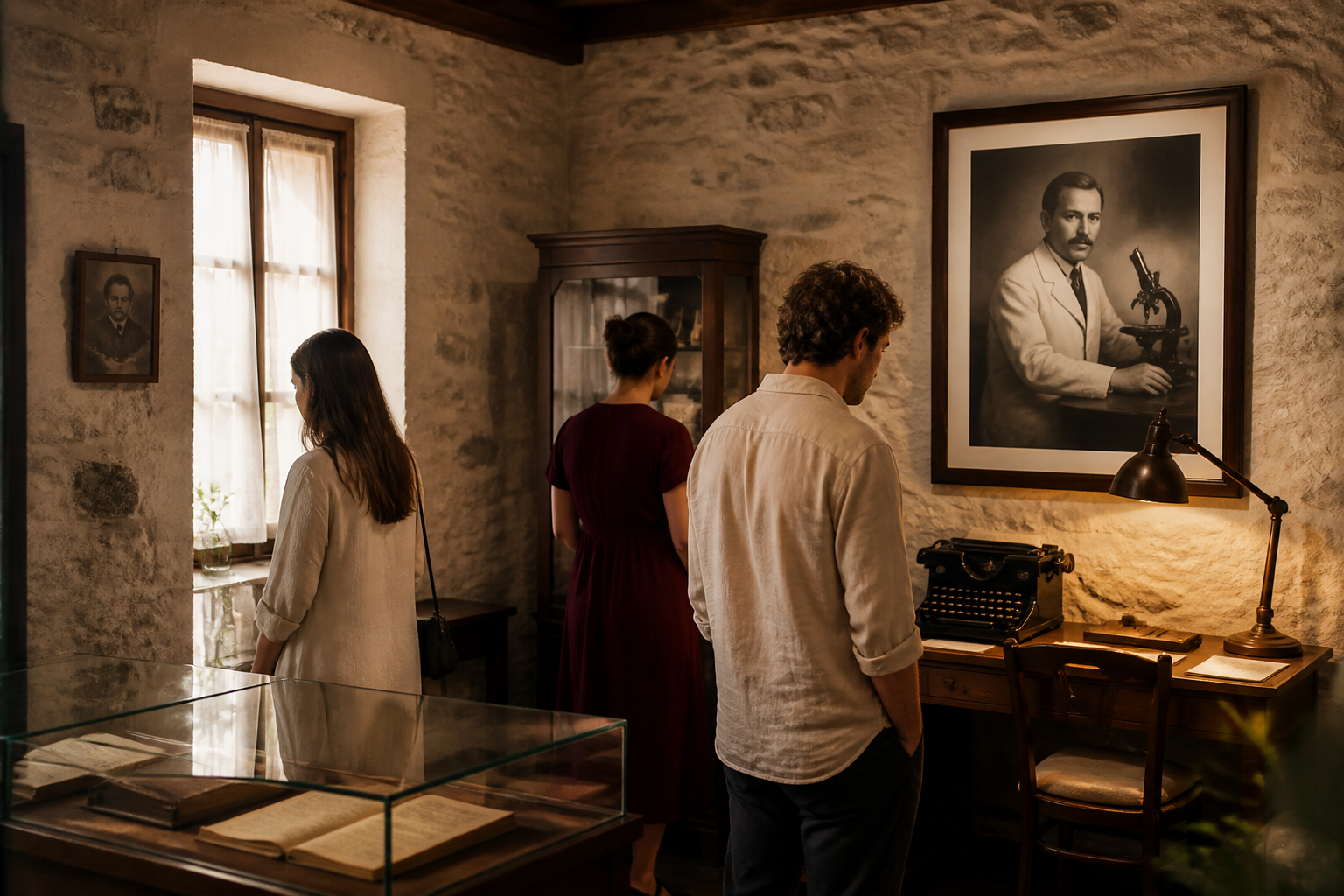
For visitors, the museum offers a rare insight into one of the most patient and dedicated minds in the history of medicine. The rooms where the young Georgios grew up have been recreated, filled with period furniture, family photographs and personal letters. Most remarkable is the so-called "microscopy room". This is an interactive part of the exhibition where visitors can sit down, look through historical lenses and get a sense of the meticulous, almost meditative work required to make the discoveries that would later bear Papanikolaou's name. It was in these moments of quiet observation that the foundation for what is popularly known as the "Pap test" was laid.
The Journey from Evia to the Scientific Breakthroughs
Georgios N. Papanikolaou was born in Kymi in 1883. His father was a local doctor and, for a period, also the town’s mayor, which gave Georgios an early and natural introduction to medicine. After completing his medical studies in Athens, where he also developed a deep interest in music and philosophy, he quickly realised that he wanted to pursue pure biological research rather than a career as a practising physician.
His journey away from Greece first took him to Germany. At the University of Jena, he studied under the famous and influential biologist Ernst Haeckel. Papanikolaou obtained his doctorate in zoology and returned briefly to Greece, but soon found that his homeland's academic and financial resources were far too limited for his scientific visions. In 1913, he made the bold decision to emigrate to the United States.
Travelling with him was his wife, Andromache Mavrogeni, often called Mary in the US. The couple arrived in New York with barely a hundred dollars in their pockets and without speaking the language. The first few years were a hard struggle for survival. Georgios worked periodically as a carpet salesman, and Mary sewed buttons in a department store to make ends meet. But his scientific talent could not be suppressed. Soon, he secured a modest research position at Cornell University, and it was there that his true life's work began.
Partnership and Revolutionary Discoveries
The research that led to what we today call a smear test or Pap test was very much a team effort. Mary Papanikolaou became not only his life partner but also his closest laboratory assistant and, furthermore, his first, most patient test subject. For several years, she allowed her husband to take daily vaginal smears so that he could map the normal cellular changes during a woman's menstrual cycle.
By studying these smears under the microscope, Papanikolaou made a groundbreaking discovery: he realised that he could identify abnormal cancer cells in the samples long before any external symptoms of cervical cancer had appeared. However, when he presented his findings at a scientific conference in 1928, he was met with solid scepticism from the medical establishment. Many believed that such a simple and inexpensive method could not be reliable for diagnosing such a serious illness.
It took another fifteen years of persistent and systematic work before the breakthrough was achieved. In 1943, Papanikolaou, together with the gynaecologist Herbert F. Traut, published the now-classic book Diagnosis of Uterine Cancer by the Vaginal Smear. This publication, filled with detailed scientific illustrations and undeniable statistics, finally convinced the medical profession. The method spread rapidly and marked the beginning of modern preventative cancer screening.
The Emotional Return in 1957
Despite his global success and the hectic life in American research laboratories, Georgios N. Papanikolaou never forgot his roots on Evia. In 1957, after forty-four years in the USA, he returned to Greece for a short and emotional visit. He was received as a national hero.
During the visit, he travelled back to Kymi. For the island's inhabitants, he was not just the world-famous discoverer, but the son of the local doctor who had gone out into the world and changed it. This return to his childhood home, to the scents of thyme and saltwater that he had so often recalled in the sterile laboratories of New York, became one of the most moving moments of his later life. He died five years later, in 1962, in Miami, Florida, just after moving there to head a new cancer institute, but his heart remained deeply rooted in Greek soil.
A Silent Revolution for Women's Health
Before the Pap test was introduced, cervical cancer was one of the most common causes of death among women in the Western world. Thanks to this simple, painless and cost-effective screening method, death rates in countries like Sweden and the rest of the Nordic region have been more than halved since the mid-20th century. It is a silent medical revolution that was fought not with surgical scalpels, but with a small wooden spatula, a glass slide and a microscope.
Visiting Georgios Papanikolaou's childhood home in Kymi today is therefore more than an ordinary historical excursion. It is a reminder of how closely interwoven the rural Greek province and global science are. In the quiet rooms on the cliff above the Aegean Sea, the curiosity was born that would go on to save millions of lives. The museum gives a voice not only to an individual pioneer, but also to all the women – led by Mary Papanikolaou – whose dedication carried his discoveries to the world. It is a place that makes the history of medicine human, intimate and deeply moving.
Facts
Sources & further reading
- Greek News AgendaGeorgios N. Papanikolaou: Honoring the Life and Legacy of a Medical Pioneer
- ekathimerini.comMUSEUM | eKathimerini.com
- en.wikipedia.orgGeorgios Papanikolaou - Wikipedia
- maxmag.orgGeorgios Papanikolaou Biography: The Pioneer Who Saved Millions of Women
Share the article
Translated from Swedish with AI assistance. Read the original.


