
The Last Masters of Spun Silver in Prizren
For generations, the silversmiths of Prizren have shaped thin metal threads into shimmering works of art. But the thousand-year-old craft of filigree is balancing on the brink of extinction. Now, a group of ageing masters is racing against time to pass on their secrets to a new generation – while young designers help this traditional silver meet contemporary design.
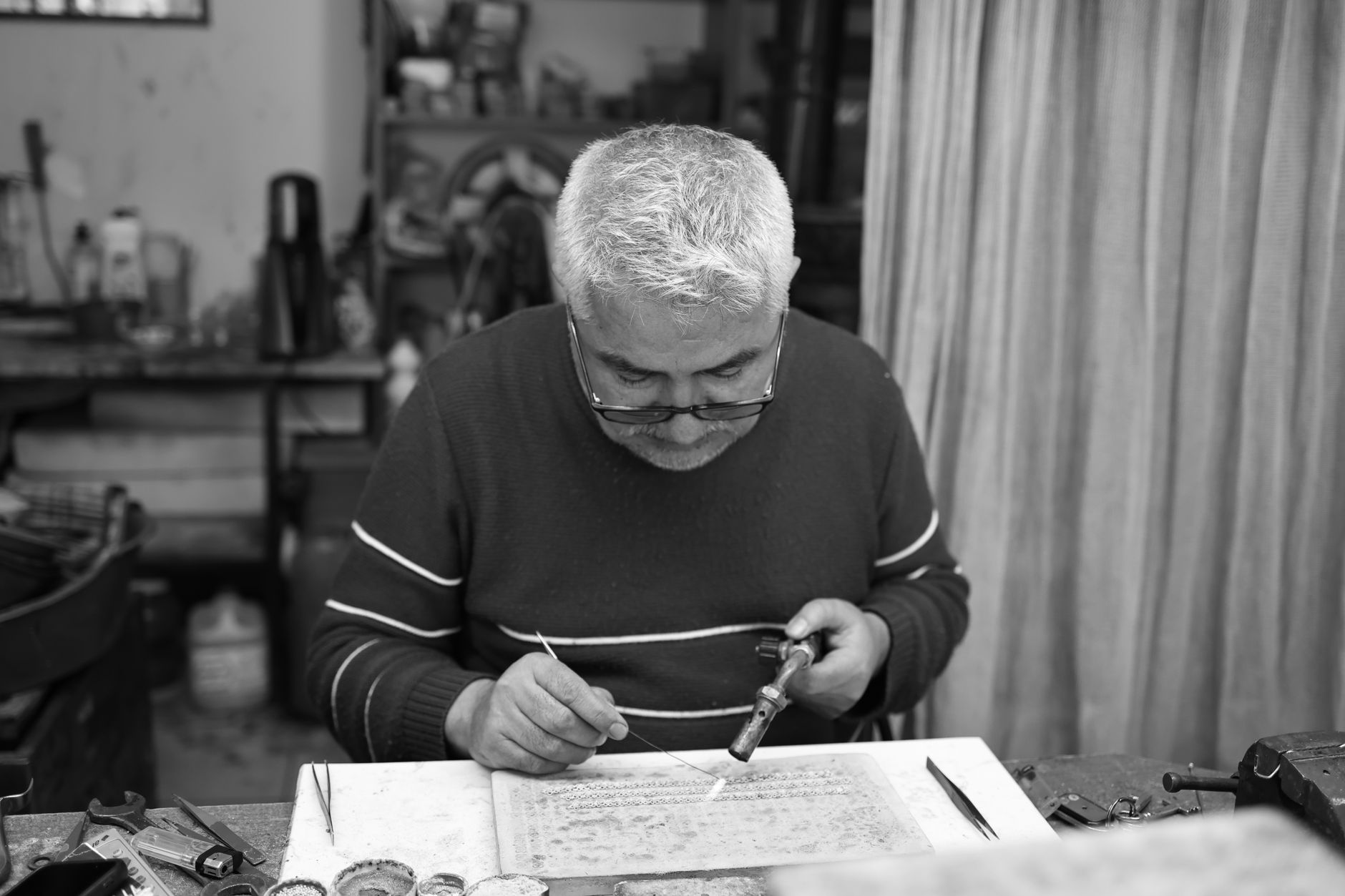
The sound of Prizren is usually the murmur of the Bistrica River, the clatter of heels on the cobblestones of the Ottoman stone bridge, and the calls from the cafés in the old Turkish quarter. But step over the threshold of the unassuming brick building in the Ortakoll district, and the soundscape changes completely. Here, the rhythmic clicking of small pliers, the hissing of gas burners, and an almost meditative calm dominate.
At worn wooden workbenches sit the last true guardians of Kosovo’s most delicate cultural heritage. They belong to the Filigran ShPK cooperative, a craft collective refusing to let a thousand-year-old artistry die out.
Using only a pair of tweezers and pliers, craftsman Bashkim Tejeci manipulates a silver wire barely thicker than a human hair. Without sketches or templates, he bends the metal into complex, organic patterns. It looks like lace, but it is pure metal.
‘It is not about strength, but about patience and sensitivity in your fingertips,’ he explains, without looking up from the piece he has started. ‘It takes years to learn exactly how hard you can bend the wire before it breaks.’
The Last Stronghold: The Filigran ShPK Cooperative
The craft of filigree in Prizren has survived the fall of empires, wars, and modernisation, but today faces its greatest challenge in the form of mass production and a lack of new recruits. Under the Yugoslav system, the state-run filigree factory in Prizren was a regional giant employing over 150 people. But after the war in the late 1990s, the factory was privatised and the business collapsed.
In 2006, a handful of the most experienced masters – including Bashkim Tejeci, Fatime Baruti, Xhafer Lushaj, and Faik Bamja – decided to save what they could. They bought some of the old equipment and founded the Filigran ShPK cooperative.
The working conditions are simple. Small gas canisters, oxidising liquids, and boxes of raw silver crowd the workbenches. Yet despite the worn tools, the precision of the work is absolute. Fatime Baruti, one of the few female masters who has been there since the factory days, speaks of the pride of keeping the production alive.
‘We are not just smiths; we are guardians of history. Every pattern we make bears traces of the people who lived here before us,’ she says.
A Thousand-Year-Old Thread Through History
It is no coincidence that the craft of filigree took root in Prizren. Kosovo's rich supply of silver and precious metals, not least from the mines in Novo Brdo, made the region a metallurgical hub as early as Roman and Byzantine times. During the Middle Ages, Prizren developed into an important trading metropolis where Catholic merchants from Dubrovnik and the Republic of Venice met local craftsmen.
It was in neighbourhoods like Mahalla e Katolikëve (the Catholic quarter) and around the old church of Santa Maria that the silversmiths gathered. Prizren became renowned throughout the Ottoman Empire for its filigree work – from jewellery and hairpins to ornate goblets, incense burners, and even decorative details on swords and gunstocks. The craft was passed down from father to son, like a closely guarded family secret.
During the 20th century, production was industrialised, but the basic principle remained the same. Although machines could press out simple metal plates, there was no machine in the world that could replicate the precision of the human hand when it came to twisting and soldering the microscopic silver threads.
Tradition Meets Contemporary Design
For the craft to survive, however, it is not enough to look backwards. It requires a modern context. One of the key figures working to bridge the gap between the traditional and the contemporary is the designer Krenare Rakovica, daughter of the well-known Prizren master Skender Rakovica.
By combining her father’s deep technical expertise with a minimalist, Scandinavian-influenced design aesthetic, she has created jewellery collections that speak to a completely new, international audience. Instead of the traditionally heavy and overloaded patterns, she declutters the structures, allowing the spun silver to contrast against empty spaces and geometric shapes.
Another important arena for this melting pot is the Autostrada Biennale, Prizren's international contemporary art biennial. Through the biennial, local filigree craftsmen have been invited to collaborate with foreign artists and designers. These encounters have resulted in everything from large-scale sculptures made of silver wire to conceptual installations, proving that this ancient craft has a natural place on the international art scene.
Training a New Generation of Craftsmen
Conscious that time is running out, Filigran ShPK has taken matters into its own hands. Supported by local organisations and international donors, they have launched courses to train young people in the city.
In the workshop on Rruga Garibaldi, several young women and men have taken their places at the workbenches alongside the older masters. This is a deliberate strategy to provide young Kosovans – in a country with historically high youth unemployment – with practical vocational training and an opportunity to earn their own livelihood.
Watching the collaboration between the young generation and the old masters is like witnessing a silent dialogue across generations. Where a young student hesitates with the burner, Faik Bamja or Bashkim Tejeci steps forward quietly, takes the tweezers, and shows with an almost imperceptible movement how the solder should flow.
‘In the beginning, I only made mistakes,’ says one of the younger students. ‘The silver wires melted or ended up crooked. But once you succeed in joining your first pattern together and see how the light reflects in the silver... then you understand why they have spent their whole lives doing this.’
Experiential Tourism and Global Interest
As Kosovo becomes an increasingly popular destination for culture- and nature-oriented travellers, interest in the craft of filigree has also grown beyond the country’s borders. Today, foreign visitors and members of the Kosovan diaspora seek out Prizren, not just to buy finished jewellery, but to experience the craft firsthand.
The workshop in Ortakoll regularly welcomes visitors who want to see the process with their own eyes, and the craftsmen offer short workshops where visitors can try their hand at bending the silver wire. It is a form of slow tourism that not only provides the cooperative with much-needed income but also raises global awareness of the craft's unique value.
As the sun begins to set behind Prizren Fortress, casting a golden glow over the town's red-tiled roofs, the gas burners in the workshop are extinguished one by one. On the workbenches lies the day’s harvest of shimmering silver butterflies, filigree hearts, and modern geometric rings.
Prizren's last masters pack up their tools for the day. They know that the battle to save their craft is far from won. But as long as the silver thread continues to be spun, there is hope that Prizren’s most brilliant tradition will keep binding the past to the future.
Facts
FACTS: FILIGRAN ShPK
- Founded: 2006 by a group of master craftsmen following the privatisation of the old state-run factory in Prizren.
- Purpose: To preserve and develop the traditional craft of filigree in Kosovo and to train the next generation of craftsmen.
- Operations: Manufactures jewellery, utilitarian objects, and custom orders in silver. Organises courses and hosts study visits in their workshop in the Ortakoll district, Prizren.
Sources & further reading
- oxfordobserver.orgKosovo tourism keeps the artful craft of making sliver filigree jewelry and ...
- kosovotwopointzero.comFiligree in Prizren - Kosovo 2.0
- telegrafi.comFiligrani në Prizren synon rilindjen përmes kursit tetëmujor me 26 ...
- kosovotwopointzero.comPrizreni i filigranit - Kosovo 2.0
Share the article
Translated from Swedish with AI assistance. Read the original.


