
The Icon Gallery in Ohrid – learning to read the images
Start with the chair, not the face. At the Icon Gallery in Ohrid, thrones, hands and letters help you understand who the image depicts – and what it wants to say. Just a few works are enough to discover the difference between a portrait and an icon.
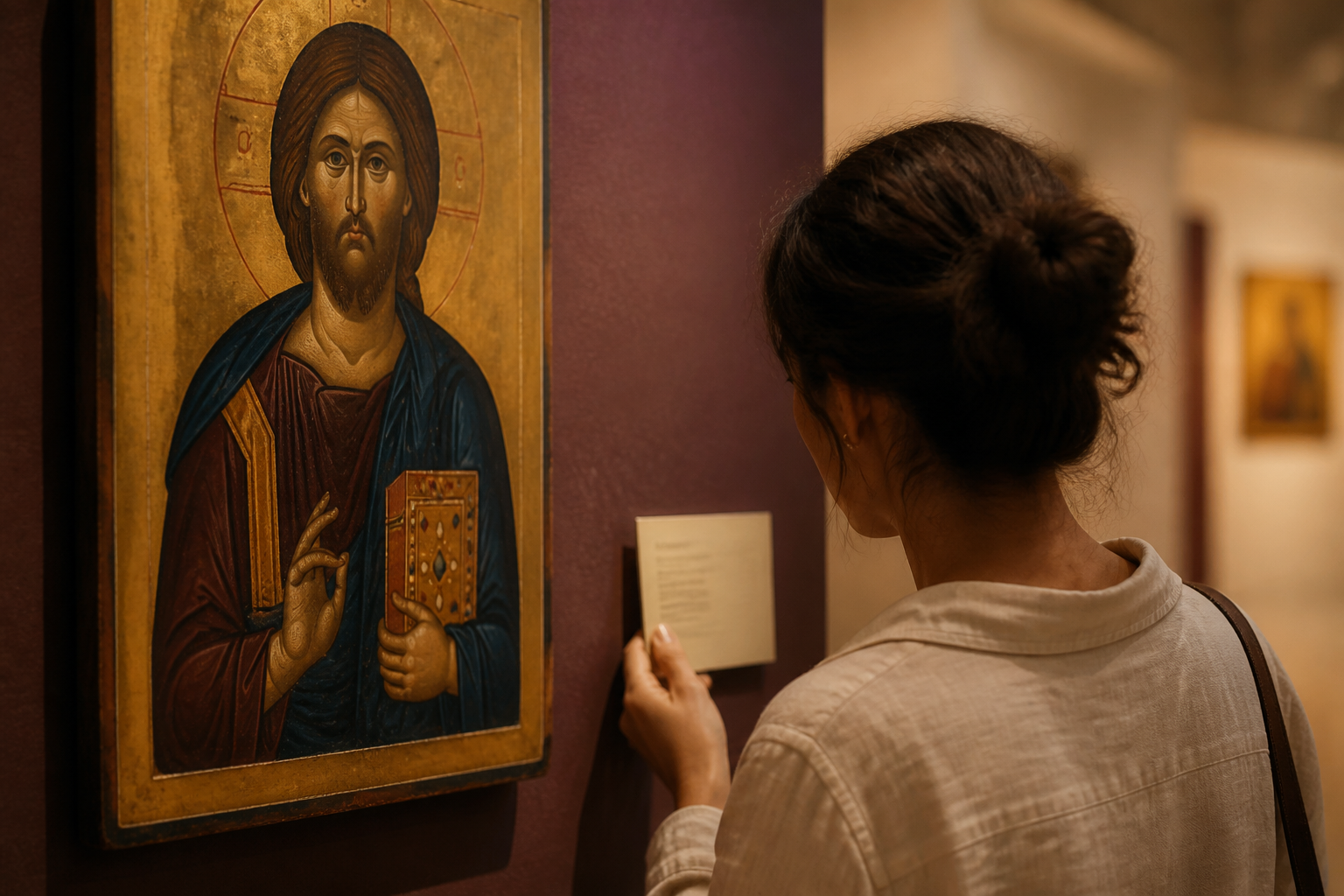
A throne is no neutral piece of furniture. The very title of the mosaic icon "Christ on the Throne" (in Macedonian, Исус Христос на престол) provides a key to the image: here, Christ is depicted as a ruler, not as a human being who has temporarily sat down.
This is a useful starting point for a visit to the Icon Gallery in Ohrid, North Macedonia. You do not need to recognise every saint or know the history of Byzantine art. Begin with what can be discerned, and separate it from the next step: interpretation. A throne is a visible object. That it expresses heavenly authority is a reading within the religious tradition of the image.
The same distinction will help you through the rest of the gallery. How is the body positioned? In which direction is the face turned? What are the hands doing? Icons become more comprehensible when you stop viewing them as portraits with strange proportions and instead begin to examine how they communicate.
Read the body, then the letters
In front of "Christ on the Throne", you can let your gaze travel from the sitting posture to the upper body and on to the face. A frontal, composed figure speaks differently to the viewer than a body twisting into a narrative scene. In Byzantine iconography, a frontal posture can emphasise presence and authority. This does not mean that every stiffness is a symbol, or that the painter lacked the ability to depict movement.
Next, look at the halo. It denotes holiness, but does not identify the person on its own. In images of Christ, a cruciform halo often appears, with a cross inscribed within the ring behind the head. This is a more specific clue than the halo itself.
The letters are also part of the image. On many Byzantine icons of Christ, the abbreviations IC XC appear, taken from the Greek name for Jesus Christ. They serve as identification, not as decorative filler. Spotting such an inscription is rather like finding the image's own nameplate.
The hand requires a little more consideration. A raised hand can be a gesture of blessing; in a narrative scene, a gesture might instead express speech or response. Read it together with the rest of the motif. A book, the attire, and the placement of the figure all help you understand the context. No single detail needs to carry the weight of the entire explanation.
The mosaic has a different surface
Now, shift your attention from the motif to how the image is constructed. In a mosaic, shapes are created from small pieces, tesserae, which can be made of stone or glass, for example. From a distance, the eye pieces them together into a face, a robe and a background. Up close, however, the joints, directions and transitions between colour fields emerge.
Precisely which materials are used in "Christ on the Throne" must be determined with the help of the work's documentation. A shiny surface is not in itself proof of gold, and not everything that glimmers is necessarily the same material. However, it is possible to examine what the surface does: where is the light refracted, where does the colour become even, and where does it dissolve into subtle variations?
Compare this with a painted wooden icon. There, the image is usually built up on a prepared ground on top of the wood. Traditional icon painting often uses tempera, in which pigments are bound with an egg-based medium. This is a general technical description, not a material analysis of every work in Ohrid; the details on the object label apply to the individual icon.
In painting, you can look for fine, light lines that shape a cheek or follow a fold. In a mosaic, you must instead trace how the pieces have been laid to create a corresponding transition. Thus, the same face can be constructed through entirely different means.
Gold is not always a sunset
A golden background is easily read as splendour. In the religious imagery of the icon, it can also signify that the person is not in an ordinary, measurable landscape. The background does not have to represent a wall, a sky or a specific time of day.
This also helps when furniture and buildings look spatially unfamiliar. Byzantine images do not always follow the model of perspective where all lines are arranged for a viewer standing still in front of the motif. Several sides of an object can be made clear simultaneously. Therefore, do not only ask if the space looks realistic, but also what the image chooses to show.
Three guideposts in front of the image
Read it together with the rest of the motif.
This rule applies to hands, objects and faces alike. Start with the whole, then select a detail, and only after that read the label. This way, the museum's explanation becomes an answer to something you have actually noticed, rather than information to be memorised.
Mary, Christ and the saints
The collection's Annunciation motifs present a different kind of reading task to the enthroned Christ. The Annunciation is an event: the Archangel Gabriel delivers the message to Mary. Here, the relationship between the figures is crucial. Follow who turns to whom, and how the hands carry the conversation forward. Wings and name inscriptions help with identification, but the movement between the figures carries the narrative.
In images of the Virgin Mary, you can look for the letters ΜΡ ΘΥ, a Greek abbreviation for Mother of God. They indicate her religious identity. Next, you need to examine what kind of Marian image you are looking at. Is she holding the child? Is she gesturing towards him with her hand? Do their faces meet? The difference between presenting the child and holding him close changes the tone of the image.
For images of saints, facial recognition is an unreliable shortcut. It is better to start with the name inscription and move on to clothing and objects. A bishop's vestments, monastic garb or armour place the person in different roles. A book, a crozier or a weapon can provide further clues, but are not always enough to distinguish one saint from another.
Nor is there a universal colour lexicon that decodes all icons. Red does not always mean the same thing, and a certain garment does not automatically identify a person. The image type, the inscription and the context of the object must work together.
The image had a life before the museum
An icon was not normally created for a neutral wall with a small label beside it. In Orthodox worship, icons meet prayers, candles, incense and reverent touch. Within the theology of the tradition, veneration is directed through the image to the depicted subject, not to the wood or paint as physical materials.
Double-sided icons make the distinction between church object and museum exhibit particularly clear. They have two pictorial sides that need to be understood together. Such icons have been used, among other things, in processions, where different motifs become visible from different directions. However, two painted sides do not prove exactly how a specific object was used. That requires documentation on that particular icon.
In the museum, technique and visual language can be compared under controlled conditions. At the same time, much of the sound, movement and activity of the original context is lost. The Church of Sveta Bogorodica Perivleptos (Holy Mother of God Peribleptos), near the gallery, serves as a reminder that these images belong to a church environment that cannot be reduced to exhibition objects.
Let a few works suffice
The gallery is located in Ohrid’s old town, on Klimentov Univerzitet Street near the Peribleptos Church. Check current opening hours and which works are on display directly with the museum before your visit. Temporary changes to the exhibition need not make the visit less rewarding: the method of looking works even if a particular piece is not available.
Try choosing one image of Christ, one of the Virgin Mary and one narrative scene. Stay until you have discovered something that was not apparent at first glance: an abbreviation, a fingertip, the orientation of the mosaic pieces or the difference between two gazes.
Then return to the first image. The throne is still a throne. But now you can also see how posture, material and signs work together to make it something more than a seat.
Share the article
Translated from Swedish with AI assistance. Read the original.


