
The Heritage of Župa: How Serbia's Ancient National Grape Stepped into the Modern Wine Scene
During decades of state-controlled mass production, it was nearly wiped out. Today, the Serbian grape prokupac is celebrated by sommeliers and wine lovers across Europe. Join us on a journey to Župa, the region where dedicated family producers refused to let history die – and paved the way for one of the Balkans' most exciting wine renaissances.
The sun has just dipped behind the forested peaks that frame the Župa Valley in southern Serbia. In the glass, a wine gleams with a pale ruby-red hue, releasing aromas of sour cherries, wild herbs, dried plums and a subtle hint of white pepper. This is neither a Pinot Noir from Burgundy nor a fine Etna Rosso from the slopes of Sicily. This is prokupac.
Just twenty years ago, the chances of finding a quality wine made from this grape in a restaurant outside Serbia's borders were virtually non-existent. Today, it is served at carefully selected wine bars in Stockholm, Copenhagen and Paris. The story of prokupac is not merely the history of a grape's survival; it is a tale of cultural identity, stubborn resistance to industrial homogenisation and a handful of families who refused to let their heritage be lost.
The Struggle Against Industrial Oblivion
Grape growing in Serbia is no modern phenomenon. The famous Studenica Charter of 1196, written by the Serbian Grand Prince Stefan Nemanja, provides the earliest written evidence that viticulture in the Župa region was strictly regulated and highly valued. For centuries, prokupac was the undisputed king of the region – a grape that yielded robust red wines and the traditional, deeply pink-coloured wine ružica.
But in the mid-20th century, everything changed. Following the end of the Second World War in 1945, the Yugoslav communist authorities initiated a sweeping collectivisation of agriculture. Private vineyards were practically banned from operating on a commercial market, and families were forced to deliver their grapes to massive, state-owned cooperatives. The focus shifted from craftsmanship and quality to extreme yields and cheap table wine.
For the families who had carried the wine culture for generations, this was a personal and economic catastrophe. A telling example is the Spasić family in Župa, whose winemaking history can be traced in written documents back to at least 1856. In 1948, and again for a second time in 1953, the authorities razed the family's eight hectares of historic vineyards to the ground. The private winemaking tradition was administratively erased, but the knowledge and passion survived in secret in family cellars, where they continued to make wine for their own use and for the local community.
The Unique Heritage of Župa: The Bush Vines That Survived
Župa is often called the Champagne of Serbia, not for its bubbles but for its historical status as the country's prime wine centre. It has a unique microclimate, protected from cold winds by the surrounding mountains of Kopaonik, Goč and Jastrebac. Here, the soil has a high proportion of limestone and clay, which gives the prokupac grape its characterful acidity and minerality.
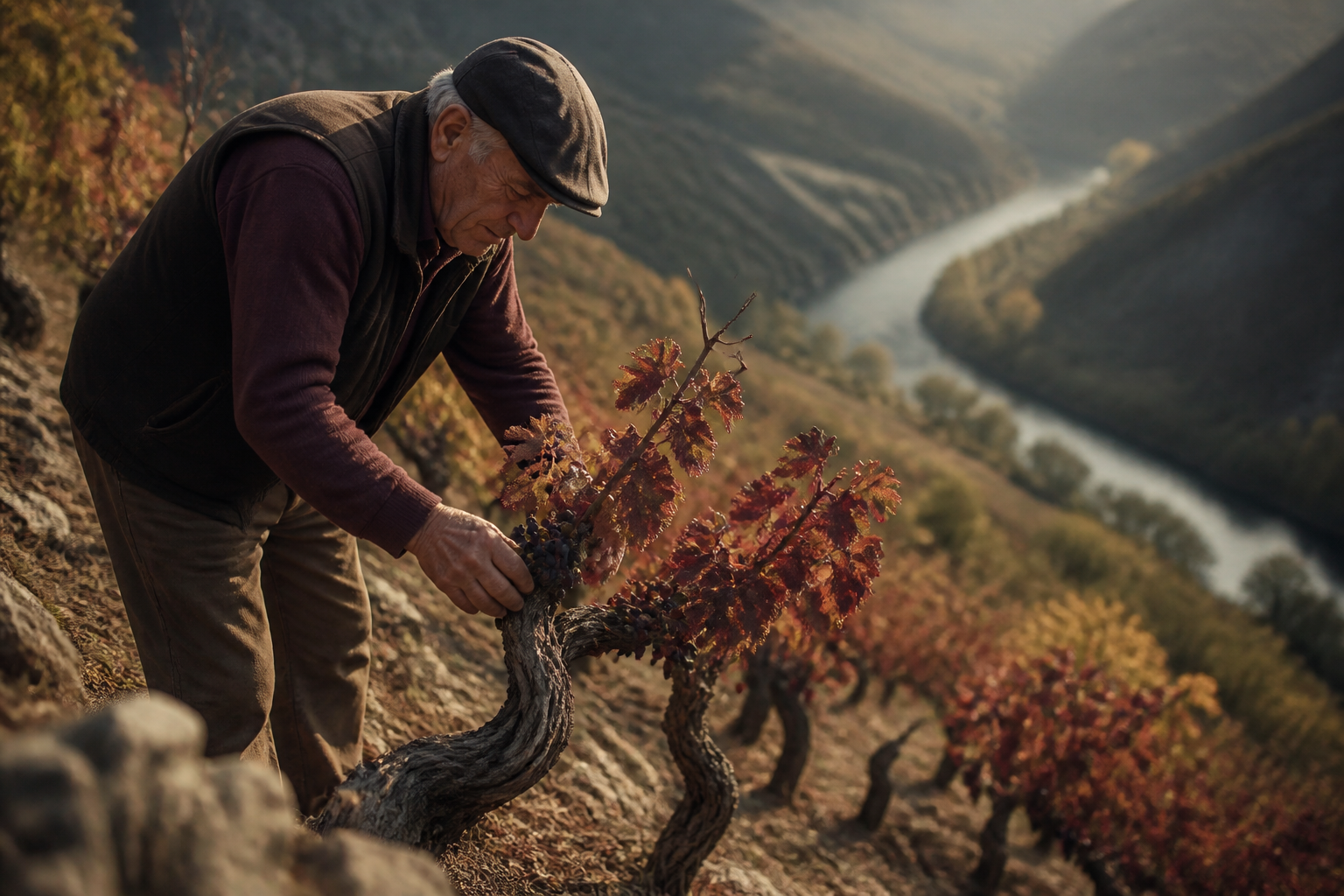
The most unique aspect of viticulture in Župa is the so-called župski kondir. This is a traditional training method where the vines grow as freestanding small bushes close to the ground, entirely without steel wires or modern trellis systems. The gnarled, old vines look like living sculptures in the landscape.
"Working in a traditional bush vineyard requires an enormous amount of manual labour. Every vine must be tended to individually, and machinery is virtually impossible to use. But it is precisely these old vines that yield the concentration and deep character required to make world-class prokupac."
One of the most important pioneers of the grape's modern renaissance was Dragoslav "Gaga" Ivanović. In the 1990s, when the state monopoly finally collapsed and Serbia slowly began to reopen to the outside world, he returned to his family's old cellar in Župa. With an almost religious devotion, he began restoring the family's vineyards and demonstrated that the written-off national grape could produce wines of great complexity and ageing potential. Today, the legacy is carried on by his son, Ivan Ivanović, who continues to refine the craft with minimal intervention in the cellar.
From Resistance Movement to "Prokupac Day"
Despite the pioneers' hard work in the vineyards, the road to recognition was long. During the 1990s and early 2000s, most Serbian consumers preferred international grape varieties such as Cabernet Sauvignon, Merlot and Chardonnay. Local grapes were often viewed with skepticism, as relics of a poorer era.
The turning point came through a guerrilla-like movement led by dedicated wine journalists, sommeliers and bloggers. Igor Luković, editor-in-chief of the wine magazine Vino & Fino, and wine blogger Tomislav Ivanović realised that if Serbian wine was to find a place on the world map, it needed a clear spearhead. And that spearhead was prokupac.
In 2016, they launched the "Prokupac Day" initiative (14 October). What began as a local celebration quickly evolved into a national movement. With central events held at historic locations such as Princess Ljubica's Residence (konak) in Belgrade, they succeeded in fundamentally changing the perception of the grape. Suddenly, young, urban Serbians wanted to drink their own liquid cultural heritage.
Internationally, the ultimate recognition came when the famous glassware manufacturer Riedel, under the leadership of Georg Riedel himself, designed a specific glass tailored to highlight the aromatic profile of the prokupac grape. Having its own glass in Riedel's exclusive range is a status symbol shared by very few grape varieties in the world.
In the Glass: From Historic "ružica" to Modern Elegance
So, what does a modern prokupac taste like? The grape is often described as a chameleon. It has a relatively thin skin, meaning the wines rarely become extremely dark or heavily tannic. Instead, they are characterised by a vibrant acidity, elegant tannins and a distinct berry-forward profile.
In its simplest and most traditional form, it is drunk as ružica – a dark, juicy rosé or a light red wine that is ideally served slightly chilled during hot summer days. But it is in the more ambitious, oak-aged interpretations that the grape's full potential is revealed.
An excellent example of the modern, high-quality style is the Temet winery and their prestige wine Tri Morave Rezerva, where prokupac is allowed to mature in large French oak casks. Here, the grape's natural freshness is combined with an elegant structure, subtle spicy notes and a long, mineral finish. These are wines that speak of their place of origin, entirely free from the heavy, oaky clichés often associated with Southern European red wines.
In the Nordic market, where interest in artisanal, terroir-driven and often low-intervention wines is greater than ever, prokupac has found a natural audience. It fits perfectly into current trends where consumers are moving away from the standardised flavour profiles of the massive wine conglomerates in the West.
The next time you see a bottle of prokupac on a wine list, spare a thought for the old bush vines of the Župa Valley and the families who refused to let their vines die. What you have in your glass is not just a wine – it is a piece of living history that has travelled all the way from medieval monasteries, through the collectivisation of the Cold War, straight into modern European wine culture.
Facts
PROKUPAC – THE SERBIAN HERITAGE
- Type: Red grape variety originating in Serbia, particularly associated with the Župa region.
- Character: Medium-bodied, high acidity, soft tannins. Typical aromas include sour cherries, redcurrants, dried plums, wild herbs and white pepper.
- Serving: Best enjoyed at around 15–17 °C. The lighter styles and the traditional ružica (dark rosé) can advantageously be served slightly cooler.
- Food pairing: Excellent with grilled white meat, game dishes, aged cheeses or traditional Balkan dishes such as sarma and slow-cooked stews.
Sources & further reading
- brandmine.aiSerbia Wine: The Grape No Database Can Benchmark | Brandmine
- thegrapereset.comSerbia
- winewithseth.comProkupac Grape Variety | WineWiki
- winera.comnternational Prokupac Day 2025: Celebrate Serbia's Red
Share the article
Translated from Swedish with AI assistance. Read the original.


