
The Gadime Cave – how to read Kosovo's subterranean marble landscape
A spire from the ceiling, a pillar from the floor, and crystals branching out to the sides. In the Gadime Cave south of Pristina, you can trace how water both hollows out rock and builds new mineral formations. Understanding the difference makes a visit significantly richer.
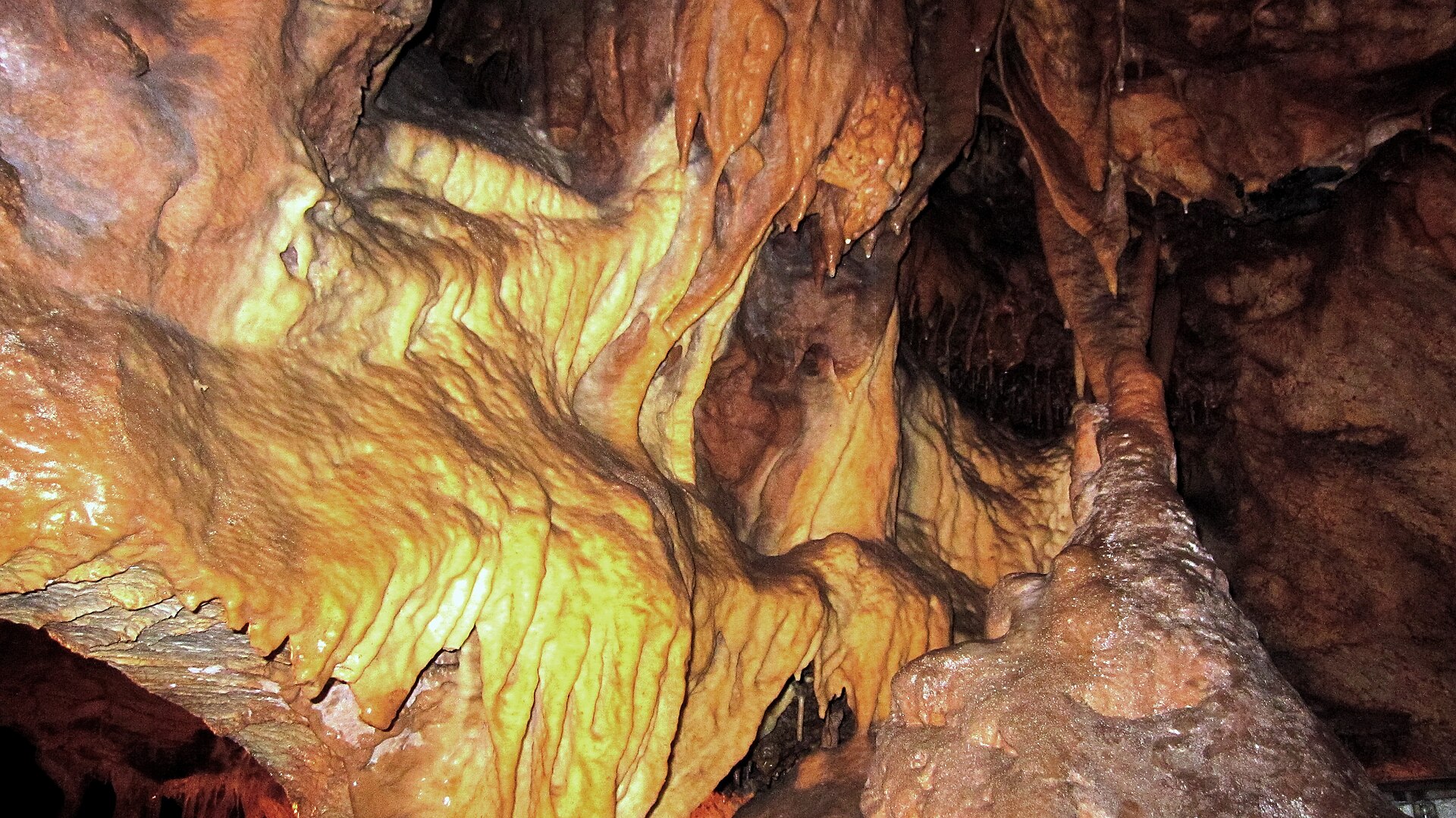
Do not just look for the large formations in the Gadime Cave. The slender outgrowths and branching crystals explain just as much about the site. A drop falling straight down leaves different traces than water finding its way through a hairline crack. Here, both stories are present, written in mineral.
The cave is located at Gadime e Ulët in the municipality of Lipjan, south of Pristina. In Albanian, it is called Shpella e Mermerit, the marble cave. The name describes the bedrock itself, but not everything visible inside the chambers. The marble walls and the formations that have grown on them were created through distinct processes.
This is a useful distinction to take with you underground. Gadime then becomes more than just a sequence of strange shapes to photograph; it becomes a landscape that you can actually read.
First marble, then cave
Marble begins as a carbonate-rich rock, usually limestone, which is transformed under heat and pressure. The minerals recrystallise, giving the rock a new structure. It is therefore not the drips inside the cave that created the marble. That belongs to an earlier stage in the mountain's history.
The cavities arise through a different process. Rainwater absorbs carbon dioxide from the air and soil, becoming weakly acidic. As the water seeps down through cracks, it can dissolve carbonate minerals in the bedrock. The cracks widen, water pathways change, and cavities develop. This type of dissolution is a fundamental process behind karst landscapes, both above and below ground.
Then, the process can be partially reversed. Water that has dissolved minerals reaches an open cave chamber and releases carbon dioxide into the air. This allows calcium carbonate to precipitate once more, now as a coating or a growing formation.
In other words, the marble is the foundation. The cave is the space that the water has opened. The dripstones are later additions. To assign all of this a single age would obscure the differences between the processes. Nor is an exact date needed to see what the water has done.
Ceiling spires and floor formations
Stalactites hang from the ceiling. Where mineral-rich water reaches a crack and forms drops, small amounts of calcium carbonate can remain behind. Through repeated precipitation, the formation grows downwards. Some stalactites begin as thin, hollow tubes, where the water is channelled through the middle.
Stalagmites, on the other hand, grow up from the floor. Drops falling from the ceiling can still contain dissolved minerals. When they strike the ground and the water spreads out, new material is left behind. This is why a stalagmite is often blunter than the stalactite hanging above it. If they eventually meet, a continuous column is formed.
In Gadime, the interplay between ceiling and floor is a good starting point for your visit. Look for the dripstones, compare their shapes, and follow their direction with your gaze. A point above a formation on the floor suggests a possible connection. But not all formations need to be active anymore: water may have changed its path inside the rock.
Where water flows along a surface instead of falling freely, the deposits are different. Then, the minerals can settle in layers, folds, or broader coatings. It is the same basic chemistry, but the path of the water flow changes the result.
Avoid, however, reading size as a simple clock. Growth is influenced by, among other things, water supply, mineral content, and conditions in the cave air. A thick formation cannot simply be assumed to be older than a thin one.
Aragonite does not only grow downwards
Gadime's aragonite crystals present a different design language than the distinct dripstones. Aragonite and calcite both consist of calcium carbonate, but the atoms are arranged differently. This difference affects how the crystals are built up. Aragonite can form needles, clusters, and branching outgrowths.
The Aragonite Gallery, Galeria e Aragoniteve, is therefore a name to remember for your visit. Ask the guide which crystal sections can be seen along the open path. Here, it is the details that deserve attention: thin points, branches, and directions that do not follow the vertical line between ceiling and floor.
Such shapes are sometimes described as if they defied gravity. They do not. A crystal grows by material being added to its surfaces; it does not need to be built by a drop falling downwards. Water can be transported through very small channels by capillary action or exist as a thin film over a surface. Along with the crystal structure and local conditions, this affects where new mineral ends up.
This does not mean that every sideways-growing formation has the exact same explanation. The point is to distinguish between a hanging drop and crystal growth. Gravity is present in both cases, but it does not determine the shape alone.
Names help the eye – but they are not geology
Romeo and Juliet, the Garden of Love, and Skanderbeg's Beard are among Gadime's named formations and settings. Such names give the visitor reference points among surfaces that might otherwise easily blur together. They are associations, not mineralogical categories.
Feel free to use them as the start of a conversation with your guide. What is it that has given the formation its name? Has the water dripped, flowed over a surface, or arrived through small cracks? Does what you see consist of the rock itself or of later precipitations?
Also ask which of the named sections are included in today's tour. A name in a presentation of the cave is not in itself an indication of how the visitor path is routed or what is accessible during each visit.
From Pristina to Gadime
From Pristina, Gadime lies to the south, in Lipjan municipality. Use Gadime e Ulët and Shpella e Mermerit when searching for the entrance or when arranging the journey with a driver. The village, the municipality, and the cave are not the same destination.
A car or pre-booked transport makes it possible to plan the journey right to the entrance. If you want to travel by public transport, you will need to check both the connection to Gadime and how you get further to the cave. Plan your return journey at the same time, rather than assuming transport will be available at the exit.
Confirm opening hours, ticket prices, and how the guiding works before departure. Ask if tours need to be booked, which languages are offered, and how long the visit takes. No fixed times or prices are stated here as up-to-date information is lacking in the source material.
For wheelchair users or those who find stairs difficult, more precise answers are needed than simply that the cave is open to visitors. Ask for information about level differences, steps, the width of the passages, the ground surface, and the possibility of turning back along the path. Shoes with good grip and an extra layer of clothing are wise for a cave environment, where surfaces can be damp and the air cool.
Look closely without touching
Observe the formations without touching them. Delicate crystals are fragile, and touching them can leave dirt and grease on the mineral surfaces. Follow the designated path and the guide's instructions, even when an interesting detail beckons just off to the side.
Any stories about ringing stalactites are not an invitation to test the sound. Never strike the formations. Ask on-site about the rules for photography, flash, and other equipment; a visitor photo must not require anyone to step off the path or touch the rock.
The beauty of Gadime is that understanding does not diminish the wonder. Quite the contrary. When the difference between the marble wall, dripstone, and aragonite becomes clear, there is more to discover in the same frame: the rock that was there, the water that opened it, and the minerals that were built up thereafter.
Facts
Country: Kosovo Location: Gadime e Ulët, municipality of Lipjan, south of Pristina Albanian name: Shpella e Mermerit Key features: Marble bedrock, stalactites, stalagmites, and aragonite crystals
Sources & further reading
- en.wikipedia.orgMarble Cave, Kosovo - Wikipedia
- sq.wikipedia.orgShpella e Gadimës - Wikipedia
- handwiki.orgEarth:Marble Cave, Kosovo - HandWiki
- evropaelire.orgRritja e gurëve: Brenda shpellës mijëravjeçare
Share the article
Translated from Swedish with AI assistance. Read the original.


