
The Flavours That Shaped Empires: A Weekend in Thessaloniki’s Historic Food Districts
Greece’s second-largest city has a culinary heritage unlike anywhere else in the country. As the country’s first UNESCO-designated gastronomic city, Thessaloniki has turned its past of Ottoman, Sephardic and Pontic influences into one of Europe’s most exciting food scenes. Join us for a weekend of fragrant market streets, historic bakeries and hidden courtyards.
The eye sweeps across the Thermaic Gulf, where Thessaloniki residents stroll at an unhurried pace along the broad seafront promenade, past the iconic White Tower. But the city’s true soul is not best revealed by the sea. To understand Thessaloniki, you have to head inland, to the neighbourhoods where the aromas of freshly ground coffee, grilled meat and sweet spices have hung in the air for centuries.
Under Roman, Byzantine and Ottoman rule, Thessaloniki was one of the most important trading cities in the Balkans. When it also became a refuge for tens of thousands of Sephardic Jews expelled from Spain in the late 15th century, the foundations were laid for a cultural melting pot. Despite the catastrophic city fire of 1917 and the dramatic population exchanges of the 1920s, food has remained the thread linking the past with the life of today’s vibrant university city. Here, East meets West on the plate, far from the standard menus of Greece’s package-holiday resorts.
A sacred start to the morning: Bougatsa at historic bakeries
There is no more quintessential way to wake up in Thessaloniki than to the sound of crisp filo pastry cracking under a sharp knife. Bougatsa—the thin filled pastry that originally came to the region with refugees from Asia Minor—is the city’s unofficial national dish.
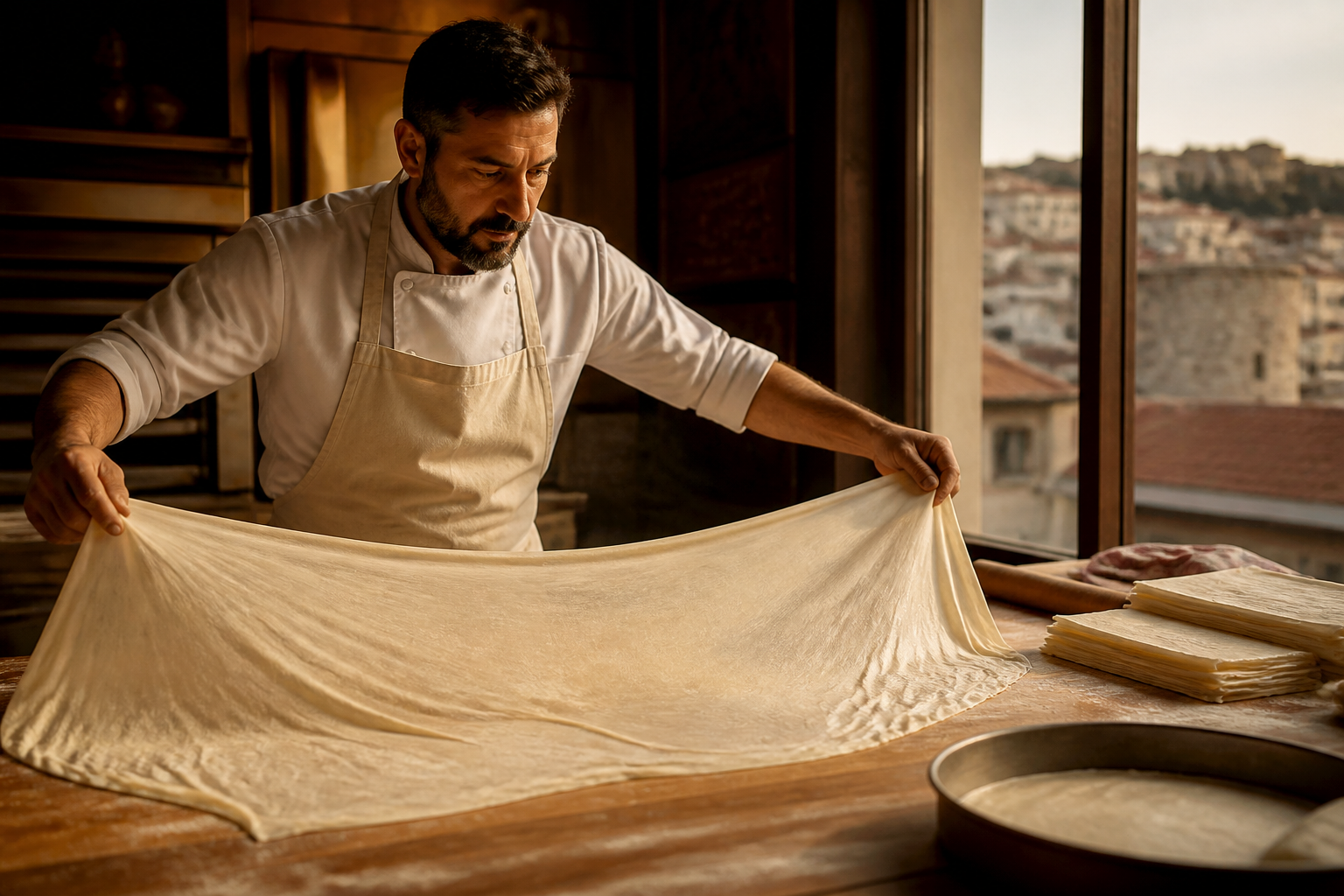
At the historic family bakery Bougatsa Bantis, in the western part of the city, master baker Philippos Bantis keeps the tradition alive. This is no industrial production. The dough is tossed, twirled and stretched by hand until it is so thin you can read a newspaper through it. The classic version is filled with a smooth, warm semolina custard and generously dusted with icing sugar and cinnamon, but the savoury versions with local feta or spiced minced beef are just as popular with the locals who queue outside every morning.
Eating bougatsa here is a chance to experience a living craft. The Ottoman heritage is evident in the technique, but in Bantis’s hands it makes for a thoroughly contemporary breakfast that sets you up for a full day of exploring.
Market contrasts: Kapani and Modiano
The heart of Thessaloniki’s food scene beats strongest in the central market district. The city’s two largest markets stand side by side, but represent two very different eras and atmospheres.
Kapani (also known as the Vlali Market) is the older and more rugged of the two. It is a maze of narrow lanes beneath open-roofed structures, where the traders’ calls echo off the walls. Slaughtered lambs hang in rows, heaps of freshly caught octopus rest on glistening beds of ice, and barrels of olives in every size stand lined up in long rows. It is sensual, chaotic and wonderfully unvarnished. In the midst of it all is the old Ottoman Bezesteni market, whose six domes now house fabric and jewellery shops, but still recall the city’s days as one of the Ottoman Empire’s most important commercial hubs.
Just a stone’s throw away, Modiano Market offers a glimpse of Thessaloniki’s future. Built in the 1920s by the prominent Jewish-Italian architect Eli Modiano, this magnificent glass-roofed basilica has recently undergone extensive renovation. Today, Modiano is an elegant food hall where traditional delicatessens sit alongside modern street-food stalls, wine bars and artisan bakeries. Here you can pick up local specialities from Ragian, a shop specialising in Pontic cuisine—the food of Greeks who were forced to flee the Black Sea region in the 1920s, bringing with them their distinctive dairy traditions and handmade pasta.
A long lunch in Ano Poli: Ottoman heritage and meze culture
As morning gives way to afternoon, it is time to head uphill. Ano Poli (the Upper Town) is the only neighbourhood that largely escaped the great fire of 1917. Here the streets narrow into steep, cobbled lanes lined with traditional Ottoman wooden houses with overhanging upper floors.
At the top, in the shadow of the old Byzantine city walls, stands Ouzeri Tsinari. This iconic taverna has occupied the same corner since the late 19th century, when it opened as a Turkish café. Today it is run in a spirit that celebrates local meze culture, where dishes are made for sharing over conversations that take their time.
At the blue-painted wooden tables, dishes are served that reflect the city’s multicultural past: grilled sardines with sea salt, spiced minced-beef patties (soutzoukakia) flavoured with cumin, and smoked aubergine salad. Here, people drink tsipouro—the local grape spirit—served in small glass carafes with ice. This is a place where history does not feel like a museum, but part of everyday culinary life.
The sweet legacy of empire: Sephardic and Ottoman desserts
Thessaloniki’s sweet tooth quickly becomes clear to anyone wandering along the grand boulevard of Tsimiski. The city’s confectionery tradition is deeply rooted in the meeting of the Ottoman court’s refined sugarcraft and Sephardic Jewish traditions.
In the classic pastry shops, you are greeted by the scents of rosewater, mastic and caramelised sugar. You will find desserts such as kazan dibi—a caramelised milk pudding with roots in the Ottoman palace kitchens—and trigona panoramatos, crisp filo triangles filled with creamy vanilla custard. The Sephardic heritage lives on, too, in the use of dried fruit, nuts and honey in the city’s bakeries, a reminder of the time when Thessaloniki’s Jewish population formed the cultural and economic backbone of the city.
The energy of the evening: Ladadika and Bit Bazaar
As darkness falls over the city, its energy changes. Thessaloniki’s enormous student population—it is home to Greece’s largest university—spills out onto the streets. For anyone wanting to experience the city’s modern nightlife, Ladadika is the obvious destination.
Ladadika was once the port-side district where oil merchants kept their warehouses (the name comes from the Greek word for oil, ladi). Today, its beautifully restored brick buildings are filled with tavernas, cocktail bars and restaurants. Traditional live music (rebetiko) mingles with modern bass in a soundscape that continues into the small hours.
For a more alternative and intimate experience, visit Bit Bazaar, a hidden courtyard north of the centre that serves as an antiques market during the day. When the shops close, the square turns into a bustling meeting place for students. Around the simple metal tables, people drink inexpensive local wine and eat simple mezedes beneath the stars. It is in moments like these, in the contrast between historic heritage and youthful creative energy, that Thessaloniki shows why it has become the gastronomic capital of the Balkans.
Facts
MOST GUIDE: Three culinary landmarks in Thessaloniki
- Bougatsa Bantis (Panagias Faneromenis 33): A family-run bakery where you can experience authentic, handmade bougatsa. Philippos Bantis carries on the Ottoman technique with a sure touch.
- Ouzeri Tsinari (Alexandras Papadopoulou 72, Ano Poli): One of the city’s oldest tavernas. Perfect for a leisurely lunch of classic mezedes and tsipouro in historic Ottoman surroundings.
- Ragian (Modiano Market): A delicatessen specialising in preserving and selling Pontic specialities, including distinctive cheeses and handmade pasta.
Sources & further reading
- heatheronhertravels.comThe best food in Thessaloniki Greece - where and what to eat
- nationalgeographic.comWhy you should visit Thessaloniki, Greece's 'city of gastronomy'
- yourmediterraneanstyle.comThessaloniki UNESCO Gastronomy: 2300 Years of Flavor
- culinarybackstreets.comShopping Through Thessaloniki's Markets and Food History
Share the article
Translated from Swedish with AI assistance. Read the original.


