
The city run from a café table – how espresso holds Tirana together
Albania has more cafés per capita than doctors and police officers combined. In the capital, Tirana, a small cup of macchiato is much more than a morning habit – it is the city’s social infrastructure, its unofficial job centre and a safety net in an uncertain economy.
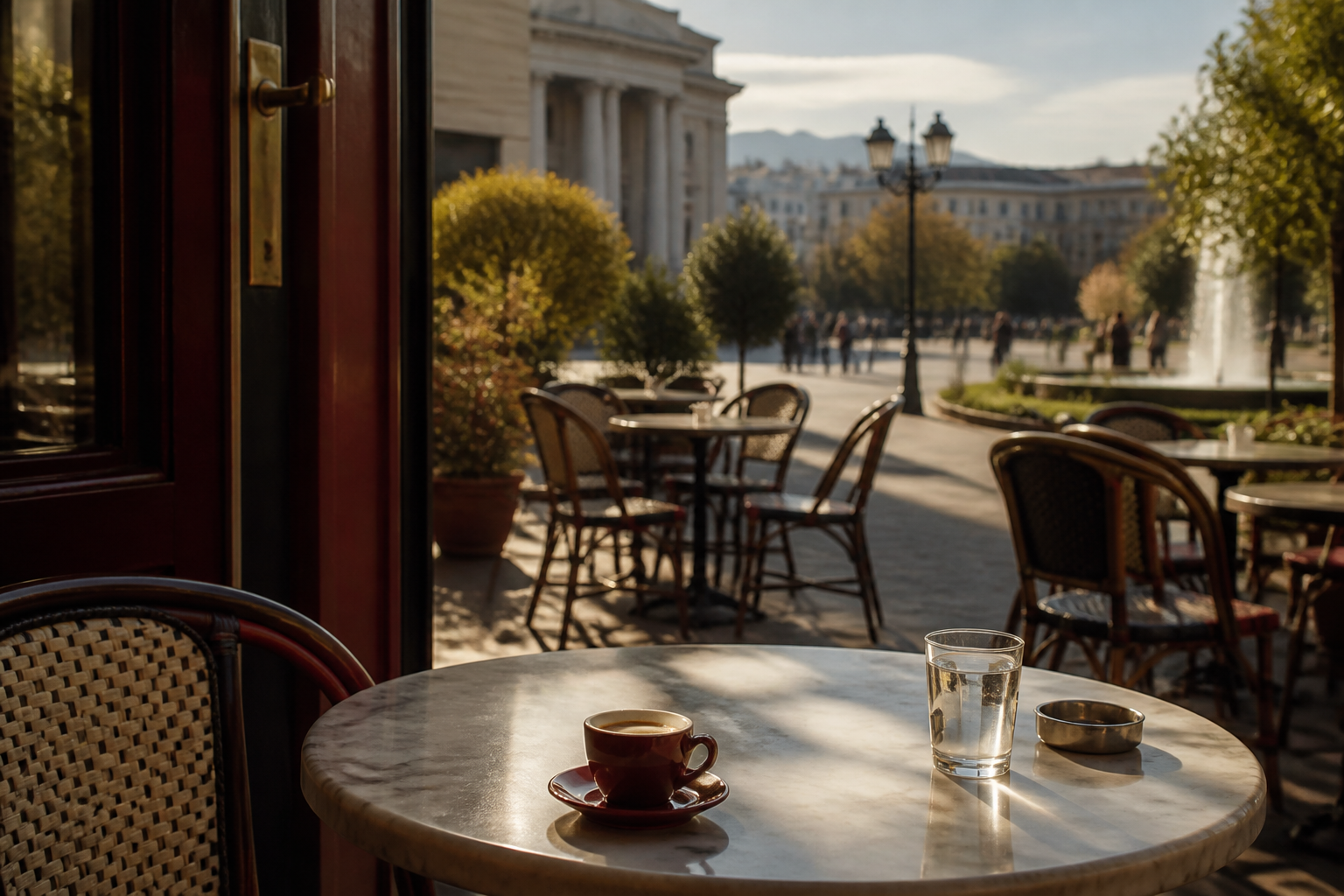
The morning sun has just crested Mount Dajti, casting its first long shadows across Myslym Shyri, one of Tirana’s busiest shopping streets. The sound that fills the early morning is neither car engines nor trams, but the rhythmic metallic clatter of portafilters being knocked against knock boxes and milk frothers hissing in dozens of bars along the pavement.
Pensioners are already sitting with the day’s newspaper, young men are deep in conversation over their phones, and businesspeople are gesticulating animatedly. In front of them are small glasses of water and even smaller cups of coffee. It is a scene that will be repeated in almost identical form at thousands of addresses across the Albanian capital over the next fifteen hours.
In the Nordic countries, we often see fika as a pleasant break in the day, a set-length pause with a cardamom bun or a quick espresso on the way to the next meeting. In Tirana, coffee is not a break from life – it is life itself. This is where business deals are struck, jobs are found, family conflicts resolved and the political situation analysed down to the last detail.
A figure that challenges the world’s top contenders
Calling Albania a coffee-loving country is an understatement. According to the national tax authority, there are more than 15,300 active bar-café businesses in the country. With a population of just under 2.7 million, that works out at roughly one café for every 154 residents. This density puts Albania at the very top globally, in constant competition with countries such as Spain for the title of the world’s most café-dense country.
To put that figure in local perspective: Albania has significantly more cafés than police officers (just over 11,300), and more than it has licensed doctors (around 6,000). In the past three years alone, more than 4,600 new cafés have been registered in the country, with Tirana leading the expansion with more than 600 new establishments over the same period.
This huge concentration is not just the result of a deeply rooted social need; it is very much an economic reality. The Albanian labour market is still developing and is characterised by a high level of informal economic activity and limited opportunities for traditional career paths. Opening a small bar requires relatively little capital and no formal qualifications. It has become the ultimate form of self-employment for thousands of families.
A generous tax system also drives this development. Small businesses with annual turnover of up to 14 million lekë (equivalent to around 135,000 euros) pay no income tax. For a family wanting to start its own business, a small espresso bar is by far the easiest route to earning an income, even though competition is fierce and a large proportion are forced to close within their first year.
The extended living room
In Tirana, the café functions as a kind of extended living room. Many of the city’s apartments are small and often house several generations under one roof. Inviting friends home is less common than in the Nordic countries – instead, people meet at their regular place on the corner.
This is also where informal work gets done. For the city’s many young freelancers, programmers and students, cafés are free offices. There is no unwritten rule that you have to order something new every thirty minutes to keep your seat. A single macchiato, which in Tirana usually costs between 60 and 80 lekë (between six and eight Swedish kronor), gives you the right to use a table and free Wi-Fi for a whole morning. The staff won’t give you a disapproving look; they understand the rules of the game.
This creates a very different social dynamic from the Nordic one. There is no demand for efficiency at Albanian café tables. To “drink coffee” – me pi kafe – is a verb that signals that you are available for conversation, that you are part of the community. Sitting alone and simply watching passers-by is an entirely respectable pastime that can go on for hours.
From Blloku’s espresso bars to the neighbourhood’s raki
Tirana’s cityscape is a study in contrasts, and this is clearly reflected in its coffee culture. In the Blloku district – which, under Enver Hoxha’s communist dictatorship, was a completely sealed-off area reserved exclusively for the party elite – the city’s trendiest, most design-conscious espresso bars are now found. The interiors are minimalist, the coffee is brewed from carefully selected beans, and the customers are well-dressed young Albanians and international entrepreneurs. It is a fascinating historical irony that an area once synonymous with the regime’s total control and isolation is now the epicentre of a globalised, outward-looking lifestyle.
But you need only go a few blocks away, to the more traditional residential neighbourhoods, to encounter a completely different world. Here, simpler local cafés with plastic chairs on the pavement predominate. At these places, traditional kafe turke (Turkish coffee) is still the order of the day, often brewed in a small copper pot, a xhezve, to create a thick, rich foam, kajmak, on top.
Here sit the older gentlemen, often with a small glass of raki beside their coffee cup, even early in the morning. It is a slower world, where conversations turn to family, football and how the city has changed since the regime fell in the early 1990s.
The rhythm of the street
When evening comes to Tirana, the cafés change character, but they never empty. The espresso machines keep working well into the night. Many Albanians have their last macchiato at nine or ten in the evening without seeming particularly concerned about a good night’s sleep.
To understand Tirana’s coffee culture is to understand the city’s soul. It speaks to a tremendous capacity to adapt and to create social bonds even in difficult economic circumstances. Coffee is the lubricant that keeps an otherwise rather chaotic, fast-growing city functioning as a close-knit, human community. It is a lesson in slowing down and being present with others that the constantly connected, time-pressured Nordic visitor can learn a great deal from – one sip at a time.
Facts
The café economy in figures
- Number of active cafés in Albania: More than 15,300.
- Café density: Around 1 café per 154 residents (among the highest figures in the world).
- Tax benefit: Small businesses with turnover below 14 million lekë (approx. 135,000 EUR) pay 0% income tax.
- Price of a coffee: An espresso or macchiato in Tirana usually costs between 60 and 80 lekë (approx. 6–8 SEK).
Sources & further reading
- albaniantimes.alCoffee culture booms in Albania as bar-cafés outnumber ...
- albanianregistry.orgAlbanian Coffee Tradition: A Diaspora Cultural Guide | NAR
- albania-spirit.comAlbanian Coffee Culture: Why Albania Is One of
- lemon8-app.comDiscover Why Albania Has One of the Highest Coffee ...
Share the article
Translated from Swedish with AI assistance. Read the original.


