
The Black Stallion of the Balkans – how the national grape Vranec made its mark on the Swedish wine range
It has been called the black stallion of the Balkans – a grape so dark and powerful that it almost stains the glass purple. But beneath the surface of the national grape, Vranec, a quiet, elegant revolution is underway. Historically associated with heavy bulk wines, ambitious producers in North Macedonia and Montenegro have now learned to tame its wild temperament. Now, these modern, oak-aged wines are finding their way all the way to Swedish dinner tables.
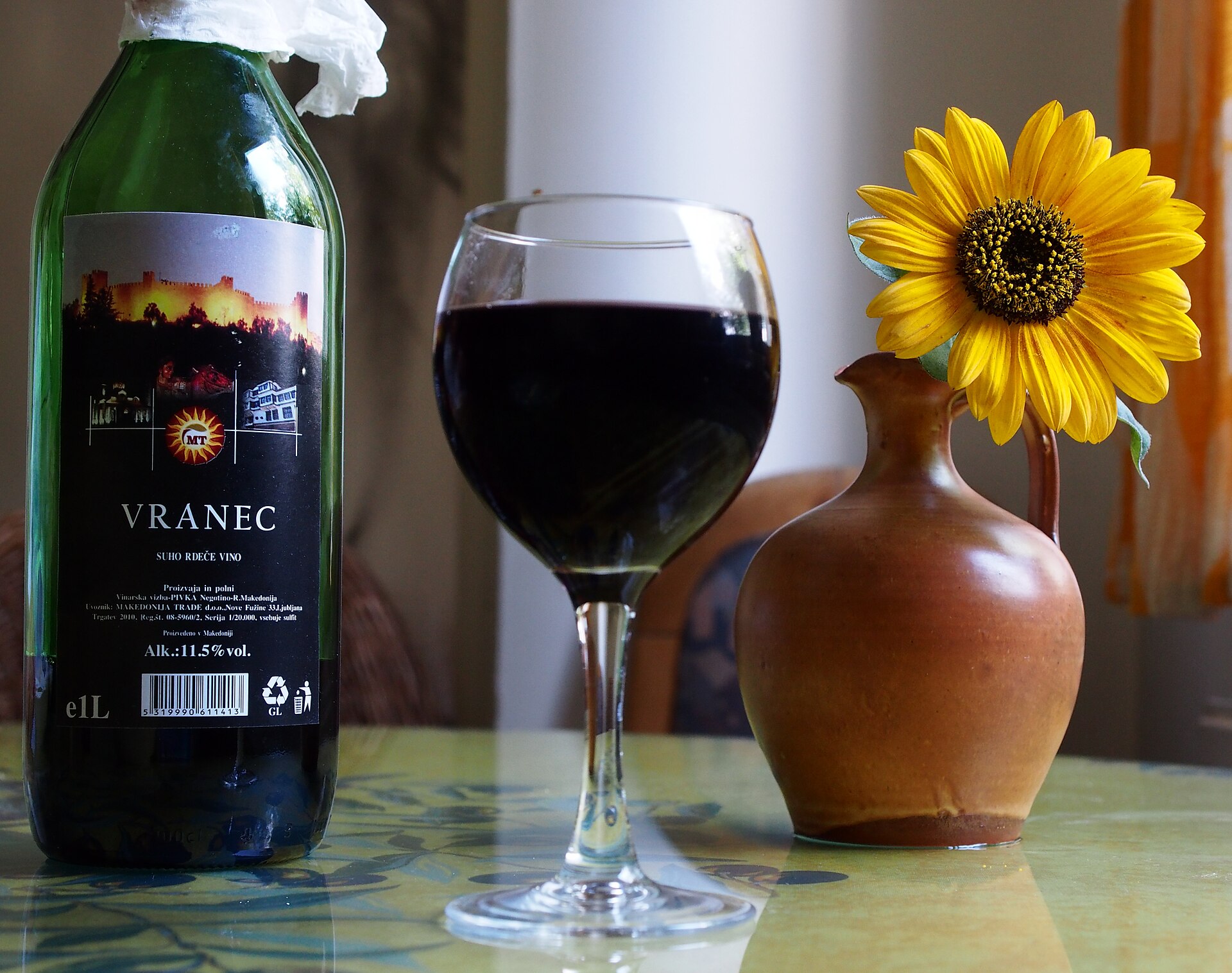
Balkans svarta hingst tämjer sin vilda kraft – så erövrar nationaldruvan vranec vinvärlden I hjärtat av Skopje, på den stimmiga vinbaren Dropstop Gastrobar, fylls glasen med en vätska så djup i färgen dat den gränsar till ogenomtränglig. För en besökare som är ovan vid regionens viner skulle doften av mörka körsbär, tobak och sötlakrits lätt kunna förväxlas med en exklusiv syrah från norra Rhône eller en fyllig cabernet sauvignon från Napa Valley. Men flaskan på bardisken berättar en annan historia. På etiketten står det skrivet med stolthet: vranec.
Denna druva, vars namn betyder just "svart hingst" eller "korp", har länge varit ryggraden i sydöstra Europas vinproduktion. Länge betraktades den som en lokal arbetshäst – använd för att ge färg, alkohol och strävhet till enklare blandviner. Men under det senaste decenniet har en ny generation vinmakare visat dat vranec, när den behandlas med respekt och precision, kan prestera på absolut internationell toppnivå. Nu är denna djupt personliga druva redo att utmana mer etablerade sorter och ta sin plats på den internationella scenen.
In the heart of Skopje, at the bustling wine bar Dropstop Gastrobar, glasses are filled with a liquid so deep in colour that it borders on impenetrable. For a visitor unfamiliar with the region's wines, the aromas of dark cherries, tobacco and sweet liquorice could easily be mistaken for an exclusive Syrah from the northern Rhône or a full-bodied Cabernet Sauvignon from the Napa Valley. But the bottle on the bar counter tells a different story. On the label, it is written with pride: Vranec.
This grape, whose name translates literally as "black stallion" or "raven", has long been the backbone of Southeast European wine production. For a long time, it was regarded as a local workhorse – used to add colour, alcohol and astringency to simpler blends. But over the last decade, a new generation of winemakers has shown that Vranec, when treated with respect and precision, can perform at the absolute highest international level. Now, this deeply personal grape is ready to challenge more established varieties and take its place on the international stage.
The unique character of the national grape: From wild power to elegant structure
To understand Vranec is to understand the climate and terrain of the southern Balkans. The grape is genetically related to the southern Italian Primitivo and thrives best in dry, sunny environments where its thick, pigment-rich skins can develop fully. The result is a wine with an extremely high concentration of tannins and natural colour.
Historically, this often led to rustic, sometimes aggressively astringent wines that required years of ageing to become drinkable. The problem rarely lay with the grape itself, but rather with cellar management. With high yields and uncontrolled fermentation, the result was heavy and unbalanced.
Today, the picture has changed radically. Modern producers have realised that the secret to a successful Vranec lies in balancing its natural power with freshness. Indeed, the grape possesses a unique quality: despite high sugar levels and high alcohol, it retains a surprisingly high acidity. It is this acidity that saves modern wines from feeling jammy or flat, instead giving them a supporting structure and a long, elegant finish.
Taming in the cellar: The oak-ageing revolution
To smooth out Vranec's sharp edges, oak ageing has easily become the most important tool for the region's premium producers. By letting the wine mature in French and American oak barrels (barriques) for 12 to 24 months, subtle notes of vanilla, coffee and spice are introduced, while the tannins slowly oxidise and become velvety smooth.
One of the pioneers of this quality revolution is Château Kamnik, located on the hills just outside Skopje. Through extremely careful selection of the grapes and advanced cellar technology, they have created wines that have achieved great international success. Their interpretations of Vranec display a complexity and finesse that few thought possible just twenty years ago.
At Bovin, North Macedonia's first private winery founded in the late 1990s, a different path to excellence has been chosen. By experimenting with late harvesting, they have managed to concentrate the flavours even further, without losing the grape's characteristic freshness.
Meanwhile, smaller, family-owned producers like Kartal and Brzanov show that Vranec also works on a craft micro-scale. Brzanov, which has earned a reputation as one of the country's most exciting "garage producers", makes unfiltered and uncompromising wines with immense character. At producers such as Popov, Peshkov and Venec, the focus is instead on highlighting pure, red-fruited elegance through more gentle oak treatment.
The terroir shaping the wine: From Ćemovsko Polje to Tikveš
Although Vranec is grown throughout the Balkans, two areas stand out as its spiritual homes: the Tikveš plain in North Macedonia and Ćemovsko Polje in Montenegro.
In Montenegro, the wine landscape is dominated by the giant 13. Jul Plantaže. Their flagship vineyard on Ćemovsko Polje is one of Europe's largest contiguous wine estates, situated on a stony, sun-baked plateau just outside the capital Podgorica. Here, Mediterranean winds and alpine air currents meet. The extreme climate forces the roots of the Vranec vines deep into the limestone-rich soil. The result from Plantaže is often wines with a distinct mineral tone, dark fruit and an almost salty finish. Their well-known wine "Pro Corde" has long served as a reliable introduction to this grape treasure for wine lovers worldwide.
Heading east, into North Macedonia, the character changes slightly. In the Tikveš region, protected by surrounding mountain ranges, the climate is more continental with hot summers and cold winters. Here, Vranec develops a more generous, aromatic profile with hints of blackberry, plum and sweet spices. This is also where many of the most nuanced and age-worthy wines originate.
A modern challenger on the international stage
For wine lovers who historically have had a strong preference for full-bodied, flavourful red wines from areas like Veneto, Rioja or the Rhône Valley, the new wave of Vranec emerges as an exciting discovery. It offers the body and power sought after for the rich dishes of autumn and winter, but with a unique personality and a striking freshness that sets it apart from more commercial, sweet wines.
That the region can no longer be dismissed as a peripheral wine producer is obvious. On the contrary, Vranec today represents some of the most exciting – and value-for-money – options one can find in the full-bodied red wine segment.
For those wishing to broaden their wine horizons, it is no longer a matter of choosing between the familiar and the uncertain. Opening a bottle of modern Vranec is to experience how one of Europe's most characterful grapes has finally found its true form.
Facts
Sources & further reading
Share the article
Translated from Swedish with AI assistance. Read the original.


