
The analogue living room: Can Balkan café culture save us from screen-induced loneliness?
At a time when more and more of our social lives are moving behind digital screens, the Balkans are holding on to one of their oldest traditions: the open-ended, hours-long conversation over a cup of coffee. But even here, in the stronghold of the analogue living room, the digital age is beginning to challenge human connection.
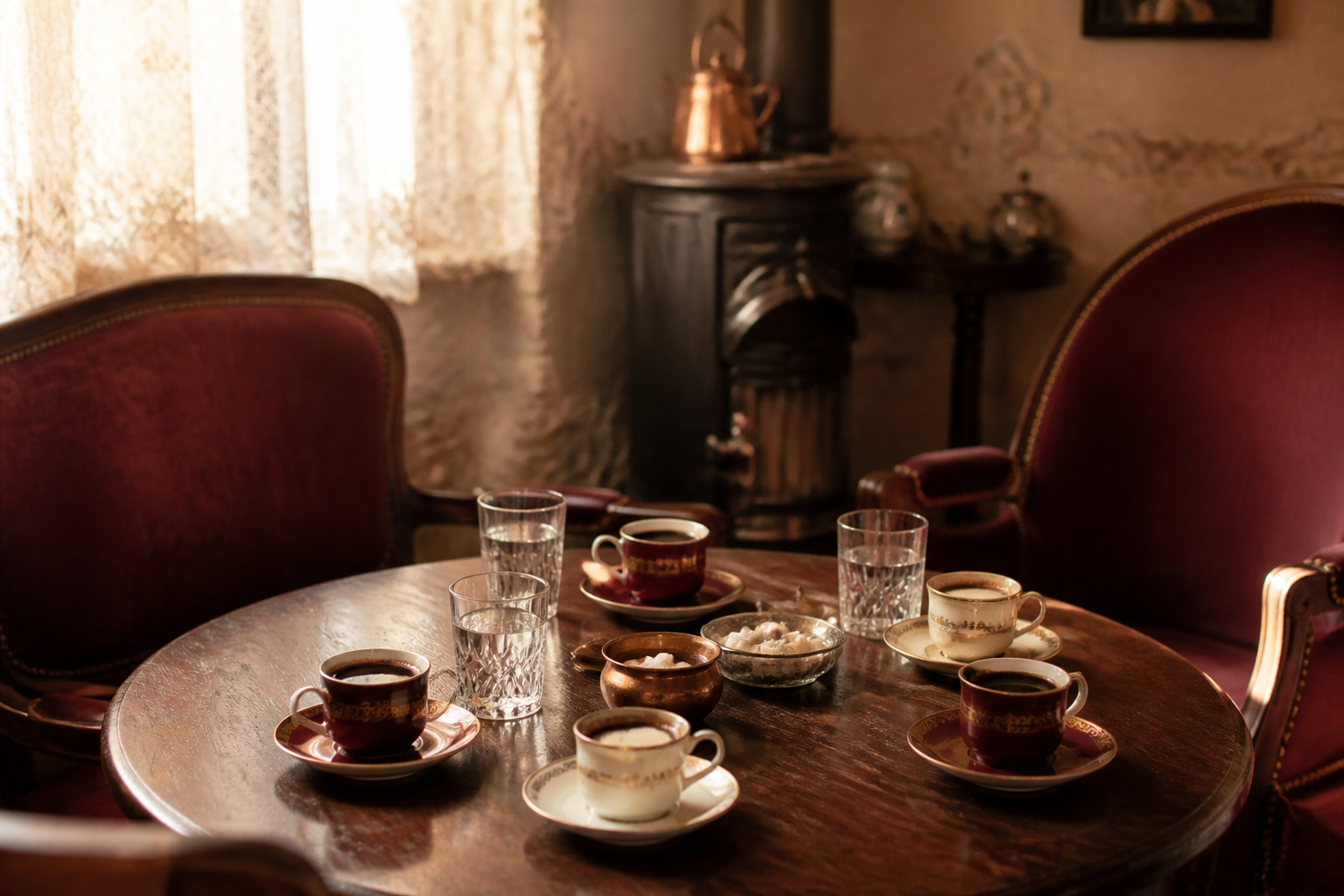
Grand gestures, clinking cups and voices mingling in an ongoing discussion about politics, family life and the small details of everyday life. Anyone who sits down at a traditional Greek café, a so-called kafeneio, or at one of the many outdoor tables in a Balkan square is immediately struck by the intensity. People do not drink their coffee on the go, on their way to the next meeting. Having a coffee is not a practical sideline – it is a central social ritual, allowed to take hours.
For a Nordic visitor, used to coffee dates booked in the diary and efficient, purposeful conversations, this is a fascinating contrast. In the Balkans, the café and the square function as a direct extension of the home. They are places where the door is always open and different generations meet without filters.
Longing for a happier time
But the social landscape is changing, even in south-eastern Europe. The award-winning Greek writer Christos Chomenidis, the first writer from Greece to receive the prestigious European Book Prize, has reflected on this shift. He believes that we live in an angry and suspicious era – an existence he describes as difficult, especially for someone like him, who remembers a happier, more open time. According to Chomenidis, society has a deep and constant need for storytellers, for people who can portray and convey our shared passions and human experiences face to face.
The challenge to face-to-face conversation is also evident in the statistics. While in-person encounters are still highly valued, surveys show that more than two-thirds of Greeks now get their daily news and social media feeds via social media. The traditional square, where news was once discussed, debated and argued over loudly, face to face, has largely moved to digital platforms.
The Nordic versus the southern public space
In the Nordic countries, we have long grappled with involuntary loneliness and a high degree of digital isolation. The Nordic coffee break is certainly deeply rooted, but it often takes place within closed circles – with colleagues during scheduled breaks or with friends agreed in advance at a particular café. Spontaneous encounters with strangers, or unbounded socialising across generations, are rare.
In the Balkans, public space works differently. It is natural for a retired teacher, a young student and a local craftsperson to end up in the same conversation at neighbouring tables. Everyday life is accessible in a way that makes the threshold for human contact almost non-existent. It is about sharing space and time without necessarily having any other purpose than being together.
Reclaiming slow time
Protecting these physical meeting places is about more than simply preserving picturesque settings. It is about social cohesion. When the algorithms on our screens tend to polarise and create distance, the physical café acts as a moderating counterforce. It is much harder to stay angry with someone whose facial expressions you can read and whose coffee steam you share.
Staying put, listening to the end and allowing a conversation to take unexpected detours may be the greatest luxury of modern life. Perhaps this art of living – the ability to pause and simply be together – is the Balkans’ most important inspiration for a stressed and screen-weary Nordic region.
Facts
Sources & further reading
- balkaninsight.comGreece - Culture and Lifestyle
Share the article
Translated from Swedish with AI assistance. Read the original.


