
The Adriatic challenger: How Slovenia’s major port is redrawing Europe’s trade map
As global supply chains falter and the giants of the North Sea grapple with congestion, attention has turned south. Slovenia’s only commercial port, Luka Koper, has quietly but firmly established itself as one of Central Europe’s most important gateways. With massive investment in rail and a strategic location, it is now challenging traditional northern European trade routes – and creating a new, faster link all the way to the Nordic countries.
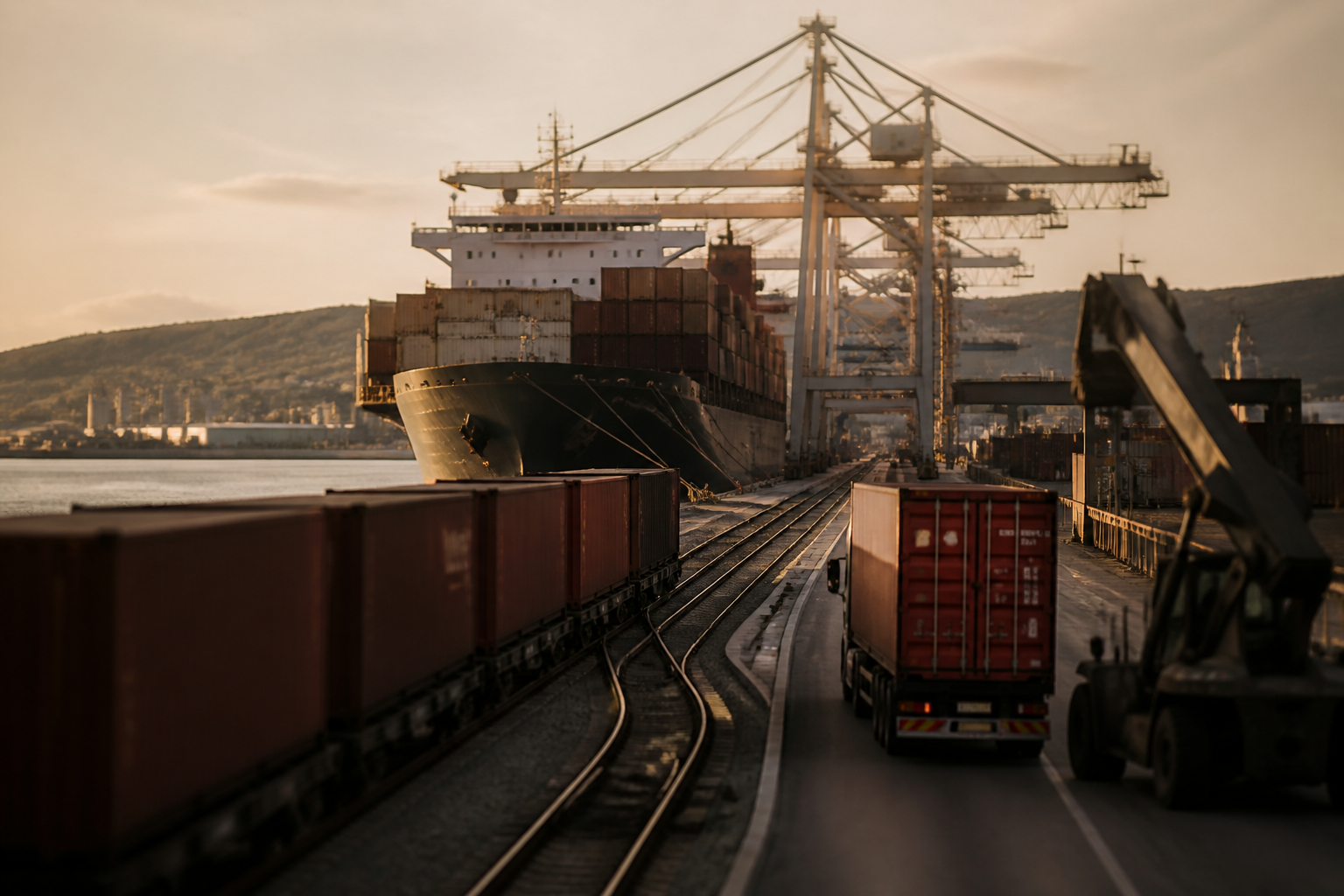
The cranes on the quayside in Koper never rest. They reach skywards like gigantic steel structures beneath the Adriatic sky, right where the Slovenian peninsula meets the sea. Visitors to the city of Koper can easily be charmed by the Venetian palaces and narrow stone streets of the historic centre. But just a stone’s throw away, a very different kind of activity is under way – one that is quietly but fundamentally redrawing the logistics map of the entire European continent.
Slovenia’s only commercial port, Luka Koper, is no longer merely a regional concern. It has become one of the most dynamic logistics hubs in southern Europe. By offering a significantly shorter and faster route from Asia to the heart of Europe, Koper is now challenging the established northern European giants of the North Sea. For Nordic businesses, logistics specialists and consumers, this southern gateway offers a key to safer and more flexible supply chains in an era shaped by geopolitical uncertainty.
Geopolitical pressure and the Adriatic Sea’s new role
Global crises in recent years have exposed the vulnerability of traditional trade patterns. The pandemic’s logistical bottlenecks, the war in Ukraine and recent security threats in the Red Sea have forced carriers to rethink their routes. When container ships are forced to sail around Africa to reach Europe, time becomes critical.
It is in this new reality that the Adriatic Sea has emerged as a highly attractive alternative. Shipping goods from the Suez Canal directly to the northern Adriatic ports saves up to a week at sea compared with sailing around the entire Iberian Peninsula to North Sea ports such as Rotterdam, Antwerp-Bruges or Hamburg. Every day saved at sea means lower fuel costs, reduced carbon emissions and, above all, a faster route to consumers.
For Luka Koper, this geographical advantage has become a powerful asset. The port has developed into a critical lifeline, helping to ensure the stability of supply chains for raw materials, finished consumer goods and the European automotive industry. Geopolitics has transformed the Slovenian coast from a beautiful holiday destination into a strategic European security zone.
Challenging the North Sea giants
For decades, it was taken for granted that goods destined for Central Europe – including the industrial heartland of southern Germany in Bavaria and Baden-Württemberg, as well as the Czech Republic, Slovakia and Austria – would enter through the gigantic northern ports. Rotterdam, Hamburg and Antwerp-Bruges have dominated trade flows. But that dominance is now facing an increasingly powerful challenge from the south.
Luka Koper has systematically built its position as the leading container port on the Adriatic Sea. By offering faster handling times, greater flexibility and a direct link to the rail networks of Central and Eastern Europe, the Slovenian port has managed to attract significant market share. This is particularly evident in the Austrian, Hungarian and Czech markets, where Koper is now the single most important port of entry and exit for several types of goods.
The southern German states of Bavaria and Baden-Württemberg, which have traditionally looked to Hamburg and Bremen, are also increasingly turning south. For a car manufacturer in Munich or a machine-building company in Stuttgart, the route to Koper is considerably shorter than the one to Germany’s North Sea ports. This is not just about geography, but about spreading risk. Having a foothold in both northern and southern Europe’s port systems is now a fundamental strategy for the continent’s largest industries.
Billion-euro rail investments: breaking the bottlenecks
But a port is only as good as the transport links that lead away from it. The historic weakness of Adriatic ports has been their inland infrastructure. While northern European ports have been connected to multi-lane motorways and high-capacity railways, the southern Alpine routes and national rail networks in south-eastern Europe have often acted as bottlenecks.
Slovenia has recognised this and is now undertaking one of the most ambitious infrastructure projects in the country’s modern history: building a second railway track between the port city of Koper and the inland station of Divača. This project, known as “Drugi tir”, is a billion-euro investment in extremely challenging mountainous terrain, with long tunnels and viaducts.
When the new track is fully complete, it will bring a dramatic increase in capacity. The railway is Koper’s true backbone: more than half of all goods passing through the port are transported onwards by rail. This makes Koper one of Europe’s most rail-dependent ports, bringing significant environmental benefits at a time when the transport sector must reduce its emissions. The port’s management, in which former acting CEO Nevenka Kržan has played a central role in advancing strategic investment, has made clear that the future lies in efficient, green and multimodal transport, with rail at its core.
Rivalry in the northern Adriatic
Koper does not operate in a vacuum. Just a few kilometres to the north, across the Italian border, lies Trieste. And to the east, in Croatia, Rijeka is upgrading its terminals. Together, these three cities make up the northern Adriatic port alliance, which both cooperates and competes for control of Central Europe’s trade flows.
Trieste has historically had the advantage of being a free port, with deeper port basins and strong historical ties to Austria-Hungary. Rijeka, for its part, has strong backing from the Croatian state and major foreign terminal operators investing heavily. But Koper has managed to maintain its lead in the container rankings thanks to an extremely efficient organisation and an early focus on niche markets – not least cars, where it is now one of Europe’s largest and most reliable terminals.
Competition is fierce, but there is also a growing recognition that the real contest is not between Koper, Trieste and Rijeka. The real challenge is to show global shipping companies together that the Adriatic corridor is a fully viable, faster and more reliable alternative to the North Sea ports.
The link to the Nordic countries and the Baltic Sea
At first glance, Koper may seem far away to Nordic readers. But in the integrated European economy, the connections are closer than one might think. Through the Trans-European Transport Network (TEN-T), and particularly the Baltic–Adriatic Corridor, Koper is directly linked to Baltic Sea ports such as Gdańsk in Poland, and from there onwards by ferry and sea routes to Swedish ports such as Gothenburg.
Many Nordic manufacturing companies have moved some of their production to Central Europe – to countries such as the Czech Republic, Slovakia, Hungary and Poland. When these factories import components from Asia or export finished products to global markets, an increasing share of that freight travels via Koper.
Having an effective southern trade route gives Nordic businesses much-needed redundancy. If there are strikes, congestion or technical problems at German or Dutch ports, the Adriatic route is there as a fully viable alternative. Slovenia’s gateway to the south has thus, paradoxically, become an important guarantee of stability in the north as well. The port of Koper is in many ways a symbol of modern Slovenia: pragmatic, efficient and strategically positioned at the crossroads of different European worlds. By quietly but purposefully investing in the future, this small stretch of Adriatic coastline has made itself indispensable to trade flows across the continent.
Facts
FACTS: Luka Koper
- Location: Koper, Slovenia’s only commercial port, situated on the country’s 47-kilometre-long stretch of Adriatic coast.
- Main types of goods: Containers, passenger cars and other vehicles (one of the Mediterranean’s largest and most important car terminals).
- Main markets: Austria, Hungary, the Czech Republic, Slovakia, southern Germany (Bavaria and Baden-Württemberg) and Slovenia’s domestic market.
- Rail share: More than 50 per cent of all goods are transported onwards from the port by train, making rail the port’s most important logistical backbone.
- Strategic role: A key point in the EU’s Trans-European Transport Network (TEN-T), linking southern Europe with the Baltic Sea region.
Sources & further reading
- osw.waw.plThe Adriatic ports: a silent expansion onto the Central ...
- transportcorridors.comLuka Koper boosts container volumes, profit H1 2026
- researchgate.net(PDF) Hamburg's port position: Hinterland competition in Central ...
- report.hhla.deMarket and competition - HHLA-Annual Report 2020
Share the article
Translated from Swedish with AI assistance. Read the original.


