
Silent Revolution in the Archipelago: How Slovenian Hybrid Yachts Rewrote the Nordic Boating Map
Gliding through the archipelago without engine noise or the smell of exhaust fumes has long been a pipe dream for motorboat owners. But the Slovenian shipyard Greenline Yachts has turned this vision into reality. By combining advanced hybrid technology with integrated solar panels, they have found one of their most important markets in the Nordic region – where environmental awareness meets a deep love of the sea.
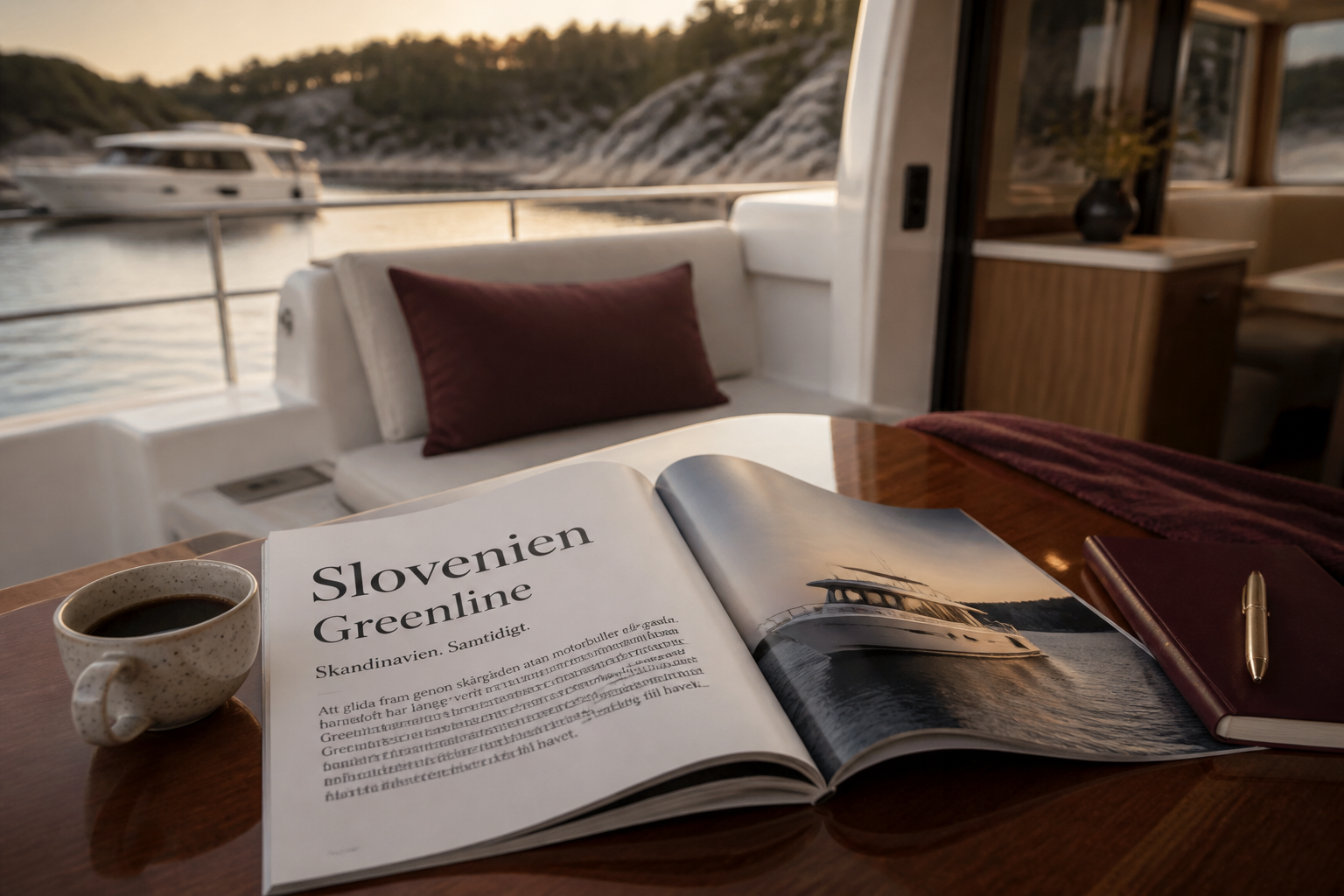
An early morning in the Stockholm archipelago. The mist lies thick over the bay and most boat owners are still asleep in their cabins. At one of the jetties, a family boat measuring just over twelve metres casts off. But instead of the characteristic, low rumble of a large marine engine and the blue-grey puff of diesel smoke, the departure takes place in absolute silence. The boat glides out into open water with barely a whisper of rippling water around its bow.
On the transom is the logo of Slovenian Greenline Yachts. To the uninitiated, Slovenia might seem an unlikely giant of marine innovation, with its short stretch of coastline on the Adriatic Sea. But the truth is that over the past fifteen years, the country has established itself as a global epicentre for sustainable shipping. And nowhere has this green wave been welcomed with greater enthusiasm than in Scandinavia.
Slovenian Pioneering: From Bold Vision to the Sixth Generation
The story of the Slovenian hybrid boats began in the midst of the 2008 financial crisis. The renowned boat designers and brothers Japec and Jernej Jakopin, founders of the design studio J&J Design, made a decision that was then considered close to madness. While the marine industry was fighting for survival, they chose to invest everything in an entirely new concept: a production leisure boat with a hybrid engine and solar panels on the roof.
The vision was simple yet technically challenging. They wanted to create a boat that offered the same range and peace of mind as a traditional diesel boat, but with the ability to run completely emission-free and silently at lower speeds. The first model, the Greenline 33, was an immediate success and sold in the hundreds during its first few years.
Today, the Slovenian manufacturer has refined its technology across six generations. What began as a bold experiment in Begunje na Gorenjskem – a picturesque town in northern Slovenia, better known for its alpine surroundings and the Elan ski factory – has evolved into a high-tech shipyard that has fundamentally changed the perception of what a modern motorboat can be.
The Technology Behind the Silence: The Advantages of the Parallel Hybrid
At the heart of the Slovenian concept is the so-called parallel hybrid, a system often referred to in marine terminology as H-Drive. Unlike a pure electric boat, where range anxiety can still be a tangible factor during longer crossings, Greenline combines a traditional diesel engine with a highly efficient electric motor on the same shaft.
With a simple press of a button at the helm, the skipper switches between the two power sources. In harbours, natural anchorages, and sensitive archipelago coves, the boat is run exclusively on electricity. When the batteries run low, or when wind and currents demand higher speed, the diesel engine is started. The electric motor then functions instead as a powerful generator, recharging the lithium batteries while underway.
Another key element is the integrated solar panels on the cabin roof. They continuously produce green electricity as soon as daylight appears, meaning the boat owner has constant access to 230-volt power on board. This eliminates the need for noisy diesel generators to run refrigerators, induction hobs, coffee makers, or air conditioning while at anchor. For the Scandinavian boat owner, who appreciates the peace of a secluded natural harbour, this is perhaps the greatest luxury of all.
The Archipelago's New Favourite: Why the Nordic Region is the Perfect Market
It is no coincidence that the Slovenian shipyard identified Scandinavia as a key market early on. Nordic boating culture is characterised by a strong environmental mindset and a desire to live in harmony with nature. At the same time, the Scandinavian archipelagos, with their thousands of islands, shallows, and variable weather conditions, place very high demands on a boat's seaworthiness.
The Swedish distributor Beckerbåt has over the years noticed a clear shift in buyer attitudes. Sustainability is no longer just a talking point; it has become a decisive factor in environmentally conscious investments in the multi-million SEK (Swedish krona) bracket. Being able to holiday in the archipelago with a minimal carbon footprint, without having to sacrifice comfort, has proven to be a winning formula.
Marine electrification in the Nordic region is also being driven from other quarters. Swedish pioneers such as X Shore have paved the way for fast, pure-electric dayboats, while the Finnish company Callboats is developing electric, on-demand ferries for public transport in urban archipelago environments. Within this ecosystem of green marine technology, the Slovenian hybrid boats occupy a unique niche as spacious, long-distance family cruisers.
Furthermore, the cooperation between the Scandinavian markets and the Slovenian shipyard runs deeper than mere sales. The high quality standards of Nordic industry are reflected in the construction of the boats, with advanced components and materials often sourced from Northern European suppliers. For instance, the requirements for the strength and insulation of the glass sections in the large saloons are extremely high to withstand the harsh Nordic climate – an area where Nordic flat glass specialists like Forserum Safety Glass (FSG) lead the way in manufacturing safety glass.
Challenging Traditional Luxury
For a long time, there was a prejudice that eco-friendly boats had to be spartan, slow, and compromised. Greenline’s model range, which today extends from 39 to 58 feet, has effectively shattered that myth. The boats are characterised by a modern, bright interior with large glass surfaces that blur the line between the saloon and the surrounding nature.
This success has not gone unnoticed by the major global boating conglomerates. Giants such as Groupe Beneteau, Brunswick Corporation, and Azimut Yachts are now investing billions in developing their own hybrid systems and electric drives. Industry organisations like the International Electric Marine Association (IEMA) report a surge of interest in electrifying the global leisure fleet.
Yet the boutique shipyard from Slovenia has an invaluable head start. They possess fifteen years of accumulated experience in how hybrid systems perform in practical operation, how batteries age in a marine environment, and how to build hulls optimised for low energy consumption rather than maximum top speed.
As the Scandinavian boating season reaches its peak, more and more people are realising that the future of boating is not about being the loudest or travelling the fastest. It is about experiencing the archipelago on nature's own terms. And that movement is, in many ways, steered from an innovative shipyard in the Slovenian mountains.
Facts
Facts: Greenline Yachts
- Founded: 2008 in Begunje na Gorenjskem, Slovenia.
- Pioneers: Introduced the world's first production hybrid boat for leisure use (Greenline 33).
- Technology: Parallel hybrid (H-Drive) combining electric and diesel propulsion, supplemented by roof-integrated solar panels and lithium battery packs.
- Awards: Has won over 30 international design and environmental awards for its innovative boat design.
Sources & further reading
- BeckerbåtBeckerbåt - Svensk generalagent för Greenline
- grandviewresearch.comElectric Boat Market Size And Share | Industry Report, 2030
- marketgrowthreports.comElectric Leisure Boats Market Size & Outlook to 2035
- marketsandmarkets.comElectric Boat Market Size Report 2025-2031 [300 Pages & 200 Tables]
Share the article
Translated from Swedish with AI assistance. Read the original.


