
Salina Turda – the salt workplace beneath Transylvania
A panoramic wheel on the mine floor and a lake far below ground make Salina Turda more than just an industrial museum. But it is the transport galleries, the hand-carved rock walls and a preserved horse-driven machine that explain why these vast caverns exist.
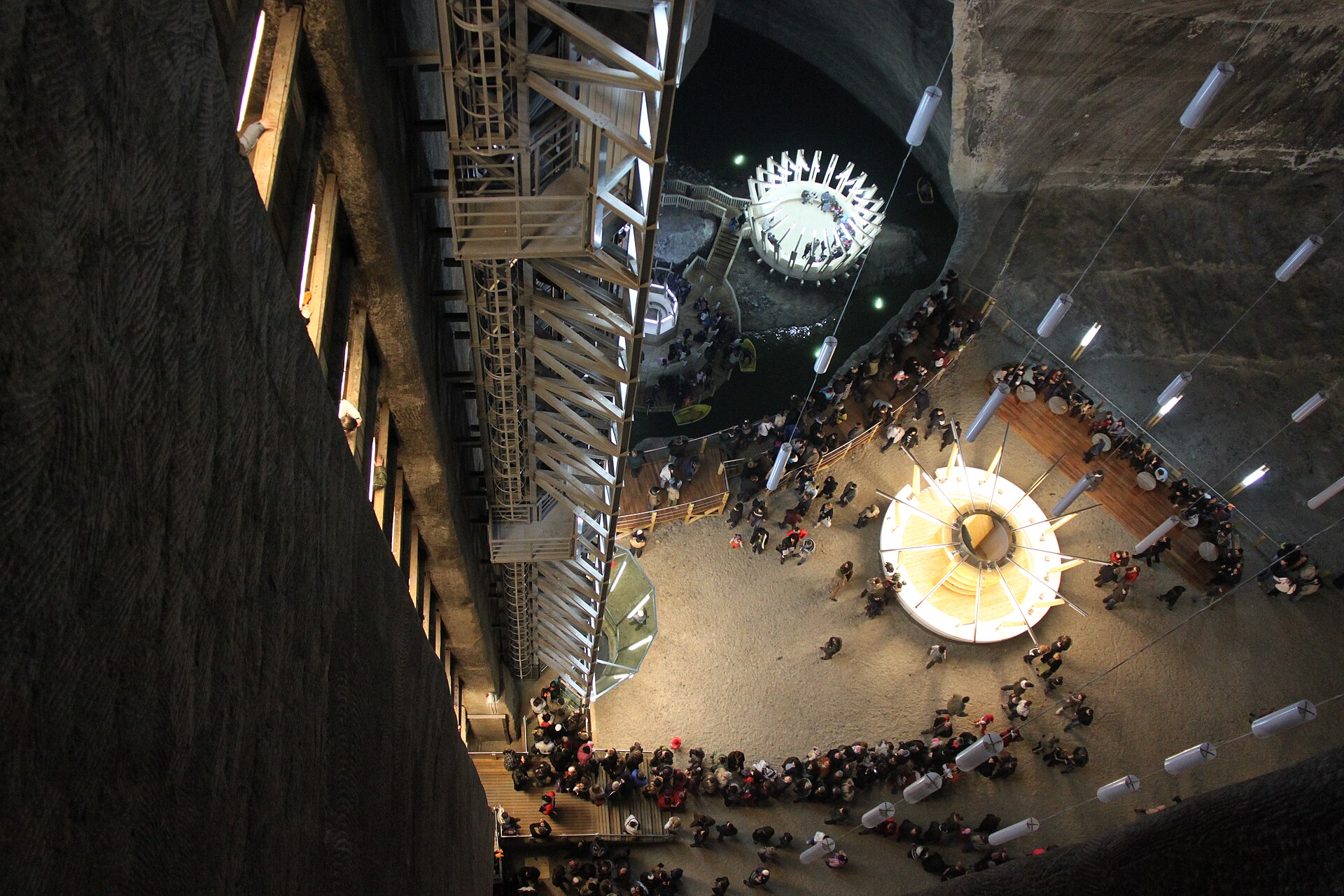
The panoramic wheel stands indoors, but the building surrounding it is a hollowed-out mountain of salt. In the Rudolf Mine, part of Salina Turda in the Romanian town of Turda, the familiar amusement attraction takes on a different scale. The 20-metre-high wheel occupies only a fraction of the space. Above, the mine walls continue towards a ceiling that today's visitors do not need any knowledge of mining to pause and marvel at.
It is easy to focus on the contrast between the old mine and the modern visitor attraction. Yet the place becomes more interesting if you flip the question: not how a panoramic wheel ended up here, but how people created the space around it. The entire empty space is a trace of labour. The rock that is missing was broken off, lifted up and carried away.
The gallery that explains the mine
Turda is located in Transylvania, south of Cluj-Napoca. Beneath the town lie salt deposits formed long before borders, kingdoms and mining companies gave the resource an economic value. Down here, you can read two different stories in the same wall: the geological history of the salt and the human intervention in it.
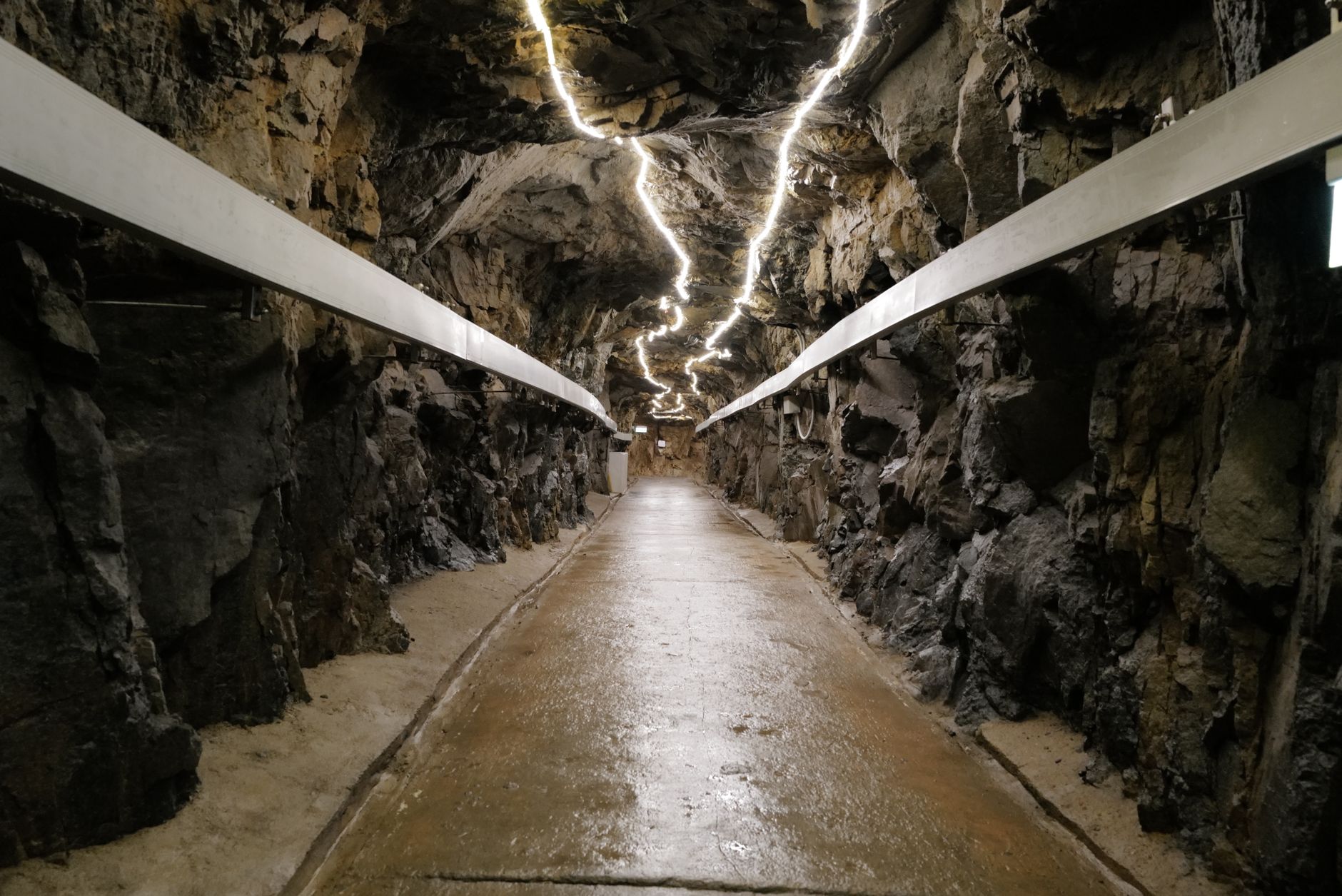
The Franz Josef Gallery gives the visit a clear direction. This long transport gallery belongs to the mine's practical infrastructure, designed to connect the underground work with the world outside. Follow it with your eyes as a working route rather than just a passageway to the next attraction. The salt was not merely extracted. It also had to be moved through a facility where elevation changes, distances and heavy loads determined the working day.
In the walls, the salt shifts between light and darker patches. This is not a uniform white mass of the kind that ends up in a salt shaker. Layers, impurities and worked surfaces give the rock structure. The limited view in the gallery also makes the opening into a mining chamber all the more striking: from a corridor scaled for transport to a cavern that is the very result of production.
The chambers have different shapes for a reason
The cross-section of the Rudolf Mine is trapezoidal, wider at the bottom and narrower at the top. The shape tells a story of how the extraction was organised and how the space gradually grew. Along the staircase, there are year markings at the mine's 13 levels. They make an abstract history of labour concrete: each step downwards corresponds not only to a distance but also to a stage in the extraction.
The staircase has 172 steps. Walking it provides a physical experience of the space that the panoramic lift does not offer in the same way. The lift, instead, provides an overview of the walls and the facilities on the floor. These are two different ways of understanding the same volume, not just two ways of moving through it.
The Terezia Mine has a different geometry. The bell-shaped chamber opens up around an underground lake and an island of salt residue. The island is important to notice: it belongs to the material left behind by the mining, even if it is now part of the visitor experience. The water, the walkways and the lighting make the site visually striking, but beneath all this, it remains a mine whose shape was determined by extraction.
The Iosif Mine, also known as the Echo Room, offers another way of perceiving the facility. Here, it is the return of sound that makes the scale comprehensible. Not all rooms need to be filled with activities to have a content; sometimes their dimensions and acoustics are enough.
When salt was a matter of power
The importance of salt before the refrigerator is easy to underestimate. It was used not just for flavour, but also to preserve food. A deposit like the one at Turda was therefore an economic asset whose value reached far beyond the mining town itself.
The documented medieval history of salt extraction is closely linked to royal control, rights and privileges in the Kingdom of Hungary. The right to salt was not necessarily the same as owning and operating a mine in the modern sense. Access to production, revenue from it and the right to trade in salt could be regulated separately. The mine was part of a system of power and sustenance, not just a local trade.
Under later Habsburg administration, salt continued to be a state affair. Names like Franz Josef and Rudolf also place parts of the preserved facility within this Central European history. Transport galleries, shafts and hoisting devices show how a valuable raw material demanded increasingly integrated technical systems.
Roman history, on the other hand, needs to be kept separate from what the visitor actually sees. Turda has a Roman past through Potaissa, but this is not in itself proof that the current mining chambers are Roman. Claims of Roman salt extraction should not be treated as being as certain as the documented medieval and later activities. Salina Turda's preserved chambers and equipment need no such backward projection to be interesting.
The machine between mine floor and daylight
One of the facility's physical links to the work is the crivac from 1881, a horse-driven hoisting machine. The large wooden structure might at first look like an object requiring a technical drawing to be understood. The basic principle is simpler: the movement of the horses drove a mechanism that made it possible to lift salt through the shaft.
Imagine the transport chain in three stages. First, the salt was loosened down in the Rudolf Mine. Next, it had to be lifted from the mine floor to the transport level. Then remained the journey through the gallery and out of the mountain. The crivac belongs to the link between extraction and haulage, where muscle power was converted into vertical movement.
The small museum by the reception complements the large machine with tools for salt extraction. The tools return attention to the actual attack on the rock. Between a hand tool and a mining chamber lie thousands of repeated operations. It is this relationship that gives meaning to the size of the chambers.
A new use for the empty space
Today's Salina Turda does not leave the industrial environment untouched. The panoramic lift, the wheel and the facilities around the lake are clear additions for visitors. They turn the site into an excursion even for those not seeking mining history, and they change how the chambers are used and viewed.
There is a tension in this, but it does not need to be described as a conflict. The attractions draw the eye to the mine floor; the walls pull it back to the work that created the space. Both remain in the same field of vision. Anyone who takes their time at the year markings and the hoisting machine can still follow the logic of production through the facility.
Therefore, plan your visit around more than just the photographs of the lake. Check which entrance is in use, which parts are open and how lifts and stairs fit into the visitor route. A lift does not automatically mean the entire facility is accessible without level changes. For those who need to avoid stairs, information about the entire route, including the return journey, is more important than a general promise of accessibility.
Then, allow the transport gallery, the machine and the mining chambers each to have their moment. The panoramic wheel shows what can be done with a decommissioned mine. The salt walls show what was required for it to exist in the first place.
Share the article
Translated from Swedish with AI assistance. Read the original.


