
Oradea – a weekend among Art Nouveau palaces
Begin under the glass roof of the Black Eagle Palace and continue into the bourgeois rooms of the Darvas–La Roche House. In Romanian Oradea, an architectural weekend is also a stroll between cafés, pedestrian streets and the Crișul Repede river.
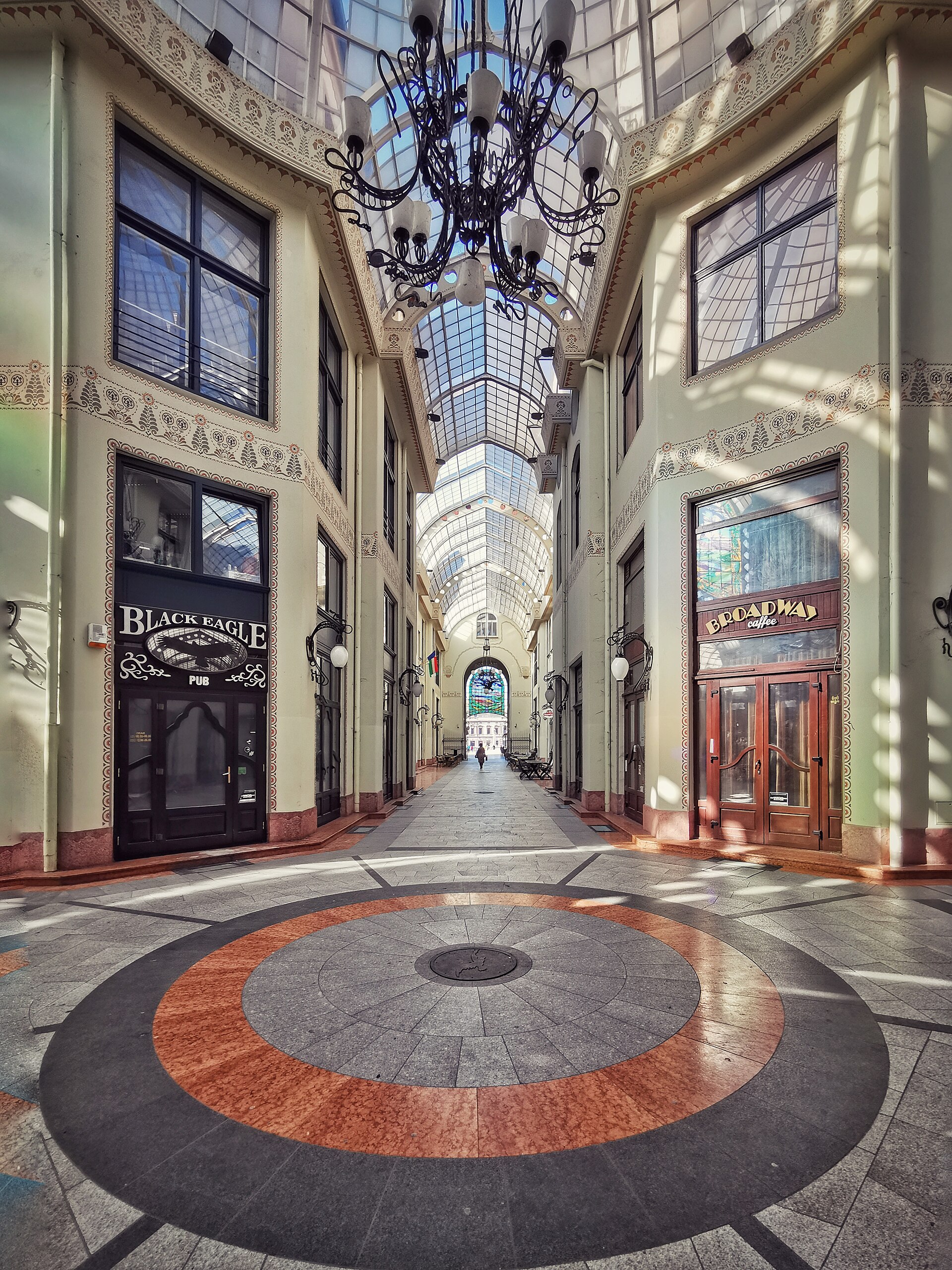
Stand a little way out on Piața Unirii before entering the Black Eagle Palace. From a distance, you can trace how the façade shifts in height and direction, how the window groupings hold certain sections together while undulating lines draw the eye onwards. The building refuses to conform to a simple, symmetrical arrangement. Then, the opening to the passage beckons.
It is a fine beginning to a weekend in Oradea, in western Romania near the Hungarian border. The city's Art Nouveau architecture can be discovered both from the pavement and behind the façades. Divide the weekend between these two perspectives: a first day among squares, passages and grand residential and commercial buildings, and a second with time reserved for the interiors of the Darvas–La Roche House.
In between, there are plenty of reasons to lower your gaze from the rooflines. The very same centre is home to restaurants, café tables and promenades along the water. The architecture is the setting for a city visit, not a reason to turn every hour into a history lesson.
Saturday starts at the Black Eagle
The Black Eagle Palace, Palatul Vulturul Negru, was designed by Marcell Komor and Dezső Jakab and built in 1907–1908. Here, the Hungarian Secession's fondness for floral motifs, decorative surfaces and a silhouette that makes the building recognisable from afar is on full display. Secession is the Central European term often used for architecture within the same broad movement as Jugendstil and Art Nouveau.
The word palace requires a brief explanation. In Oradea, it usually denotes lavish urban buildings constructed for housing, commerce and entertainment, rather than royal residences. The Black Eagle belongs to this urban variety: a building designed to be used, walked through and to draw people in.
Enter from the square and follow the glass-covered passage. It branches out towards three openings, connecting to Piața Unirii, Strada Independenței and Strada Vasile Alecsandri. Take a brief detour through each arm; it soon becomes clear that the passage is not just a decorative space, but a way of binding the block together.
The stained glass window featuring the black eagle is the obvious detail to linger by. But look also at the whole: how the daylight enters from above, how shopfronts and entrances face inwards, and how the walkway takes on the character of a roofed street. Here, Art Nouveau is as much an idea of urban life as a matter of ornamentation.
Lunch without stylistic demands
Take the exit towards Strada Vasile Alecsandri and let the next part of the day be about something other than years of construction. The pedestrian street is a natural stretch for lunch, coffee or a later dinner. Look at the menus and choose based on what you want to eat, rather than which venue seems to fit best into an architectural narrative.
This is an important distinction. A restaurant in a historic quarter does not need to have a preserved Art Nouveau interior, and a modern espresso bar is not an interruption to the experience. It shows how the neighbourhood is used today.
Further along your walk, Ristretto Caffè on Calea Republicii is a specific coffee stop worth keeping in mind. By the Crișul Repede, you will also find the restaurant Dock, if you would rather let the water than the pedestrian street dictate your pause. Check the venues' current opening hours before your visit; do not plan your entire route around a single table.
The river is also worth some time without any booking at all. Follow a stretch of the embankment and see how the centre opens up by the water. After the enclosed space of the passage, the riverside promenade offers a different scale, with longer vistas and room to view the buildings from the side.
From the square to Calea Republicii
From Piața Unirii, the walk crosses the Crișul Repede towards Piața Regele Ferdinand. Strada Iosif Vulcan, where the Darvas–La Roche House is located, makes a short detour before you continue towards Calea Republicii. You do not need to enter the house just yet. Seeing it from the outside first and returning the next day gives the façade a context within the city.
On Calea Republicii, the picture of Oradea's Art Nouveau broadens. The street is not a row of identical masterpieces, but an urban space where different buildings and expressions stand side by side. Look out in particular for Palatul Stern and Palatul Moskovits-Miksa.
The Stern Palace is also among the works of Komor and Jakab. Here, it is rewarding to trace the decoration across a longer façade: recurring windows, colour fields and ornamentation that bind the building together. Compared with the Black Eagle passage, the experience is more about the rhythm of the street than stepping into an enclosed world of its own.
The Moskovits-Miksa Palace has a different temperament. The blue façade, the prominent corner shape and the dense floral decoration offer much to discover in a small area. Look first at the outline of the building, and then step closer to distinguish the sculpted details from the smooth wall panels.
It is precisely this comparison that makes the walk interesting. Art Nouveau was not a ready-made package applied to every building. The same interest in natural forms and cohesive design could produce both grand, sweeping gestures and more austere compositions. Oradea allows you to see the differences without having to travel between multiple cities.
Sunday behind the façade of Darvas–La Roche
Let the Darvas–La Roche House on Strada Iosif Vulcan be Sunday's anchor point, provided the museum's current opening times suit. The house was designed by the brothers László and József Vágó. After the grand public spaces of the Black Eagle, the scale here feels more private: the focus is on the residence and its meticulously crafted details.
From the outside, the expression is more geometric than that of the exuberant façades on yesterday's walk. The placement of the windows, the lines in the façade and the interplay between different materials are just as important as the individual decorations. Indoors, it becomes easier to understand Art Nouveau's ambition to unite architecture and interior design.
The restored house is used as a museum, with rooms and furnishings that recreate a well-to-do bourgeois environment during the Belle Époque – the period around the turn of the century before the First World War. Here, grand urban architecture is given an everyday context: rooms for socialising, privacy and formal reception.
But distinguish between the house itself and the staging. Preserved architectural details, restored sections and the museum's recreated environments are not the same thing. Do not automatically assume a chair, lamp or table setting belonged to the original family. The museum's furnishings help the visitor understand an era, but are not in themselves proof of exactly how the home once looked.
Read the signage, therefore, with a specific question in mind: what belongs to the building itself, and what has been added to tell the story of life within it? This makes the visit more rewarding, not less atmospheric. Then, observe how windows, glass, doorways and decoration interact from room to room.
Two days with room for pauses
The route works as two connected walks rather than a checklist. Saturday can move from Piața Unirii through the Black Eagle, onwards to lunch on Strada Vasile Alecsandri, and over the river towards Calea Republicii. Sunday is built around the museum visit, leaving room to return to a façade or a café that caught your fancy.
Check the Darvas–La Roche House's current opening hours, ticket conditions and last admission with Oradea Heritage before deciding on the order. If you require step-free access, ask specifically about the entrance and which museum rooms can be reached. Also check access to the Black Eagle passage if you want to walk through it early or late; do not plan on the assumption that all thoroughfares are always open.
Perhaps finish by the Crișul Repede, or at a table back on the pedestrian streets. After two days, the distinction between the grand passage building, the residential palaces and the private house feels clearer. But you do not need to know the names of the architects by heart. It is quite enough, the next time you walk past, to actually look up and see what is happening above the shopfronts.
Sources & further reading
- ro.wikipedia.orgPalatul Vulturul Negru din Oradea - Wikipedia
- visitoradea.comCasa Darvas-La Roche
- agerpres.roPalatul Vulturul Negru din Oradea, deschis vizitatorilor cu ocazia Zilelor Europene ale Patrimoniului (GALERIE FOTO) - AGERPRES
- oradea.roCasa Darvas - La Roche adăposteşte primul muzeu Art Nouveau din România - Oradea.ro
Share the article
Translated from Swedish with AI assistance. Read the original.


