
Nisyros: An Island Weekend with the Volcano at its Heart
Black shoreline pebbles, a village square perched above the caldera, and a crater where the earth’s inner forces make themselves felt. On Nisyros, geology shapes the entire journey. Give the island a couple of nights, using Mandraki as your base and leaving plenty of time between excursions.
At Chochlakoi, it is the stones that define the beach. Dark, smooth and tightly packed, they lie between the sea and the steep hillside. As the waves retreat, they roll against each other. Here, just outside Mandraki, the volcanic origin of Nisyros takes on both colour and sound – even before you have set eyes on a crater.
It is an ideal start to a weekend on the island. The volcano is not an isolated sight to be ticked off between boat trips. It has shaped the heights, the coastal stones and the vast depression in the island's interior. Meanwhile, island life goes on all around: in the narrow alleys, at the café tables and along the quay. The journey is richer when there is room for both.
Mandraki as a base
Mandraki, where the harbour is located, provides an easy starting point for the weekend. Here you will find accommodation, places to eat and alleys to wander through without any particular plan. Whitewashed houses stand close together, stone steps cut between the facades, and the narrow passages occasionally open up to the sea. The contrast between the coastal front and the inner quarters is quickly felt: out by the water there is wind and horizon; inside the settlement, shade and intimate spaces between the houses.
Let the first afternoon be spent here. Make your way towards Ilikiomeni Square, sit down for a coffee and then continue through the alleys back to the coast. Evening life need not be anything more than a long dinner and another stroll along the water. This is also the reason to stay overnight rather than visiting just for a day trip to the volcano: there is time for Mandraki once the sightseeing is done.
On the menu, it is worth looking out for chickpea patties and capers, ingredients central to the island's culinary culture. Ask what the kitchen has prepared for the day and build your meal around a few small plates. A dinner of pulses, vegetables, cheese and bread can easily take centre stage, just as much as fish or grilled meats. There is no reliable current price guide in our source material, so choose according to the local menu rather than assuming a small Greek island is automatically cheap.
Chochlakoi is a natural continuation of the coastal walk. See it primarily as an encounter with the island's raw materials and the sea, rather than a promise of a comfortable sandy beach. If you also want to climb up to Paleokastro, the ancient walls show how the volcanic stone has been used as a building material. The massive blocks make the connection between landscape and architecture exceptionally clear.
Nikia gives the landscape proportion
The next day, Nikia is an excellent first stop. The village sits high above the caldera, offering a perspective on the island’s interior that is impossible to grasp from the coast. The houses cluster tightly on the ridge, while the ground opens up into a vast depression below.
The small square, with its patterned pebble mosaic, is worth a pause before you lose yourself in the view. Have a coffee, wander through the alleys and allow the village to be more than just a viewing platform. The houses, the steps and the enclosed shape of the square bring a human scale to a landscape that might otherwise feel abstract.
The Volcanological Museum is housed in Nikia’s former school. It is an ideal visit before heading down to Stefanos: context first, then the ground beneath your feet. The museum's existence is confirmed by the Greek National Tourism Organisation, Visit Greece, which states that the museum is open only during the summer season, from the beginning of May to the end of October, daily from 10:00 or 11:00 until 18:00 or 19:00. Be sure to check opening times locally before letting a museum visit dictate your day's schedule.
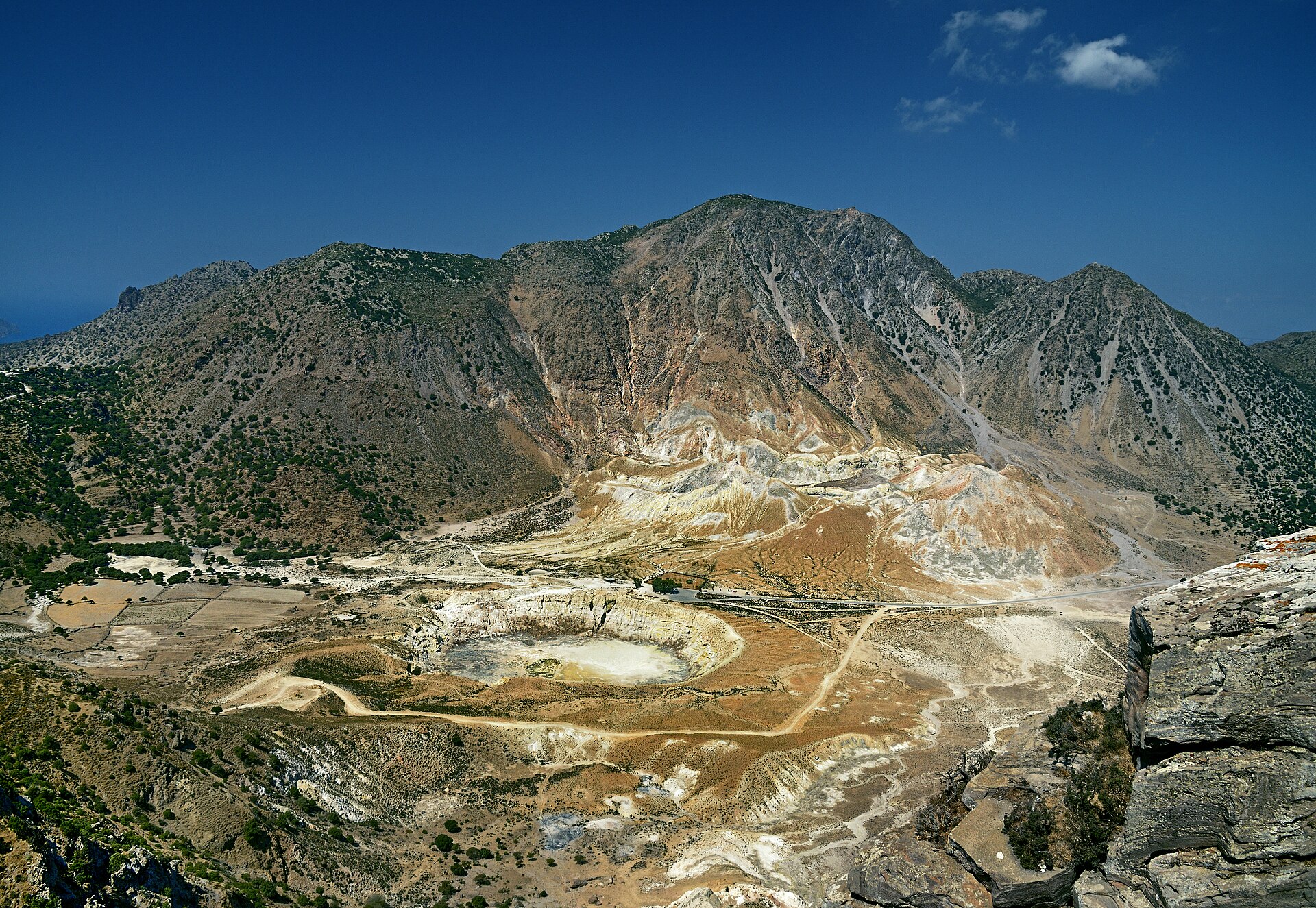
From this height, it is easy to distinguish between two things that are often confused. The caldera is the large volcanic depression, formed when the ground collapsed during volcanic activity. Stefanos is a much smaller crater within this landscape. The entire basin is not Stefanos, and the crater is not a vent filled with glowing lava.
Stefanos is a hydrothermal crater
Stefanos belongs to the volcano's hydrothermal system. This means that underground water is heated by volcanic heat. When hot water and steam build up under pressure, explosive events can occur. Such a crater differs from the image many people have of a volcano: a cone-shaped mountain with lava flowing from the top.
Here, the drama lies instead in the pale, mineral-stained ground, the sulphur deposits and the traces of heat beneath the surface. After the dark coastal stones of Chochlakoi and the whitewashed houses of Nikia, the shift in colour is striking. The same island reveals completely different sides of its geology.
However, your visit should not be planned as a free-roaming walk across the entire crater area. Current access and which areas visitors are permitted to enter must be checked prior to your trip. Follow signs, barriers and the instructions of staff on site; the fact that an area looks accessible does not mean it is permitted to walk there.
Let the heat of the day guide your schedule as well. Avoid rushing from a strenuous hike straight into a crater visit just to catch a specific ferry. Give your excursion some margin, and let local conditions dictate if and how a descent into the crater is appropriate that day.
Walking between Nikia and Stefanos – with a plan for the return
The hiking trail between Nikia and Stefanos connects the view with the landscape below. Starting from the volcanological museum, your thoughts travel from the grand scale to the details: the shapes of the slopes, exposed volcanic material and the transition to the caldera floor.
It is an enticing continuation of the museum visit, but not a route to be judged solely by a single estimated hiking time. Going down and climbing back up are two very different walks. Elevation change, terrain, temperature and the current condition of the trail have a greater impact than a brief description suggests. Furthermore, exploring the crater at the end makes the excursion longer than the walk itself.
Therefore, ask for a local update on the state of the trail before setting off. Decide on your return route in advance: will you hike back up to Nikia, or arrange transport from the volcanic area? Do not assume you can easily book a car once you arrive. If the walk is not suitable for the weather or your group, Nikia and Stefanos can easily be visited as two separate stops with transport in between. Geology remains the thread that holds the journey together.
Fitting the weekend in
Nisyros is reached by boat, for example via Kos. For a short trip, the ferry schedule is your framework: check the connections for your specific travel days before booking accommodation. Think of two nights as a baseline, not a promise of two full days on the island. Arrival and departure times will dictate how much you can actually fit in.
A sensible itinerary is Mandraki and Chochlakoi on your arrival day, followed by Nikia and the volcanic area on your full day. Arrange transport to the island's interior in advance, and check which local options are genuinely operating during your stay. Current ferry timetables and local transport are not verified in our source material.
Save your departure day for breakfast, a short stroll and some time by the sea. Mandraki’s municipal thermal baths are often mentioned in descriptions of the island, but details about historic bathing facilities do not guarantee what is open to visitors today. Do not pencil in a bath as a fixed plan without up-to-date confirmation.
The beauty of this weekend is the shift in scale. In the morning, you see the entire caldera from Nikia. Later, you discern minerals and the structure of the earth at Stefanos. Back in Mandraki, all you need is a table, something to eat and the sea nearby. The volcano has bound the trip together, but the island has been allowed to be more than its crater.
Sources & further reading
- visitgreece.grVisit Greece
- greece-is.comThe Grand Tour of Nisyros - Greece Is
- medgulets.comMandraki: Volcanic Pebbled Beaches and Exquisite Rock Formations
- in2greece.comNisyros beaches
Share the article
Translated from Swedish with AI assistance. Read the original.


