
In the Capital of Slow Coffee: When Sarajevo’s Ritual of 'Ćejf' Meets the New Coffee Wave
In the historic heart of Sarajevo, coffee has never been just a drink, but a way of measuring time. Now, the centuries-old tradition of domaća kafa and hand-hammered džezvas is being challenged by light-roasted specialty beans, oat milk and minimalist aesthetics. But in the meeting between traditional slowness and modern third-wave culture, it turns out that the city's deeply rooted coffee philosophy – ćejf – is more adaptable than you might think.
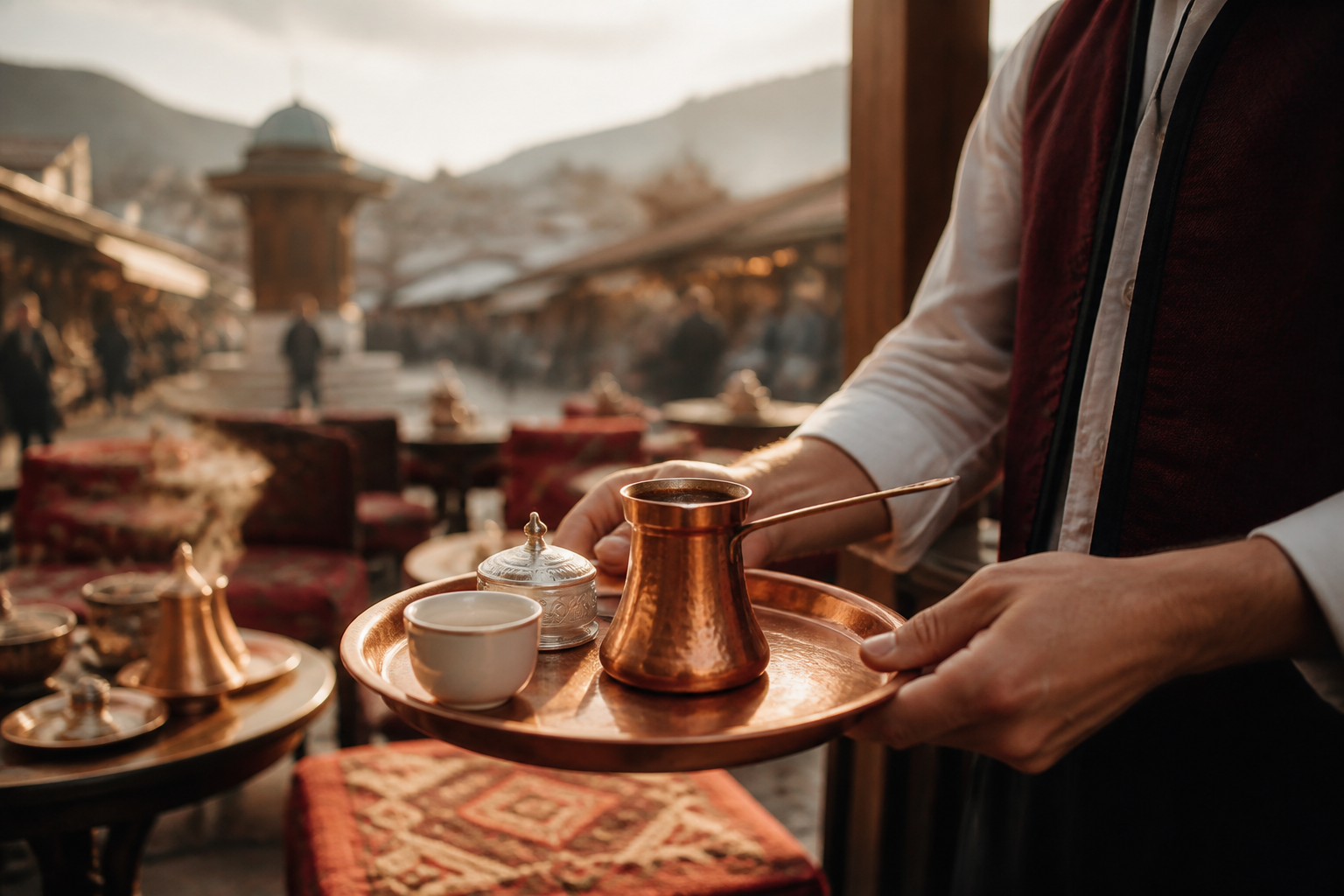
The sound of Sarajevo is intimately bound up with metal against metal. In the narrow alleys of the Ottoman quarter of Baščaršija, the rhythmic hammer blows of coppersmiths mingle with the characteristic clinking of small porcelain cups against round metal trays. Here, along cobbled streets worn smooth by centuries of footsteps, the air smells heavy with dark, almost burnt coffee beans ground to a fine, velvety powder.
Yet only a stone's throw from the old caravanserais, where coffee traditionally simmered over glowing coals, another sound can now be heard. The hissing, controlled pressure of a modern espresso machine and the delicate clink of handmade stoneware cups. Sarajevo, a city that for centuries has regarded coffee as its most sacred social ritual, finds itself in the midst of a quiet generational shift, where traditional brewing craftsmanship meets the global, Nordic-inspired specialty coffee wave.
Baščaršija’s Deeply Rooted Coffee Philosophy
To understand the impact of this encounter, one must first understand what coffee represents in Bosnia and Herzegovina. It is not a quick caffeine kick on the way to work, but a social architecture. The essence of this culture is best summed up by the hard-to-translate word ćejf (pronounced roughly chayf). It describes a state of pure pleasure, of doing something simply because it feels good, entirely without stress and with absolute presence. Drinking coffee is the ultimate expression of ćejf.
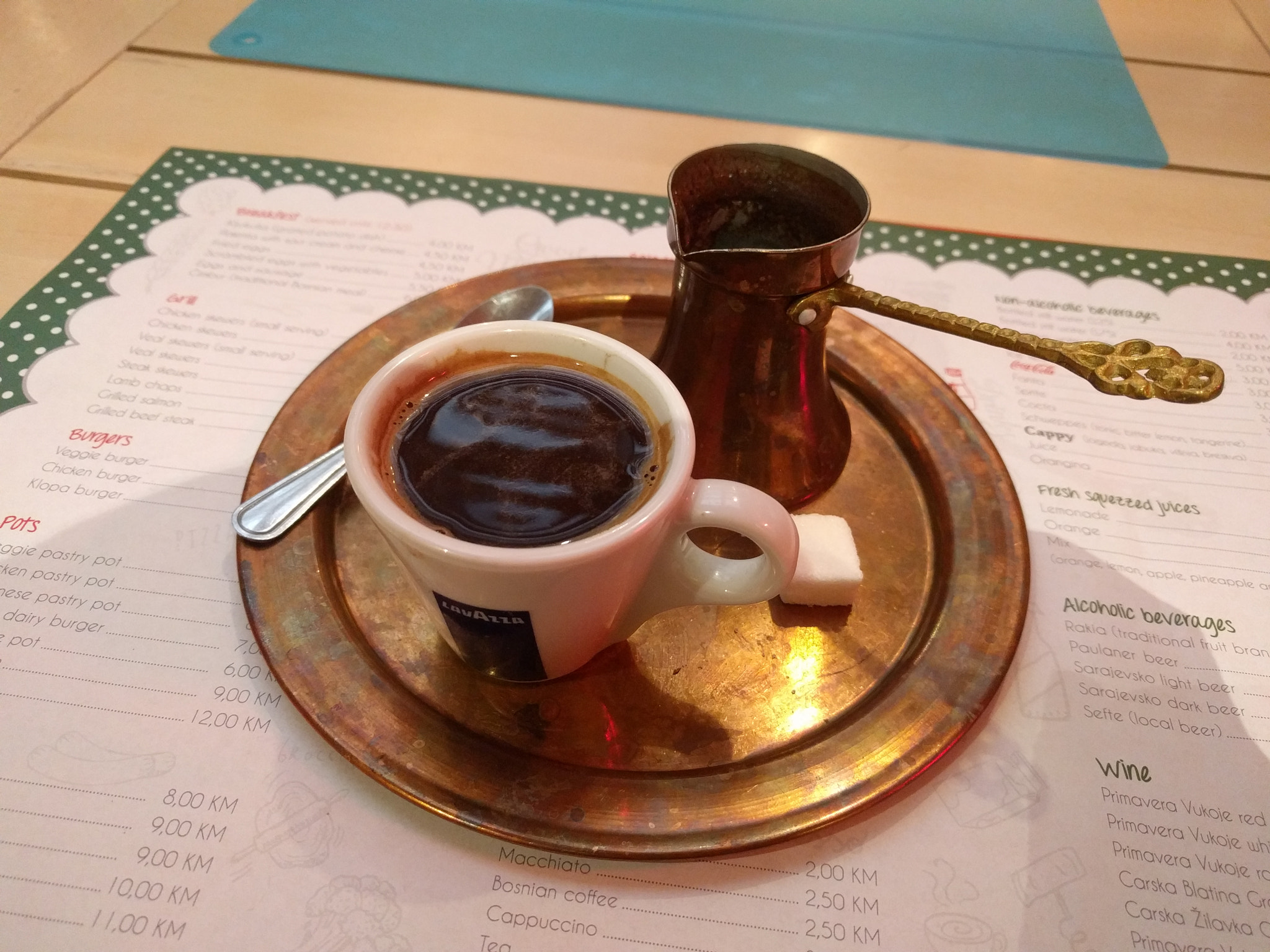
Traditional coffee, often called domaća (homemade) or bosanska kafa (Bosnian coffee), is prepared with a precision reminiscent of a tea ceremony. Unlike Turkish coffee, where the coffee powder is boiled together with the water and sugar, in Bosnia the ground coffee is first warmed in a small copper pot, a džezva. Boiling water is then poured over so that a thick, golden foam – kajmak – rises to the brim. The coffee is then served on a hand-hammered copper tray alongside a glass of cold water, a sugar cube to place under the tongue, and a piece of rahat lokum (Turkish delight).
Hurrying through such a service is not just a breach of etiquette; it is an impossibility. The coffee must be allowed to settle, the temperature must drop to just the right level, and the conversation must be allowed to drift freely. In traditional cafés like Rahatlook in the old town, or Kamarija with its breathtaking views over the city’s rooftops, this slow rhythm has been law for generations.
When Tradition Meets the Scandinavian Wave
Over the past decade, however, a new generation of Sarajevans has returned from studying and travelling in Northern Europe with different coffee habits in their luggage. They have grown accustomed to light-roasted beans from the Ethiopian highlands, traceable micro-lots, and baristas who talk of extraction rates and acidity rather than tradition.
One of the first places to seriously challenge the local palate was Ministry of Ćejf. Located on the steep, picturesque slope of Kovači, just above Baščaršija’s bustling square, this tiny café managed to build a bridge between two worlds. The name itself was a manifesto: modern espresso and filter coffee were served here, but with the same respect for the slow moment and the personal connection that has always characterised the Bosnian coffee house.
The full step towards the pure third-wave roast was taken when the café Kawa opened its doors. With its minimalist interior, light woods, and large glass panes letting in the shifting Sarajevo light, Kawa feels as if it were taken straight out of Södermalm in Stockholm or Grünerløkka in Oslo. Here, it is not the džezva that takes centre stage, but precision brewers, exact scales, and beans from some of Europe’s leading micro-roasters.
Kawa has become a melting pot for the city's young creatives, digital nomads, and returnees. Here, they meet over flat whites made with oat milk – an ingredient that just a few years ago was almost impossible to find in a Sarajevo café.
The New-School Cafés Conquer the City
However, introducing light-roasted beans with high, fruity acidity to a city that has drunk dark, full-bodied, and bitter coffee for centuries has not been entirely straightforward. The older generation often turns up their noses at the new-wave flavours, sometimes comparing it to "sour tea".
Despite this, the movement is spreading rapidly. Fabrika Coffee has established itself as a strong player, combining modern roasting technology with an accessible approach, which has lowered the threshold for the general public. At Gypsy Coffee Lab, the craft is taken a step further, with an almost scientific approach to bean origins, roast profiles, and brewing temperatures. They demonstrate that Sarajevo is no longer just a recipient of global trends, but a city actively participating in shaping its own modern coffee identity.
This development has also given rise to a new kind of professional pride. The profession of barista, once often viewed as a simple part-time job alongside studies, has gained high status. Young Bosnian baristas now study sensory analysis, milk frothing techniques, and bean biology with the same dedication as their counterparts in Copenhagen or Seattle.
The Industry Meetup Cementing the Renewal
That the coffee scene in Sarajevo has matured and professionalised becomes particularly clear during the annual Coffee Fest Sarajevo. Since its launch in 2014, the festival has served as an important gathering point for both regional and international players. Here, roasters, machine manufacturers, and baristas meet to exchange experiences, showcase the latest trends, and compete in categories such as Latte Art.
The festival has played a crucial role in educating the local market. Through open workshops and tastings, residents of Sarajevo have had the opportunity to develop their palate and understand the difference between industrially mass-produced coffee and sustainably grown specialty coffee. What began as a niche industry meetup has grown into a public celebration, showing how deeply rooted the passion for coffee is in the Bosnian soul, regardless of the brewing method preferred.
Ćejf Is Not a Brewing Method – It Is a State of Mind
Perhaps the most fascinating aspect of Sarajevo’s coffee revolution is not how much has changed, but how much, after all, remains the same. Even in the most distinct hipster cafés, where the espresso machines gleam in chrome and the beans smell of jasmine and stone fruit, the original coffee philosophy lives on.
For even if the cup has been replaced by a glass and the dark domaća coffee by a bright V60 brew, the behaviour is identical. People still sit for hours. They talk about politics, art, love, and everyday life. The phone is left in the pocket. No barista glances at the clock to nudge you to vacate the table for the next guest.
In the end, the encounter between the traditional Bosnian coffee ritual and the new Scandinavian third-wave roast is not a conflict between old and new. It is about an organic fusion. The Bosnian concept of ćejf has proven to be completely independent of the brewing method. It is not the džezva or the espresso machine that defines the moment – it is the desire to stop time, if only for the sake of a cup of coffee. And in an increasingly fast-paced world, that is a ritual Sarajevo refuses to let go of.
Facts
Guide to Sarajevo’s Coffee Scene
Domaća Kafa (Traditional)
- Rahatlook: Located in the heart of the old town (Baščaršija). Perfect for experiencing traditional Bosnian coffee with homemade rahat lokum in a cosy, historic setting.
- Kamarija: A café built in terraces on the slope below the Yellow Bastion fortress. Offers traditional coffee with one of the city's most spectacular views.
Specialty Coffee (Modern)
- Kawa: Sarajevo’s premier destination for third-wave coffee. Minimalist Scandinavian design, excellent filter coffee, and a strong focus on the origin of the beans.
- Ministry of Ćejf: A charming pioneer on the historic slopes that manages to combine modern coffee artistry with classic Bosnian hospitality.
- Gypsy Coffee Lab: For the coffee connoisseur seeking precise brewing methods, micro-roasted beans, and an in-depth discussion about flavour profiles with the barista.
Sources & further reading
Share the article
Translated from Swedish with AI assistance. Read the original.


