
Horezu Ceramics – The Craftsmanship Behind the Rooster on the Plate
The rooster catches the eye, but the thin lines of colour tell just as much about the craft. In Horezu, Romania, plates are shaped on the potter's wheel and decorated using horns and pointed tools. The journey from clay to a glossy surface demands both steady hands and the patience to wait.
A fine tip is drawn through wet lines of colour. As it passes, the colour is swept along, creating small peaks, arches and branches. What were just separate bands a moment ago become a unified pattern. In the ceramic tradition of Horezu, this technique is called jirăvire: the decoration emerges by drawing the colours into one another, rather than painting each tiny detail individually.
This is a good introduction to the plates of Horezu in Vâlcea County, southern Romania. The rooster is their famous hallmark, but the pottery is also recognised by the interplay between form, colour and line. A wide rim becomes a canvas in its own right. The centre might feature a bird, a flower or a pattern unfolding from the middle.
Around Strada Olari, the craft is alive in its workshop settings. Here, pottery is not just an object to put on a shelf, but the result of a process where the properties of the clay, the throwing on the wheel and the tempo of decoration must all align.
The Plate Begins Long Before the Potter's Wheel
A lump of freshly dug clay is not yet a finished working material. It needs to be processed: coarser impurities are removed, the moisture level is balanced, and the clay is wedged until it can be shaped. Stones and imperfections do more than just disturb the potter's hands during throwing; they can also create weak points in the finished vessel.
Wedging is therefore about more than just making the clay soft. The potter needs a body that behaves consistently under pressure. Clay that is too wet holds its shape poorly; clay that is too stiff makes it difficult to open and widen the piece without the edges cracking.
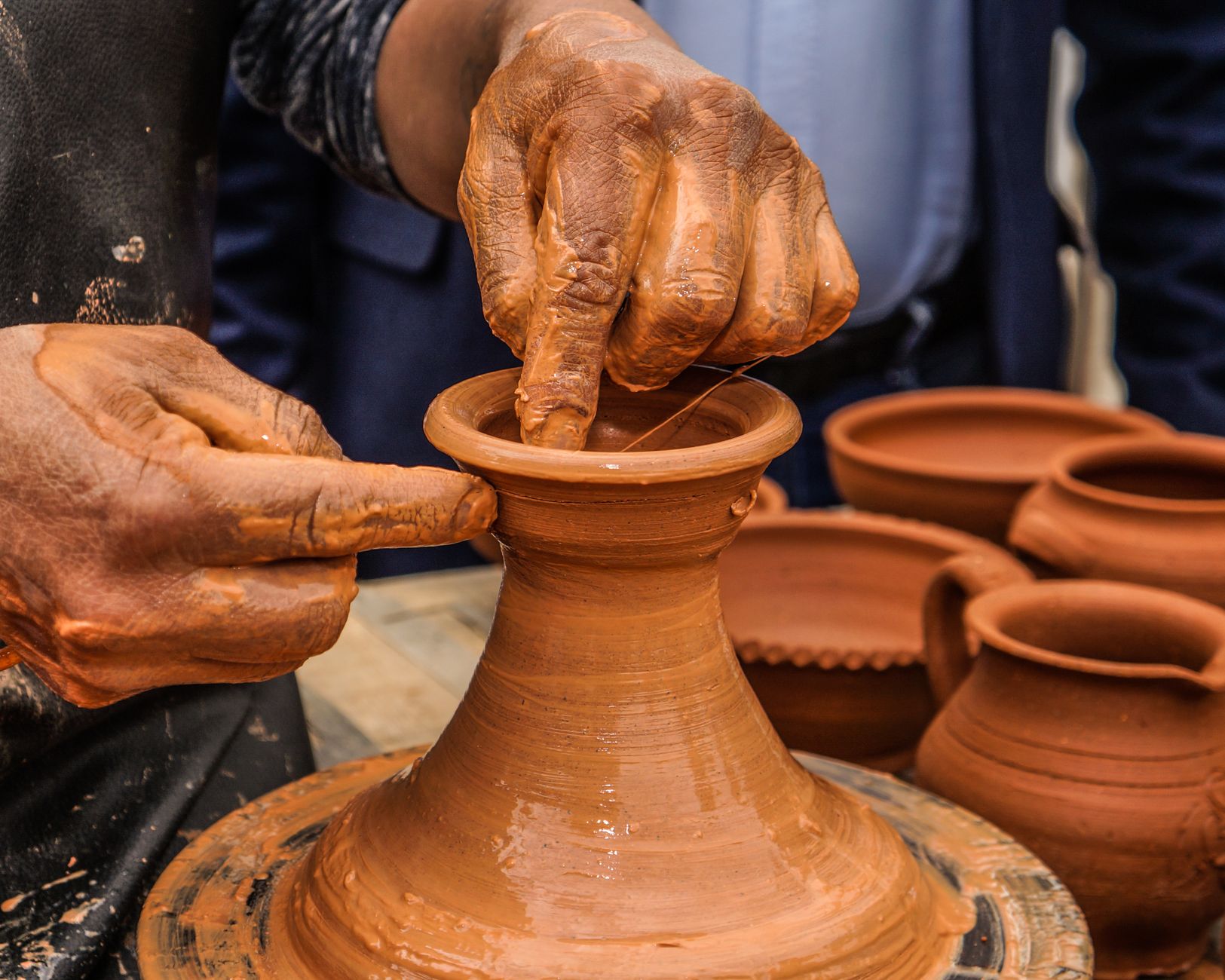
Centring comes next on the potter's wheel. The clay must rotate around the exact same centre point as the wheel, without wobbling from side to side. Only then can the hands open up the lump, work the base and draw the clay out towards the rim of the plate.
A plate is not simply a flattened bowl. The thickness of the base, the transition to the rim and the angle of the edge must work in harmony. The wide rim provides space for the decoration but also makes the form vulnerable during drying. Any uneven distribution of clay will persist throughout the work; it cannot be painted away.
Thus, when the plate leaves the wheel, a large part of its character is already in place. The decorator is given a form to work with, with a centre, a slope and an edge that dictate how the pattern can be built.
The Horn Applies the Colour – The Tip Transforms It
The decoration of Horezu ceramics relies on coloured clay slips, known as engobes, applied to the ware. Engobe is not the same as glaze. It provides colour and coverage; the glaze later adds the glassy surface layer. This distinction explains how the plate's pattern can be worked while the layers of colour are still wet.
The traditional palette contains earthy red and brown tones, green, blue and a light, ivory-coloured base. The colours can lie as clearly defined lines or be drawn together into denser ornamentation. It is the combination and the touch of the hand, rather than any single colour, that gives the style its character.
The decorating horn functions as both a small container and a drawing tool. A hollow horn fitted with a fine quill tip allows the slip to flow in controlled lines. The movement of the hand and the consistency of the slip determine whether the line is steady, broken or fluid.
Gaița is another tool: a fine tip used to manipulate the decoration. The names thus refer to different elements. The horn applies the colour, the gaița works within the colour, and jirăvire refers to the technique of drawing through the wet layers.
In the motif coada de păun (the peacock's tail), such strokes create a feather-like pattern. The name does not necessarily refer to a depicted peacock. It is the repeated shapes of the ornament that resemble the plumage.
This is also where the material's window of time becomes clear. If the decoration is too wet, it runs together too much. If it has had time to dry, the colour no longer follows the tip in the same way. The decorator is therefore not just working with a pattern, but with a specific state of the surface.
The Rooster Shares the Plate with Other Motifs
The Horezu plate in the collection of Muzeul de Artă Constanța (The Constanța Art Museum) is an example of how this type of object also belongs in an art collection. The local term taier refers to the plate itself, not a specific decoration. The shape can carry several different visual languages.
The rooster gives the ceramics an instantly recognisable figure. The comb, beak and tail feathers make the bird legible even when the body is simplified and the lines become ornamental. As a motif, it is both image and form: the tail can mirror the curve of the plate, while the direction of the body creates movement across the surface.
It is tempting to assign a ready-made symbolic explanation to every rooster. The bird's connection to dawn and awakening is easy to understand, but that does not mean every potter imbues the motif with the exact same meaning. A local tradition is not a code system where every figure can always be translated into a single message. The rooster also serves as a hallmark of the craft itself.
Flowers, spirals and geometric patterns offer other ways to organise the surface. A flower can anchor the centre of the plate, while repeating arches or lines give rhythm to the rim. The spiral creates movement without representing any specific plant or bird.
For the observer, it is rewarding to compare these very solutions: how much of the light background is left visible, how closely spaced are the lines, and how do the centre and the rim meet? Two plates with the same rooster motif do not have to share the same expression at all.
The Drying Cannot Be Rushed
After shaping and decorating, moisture must leave the ware under controlled conditions. The different parts of the plate need to dry reasonably evenly. If the edge loses water long before the base, tension builds up as the clay shrinks.
This is why there is no single production time that applies to every plate. The moisture content of the clay, the thickness of the ware, the humidity and the temperature of the workshop all influence the waiting time. A dry surface is also not the same as a bone-dry piece.
Glazing and firing should be understood as parts of the workshop's own workflow, rather than a universal schedule. In ceramic production, glaze can be applied to raw or already fired ware, depending on materials and methods. The essential thing is that the body, the decoration and the glaze work together through the heat of the kiln.
The kiln transforms the object in a way that hands can no longer correct. The clay becomes ceramic and the glaze fuses to form its surface. The resulting colours are shaped by materials and firing; the wet decoration is therefore never an exact preview of the finished plate. Knowing how to visualise the result during the process, but also how to read what actually emerges from the kiln, is part of the master's expertise.
UNESCO Recognises the Craftsmanship, Not Just the Object
In 2012, the craftsmanship of Horezu ceramics was inscribed on the UNESCO Representative List of the Intangible Cultural Heritage of Humanity. It is the knowledge and skills that are recognised, not just a collection of beautiful plates or a specific rooster motif.
The difference is vital. A finished object can be preserved in a display case, but it cannot teach anyone how to feel the correct moisture in the clay or to choose the exact moment to draw the tip through the engobe. Such knowledge is passed on by watching, trying, failing and having one's technique corrected by an experienced practitioner.
The tradition lives in the transmission between people, within families and between master craftspeople and apprentices. Wheel throwing, decoration and material science must all be passed down together. Knowing how to reproduce the rooster is not the same as mastering the plate.
This is also why Horezu ceramics deserve a closer look than just quick recognition. Follow a line of colour around the rim and see how it changes where the tip has passed. There, you see not just an ornament, but a decision made while the clay and the colour could still be shaped.
Sources & further reading
- ich.unesco.orgCraftsmanship of Horezu ceramics - UNESCO Intangible Cultural Heritage
- ro.wikipedia.orgCeramică de Horezu - Wikipedia
- porumbacu216.roLutul de la Horezu - Atelier de olărit cu Georgeta Popa - Porumbacu 216
- mesterpopular.roMester Popular Ceramica-Olarit Horezu
Share the article
Translated from Swedish with AI assistance. Read the original.


