
From Yugoslav Furniture Factory to Design Classic: The Story of Niko Kralj’s Rex
At first glance, it looks Scandinavian – clean, functional and made from warm bentwood. But the folding Rex chair was created in post-war Ljubljana. Here’s how the Slovenian architect Niko Kralj’s masterpiece crossed borders to become a beloved design classic in Nordic homes.
A light-filled room in a turn-of-the-century Stockholm apartment, or a minimalist villa outside Copenhagen. On the bare wooden floor stands a chair that feels as natural in the room as a piece by Hans J. Wegner or Alvar Aalto. It is a folding construction in bent plywood, with the slats of the seat and back forming a graphic play of lines.
But anyone who turns the chair over in search of a Danish or Swedish signature would be mistaken. This piece of furniture originated in the Balkans, in the forested heart of Slovenia, to be precise. The Rex chair, designed by architect Niko Kralj in 1952, is one of the region’s most successful exports and living proof of how Slovenian furniture craftsmanship found a natural place in the golden age of Nordic minimalism.
Pioneering work with bentwood: Niko Kralj’s ergonomic breakthrough
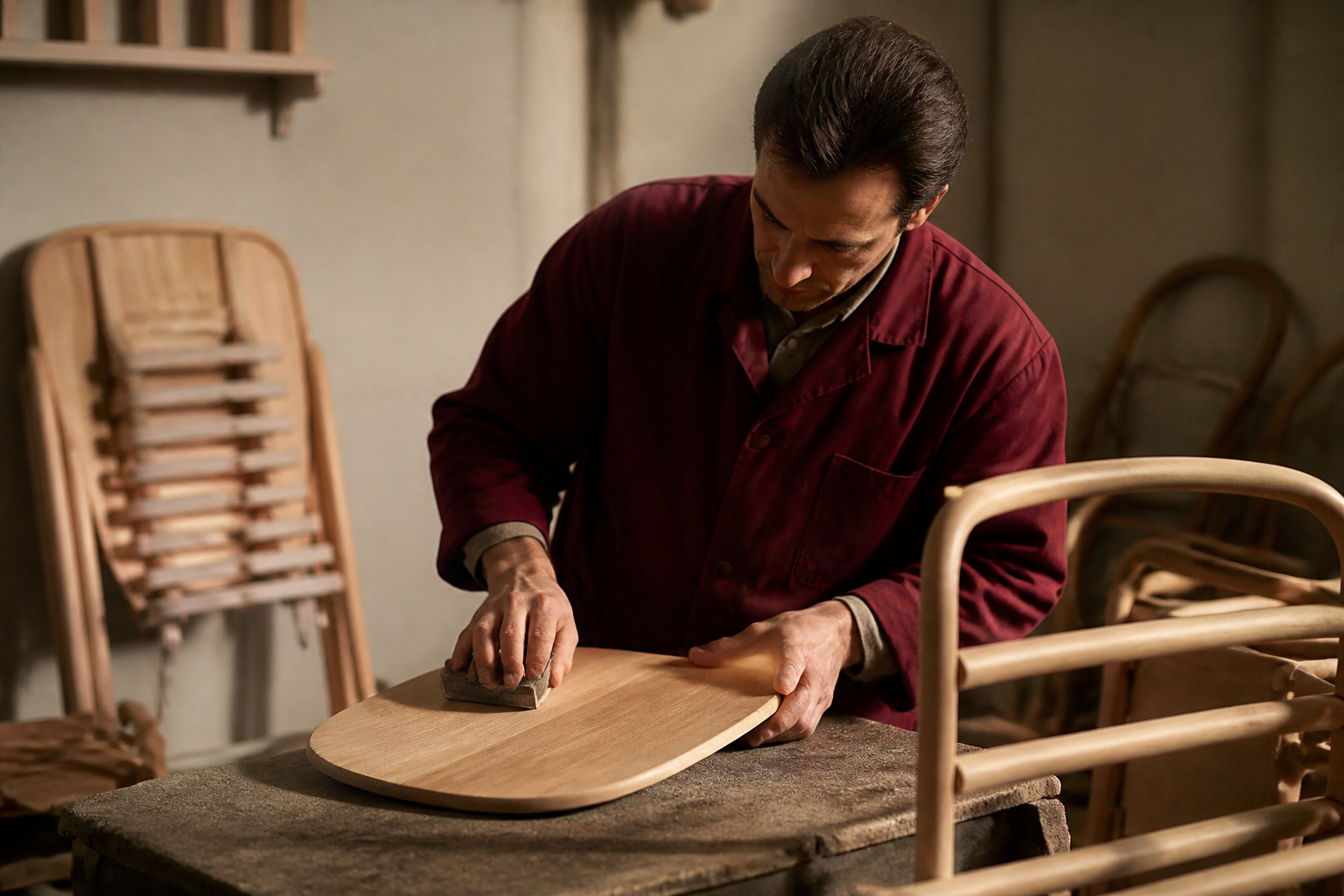
Niko Kralj (1920–2013) is often called the father of post-war Slovenian design. After the Second World War, much of Europe lay in ruins and materials were in desperately short supply. Kralj, who had studied architecture in Ljubljana under the influential Edvard Ravnikar, was hired by the Stol furniture factory in the town of Kamnik. The brief was clear but challenging: to design affordable, functional, space-saving furniture for the general public.
The solution lay in the new technique of moulded and bent plywood. Kralj was not the first to experiment with the material – pioneers such as Charles and Ray Eames in the United States had already shown the way – but his approach was deeply influenced by European functionalism and craftsmanship.
In 1952, he presented the Rex chair. Its breakthrough lay in the way he designed the seat and back. Instead of using large, expensive sheets of plywood, he had narrow slots cut into the wood. This not only reduced material use and the chair’s weight to a minimum; the slots also gave the wood a natural flexibility and spring, allowing the chair to adapt to the body. It was ergonomic innovation disguised as pure aesthetics.
Niko Kralj did not stop at Rex. During the same decade, he also designed the distinctive Mosquito chair (1953) – whose split seat recalls the wings of a mosquito – and the elegant, enveloping Shell Lounge chair (1956). Both models built on the same basic idea: to make moulded wood into furniture that was both sculptural and accessible.
Slovenian design meets Nordic minimalism
During the 1950s and 60s, Scandinavia experienced its own design revolution. There was a strong ideological connection between the Nordic pursuit of “more beautiful everyday goods” and Niko Kralj’s work in Slovenia. Both shared a belief in honest materials, pared-back lines, democratic prices and, above all, the idea that form should serve people.
Despite the Cold War and the political division of Europe, the Rex chair managed to cross borders. The Slovenian chair quickly attracted international attention for its ingenious folding mechanism, which made it perfect for the increasingly small and modern city homes of the time.
One of the earliest and most prestigious endorsements in the Nordic countries came when the Kunstindustrimuseet in Copenhagen (now Designmuseum Danmark) acquired the Rex chair for its permanent collection. For a chair made in socialist Yugoslavia to be displayed alongside the work of Denmark’s leading architects was a tremendous triumph. Around the same time, the chair was acquired by the Museum of Modern Art (MoMA) in New York. For discerning Nordic audiences, this showed that Slovenian design was of the highest international standard.
The modern collector’s piece in Scandinavian homes
In the decades after its launch, more than two million Rex chairs were made worldwide. In the Nordic countries, it became a familiar sight on glazed balconies, in summer cottages on Sweden’s west coast and in Danish villa gardens. Its ability to fold away easily made it the ultimate extra chair.
Today, as interest in mid-century modern design is stronger than ever, the Rex chair has taken on a new status. It has moved from balconies into the formal living rooms of people’s homes. At Nordic auction houses such as Bukowskis and Lauritz, and on various online vintage platforms, early originals from the 1950s and 60s are now highly sought-after collector’s items.
The chair has aged with such dignity thanks to the character of its materials. The patina on the dark-stained beech and the small brass details in the folding mechanism tell a story of European industrial history. It makes a perfect contrast with today’s often mass-produced and anonymous furniture.
A legacy evolves: From revival to international ownership
After the original production in Kamnik closed in the early 2000s, there was a risk that Niko Kralj’s life’s work would be forgotten. But design history had other ideas. In 2012, Slovenian entrepreneurs Žiga Vrhovec and Tomaž Sešlar founded the Rex Kralj brand with the stated aim of bringing the architect’s designs back to life.
They secured the rights to Kralj’s best-known models, modernised the manufacturing processes and began exporting the chairs once again to design shops around the world. Collaborations with contemporary creatives were also launched to keep the legacy alive. German star designer Konstantin Grcic has been inspired by Kralj’s techniques, and designer Lili Radu has created exclusive editions in which the distinctive wooden slats are upholstered in fine leather.
Slovenian design heritage has now become a global concern. In 2023, Rex Kralj was acquired by the respected Italian design company Gervasoni SpA (part of IDB Group). The purchase marks a new chapter, in which Niko Kralj’s Slovenian vision is supported by Italian distribution and marketing, while production and respect for its Slovenian origins are maintained.
Today, if you walk through Slovenia’s capital, Ljubljana – along the Ljubljanica river at Gallusovo nabrežje, for example – you will often see Rex chairs on café terraces. They are used just as Niko Kralj intended: as durable, beautiful and functional everyday objects. The story continues, too. His archive is preserved at the Muzej za arhitekturo in oblikovanje (MAO) in Ljubljana, and across Europe, in Scandinavian homes, his most famous chair continues to unfold – ready for the next generation of design lovers.
Facts
NIKO KRALJ (1920–2013)
- Background: Slovenian architect and designer, educated at the University of Ljubljana under Edvard Ravnikar.
- Masterpiece: Designed the Rex chair in 1952; more than two million have been sold worldwide.
- Key works: In addition to the Rex chair, he designed the Mosquito chair (1953), the Shell Lounge chair (1956) and a large number of innovative modular storage systems.
- Recognition: His work is represented in the permanent collections of, among others, MoMA in New York and Designmuseum Danmark in Copenhagen.
Sources & further reading
- Slovenian Tourist BoardSlovenian Design Showcase
- Rex Kralj OfficialRex Kralj Heritage
- Muzej za arhitekturo in oblikovanjeMuseum of Architecture and Design (MAO)
- probauhaus.comČAS ZA LES - inovativna raba lesa v sodobni slovenski arhitekturi
Share the article
Translated from Swedish with AI assistance. Read the original.


