
Danish Eurowind links solar power and batteries in Tenevo
In Tenevo in south-eastern Bulgaria, solar production and battery storage meet in a project co-owned by the Danish company Eurowind Energy. The solar park and a first battery stage have been commissioned, while wind power remains part of the expansion plans. What matters is not just how much electricity the facility produces, but when it can be delivered.
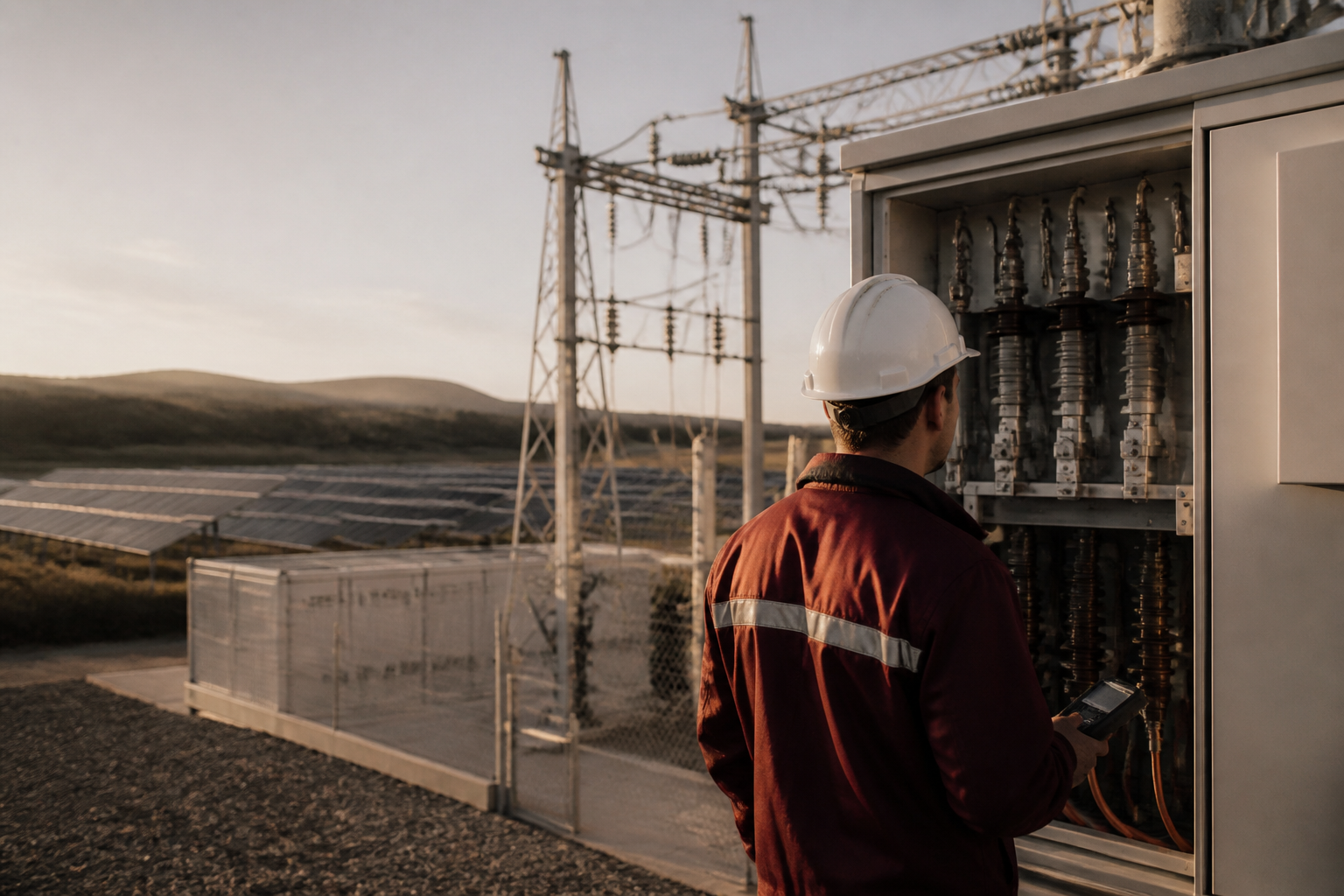
Solar panels produce power when the sun provides energy. Batteries make it possible to shift a portion of the delivery to another time. This difference is the very point of the energy project in Tenevo, where Danish Eurowind Energy and Renalfa IPP are combining solar power with storage and planning to complement it with wind power.
The connection between the Nordic region and the Balkans is tangible: a Danish energy company is a co-owner of a Bulgarian production facility. But Tenevo is also an example of why an energy park is no longer particularly well described by a single capacity figure. Solar panels, batteries and grid connections do different jobs. And what has been inaugurated must be kept separate from what is still just a plan.
From first connection to larger solar park
In August 2025, a first solar stage of 69 MW was connected. At the time, the grid connection was also described as complete. This meant that a part of the solar project had begun delivering electricity, rather than signaling that all planned production and storage components were finished.
Reporting from October 2026 describes a 242 MWp solar park and a first battery stage in operation. This latter status should not be confused with the initial connection. A large energy project can begin producing long before all stages are completed, and an inauguration is not in itself a final technical sign-off for every part.
The size of the solar park must also be read with care. In the data regarding Tenevo, both 238 MW and 242 MWp appear. The designation MWp (megawatt peak) is used for the combined peak capacity of the solar panels under standardised test conditions. A value in MW, on the other hand, might refer to another part of the facility, such as the capacity on the alternating current (AC) side.
This does not mean that this specific detail explains the discrepancy at Tenevo. Without a common technical specification, it is impossible to determine whether the numbers describe different metering points, changed design plans or distinct project versions. They should therefore not be used as proof that the park has grown by a certain number of megawatts.
The battery produces no electricity – it shifts it
Solar generation follows the light, not the desires of electricity users. Batteries introduce a different function: they can charge when electricity is available and release energy later. This makes it possible to separate the timing of generation from the timing of delivery.
The October data mentions two co-located battery systems with a total capacity of 311 MW and 773 MWh of energy capacity. These two metrics answer different questions. MW describes how quickly the batteries can absorb or discharge energy. MWh describes how much energy they can store.
However, a figure for the combined size of two systems is not automatically an announcement that the entire capacity has entered commercial operation. The reports describe a first battery stage as commissioned. This does not provide a sufficient basis to equate this with both systems working at full specified capacity.
Tenevo is connected to the Bulgarian transmission system operator ESO's 400 kV grid. The grid connection is the link between the energy park and the external power system. The solar panels and batteries must be managed so that deliveries remain within the technical and contracted limits of the connection.
Adding together the capacity figures of the solar park and the batteries therefore does not tell us how much electricity can be fed into the grid simultaneously. Nor does it say how the batteries are actually used. Storage can be used to delay deliveries or help balance the power grid, but what services Tenevo delivers and how often requires operational data and agreements. Technical capability is not the same as documented use.
Eurowind's role is that of owner
Eurowind Energy, alongside Renalfa IPP, is behind the Tenevo project. The Danish connection is therefore on the ownership side, rather than simply a Nordic component being purchased for a Bulgarian facility.
This is an important distinction. An owner has a long-term interest in the project's production, costs and value. A contractor is responsible for contracted construction or installation work, while a component supplier delivers equipment. The same project can gather many well-known corporate names without their responsibilities being comparable.
At the same time, Eurowind's involvement should not be made larger or more detailed than the evidence allows. The ownership role does not in itself reveal who designed the battery control systems, who manages the daily electricity trading, or how operational responsibility is split between the partners. Nor is it possible to attribute a specific funding amount to Eurowind based on the disclosed project details.
What can be said is that the company is participating in a project where multiple technologies must function as a coordinated facility. For an owner, the task involves more than simply installing solar panels. Production, storage, grid connection and maintenance must work together over the lifetime of the installation. How that work is divided between Eurowind, Renalfa and their suppliers is a separate issue from ownership.
Hail tested the implementation
The path to the subsequent commissioning was not straightforward. Hail-damaged panels affected the second stage of the solar park, which in the earlier schedule was due to start at the beginning of 2026. This date is an older planning target and should not be presented as a future start date.
The damage demonstrates a concrete aspect of weather dependence. Weather does not only determine how much a solar park produces; it can also damage equipment and affect construction. When panels need to be inspected or replaced, additional work is required before the affected section can be handed over to operations.
However, it is impossible to draw conclusions about repair costs, replacement panels or insurance outcomes without specific data. The fact that a facility is struck by hail does not in itself say anything about the quality of the project planning. For Tenevo, the established point is narrower: the panel damage affected implementation, and the older schedule must be read in the light of later reports on operations.
Wind power is still the next step
The plans also include 250 MW of wind power. This part must be kept clearly separate from the solar park and the commissioned battery stage. Wind power is a planned expansion, not existing production in Tenevo.
Technically, there is a clear rationale behind the combination. Wind and solar have different production profiles. Wind power can generate even when the sun has gone down, and batteries can smooth out some of the variation over time. However, how well they complement each other at a given location depends on actual wind and solar conditions, grid constraints and how the facility is managed. The combination does not guarantee constant supply.
The figure of a total investment exceeding €500 million (approx. £420 million) relates to all stages of the project. It should therefore not be read as the cost of only what is already in operation, nor as proof that the entire subsequent expansion is funded. For the wind portion, the available information provides no clear confirmation of full permitting status, secured financing or a binding start of construction.
The significance of Tenevo does not need to be built on European rankings. Here is already a concrete story of Danish co-ownership in Bulgarian energy production, a solar park developed in stages, and batteries that bring the ability to manage deliveries over time. The next test will be how this coordination functions in daily operation – and whether the wind plans become part of the actual facility.
Sources & further reading
- Balkan Green Energy NewsRenalfa IPP, Eurowind Energy inaugurate giant hybrid power plant in Bulgaria
- renalfaipp.comThe first phase of the complex RES project "Tenevo" has ...
- ceenergynews.comRenalfa IPP launched the first phase of a hybrid RES project in Bulgaria
- now.solarRenalfa IPP, Eurowind inaugurate 242MW solar-plus-storage project in Bulgaria – PV Tech | Solar Now
Share the article
Translated from Swedish with AI assistance. Read the original.


