
Chiprovtsi rugs get their patterns in the loom
No pile hides the construction of a Chiprovtsi kilim. The smooth woollen surface is both image and weave, built by hand on a vertical loom. In the Bulgarian town of Chiprovtsi, a textile expertise lives on, where colour, density, and geometric motifs must be resolved together – thread by thread.
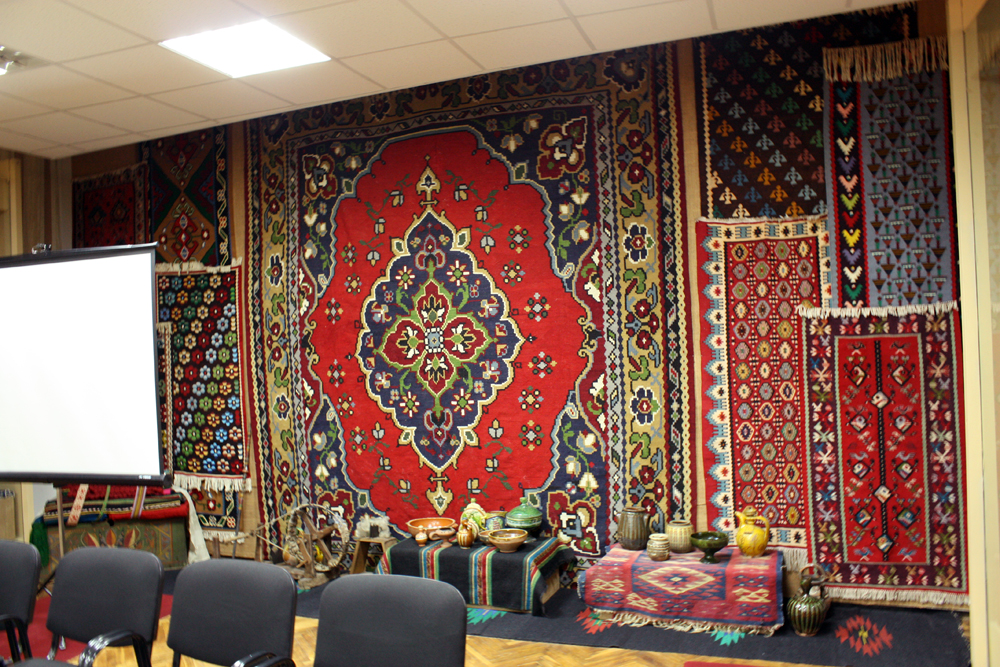
Turn a Chiprovtsi kilim over, and the pattern follows. It does not sit on top of the rug, printed or embroidered onto a pre-made base. Coloured weft threads form the weave itself. The rug's double-sided nature is therefore more than just a useful feature: it reveals how the object is made.
Chiprovtsi is located in north-western Bulgaria, on the slopes of the Balkan Mountains. Here, flat-woven rugs belong to a living craft, with female weavers as the central keepers of knowledge. The work combines a clear technical order with a multitude of decisions that must be made during weaving. How tightly should the weft be packed? Where should a colour area end? How do you maintain the pattern's proportions when the dimensions of the rug change?
For anyone interested in textiles, there is much to be read in the surface. A pointed shape tells of the meeting between vertical warp and horizontal weft threads. A sturdy border shows how repetition holds the composition together. And colour is never separate from the material: the same hue has a different effect in a loose yarn than in a tightly packed weave.
A rug without a knotted pile
At the vertical handloom, the warp runs from top to bottom. It consists of the taut threads around which the work is built. The weft is passed across through the warp and packed so tightly that it dominates the finished surface. In Swedish weaving terminology, this is a weft-faced flatweave.
The coloured yarn does not need to run across the entire width of the rug. Different wefts work within their own pattern areas, turning and meeting other colours. In this way, both the rug and its image emerge simultaneously. The weaver does not first produce a neutral base only to decorate it later.
The difference from a knotted pile rug is concrete. In such rugs, yarn knots form an upright pile, anchored around the warp threads and stabilised by the weft. The surface of the Chiprovtsi kilim is instead smooth. Here, it is the density of the weave and the edges of the colour fields that provide structure, not the height of a clipped pile.
The upright loom also makes the relationship between hand and image clear. The weaver works closely on a small section but must keep the entire composition in mind. An error in the distance between two motifs can affect the next repetition and, ultimately, the meeting with the border. Pattern mastery is therefore as much a question of proportions as of recognising a shape.
The surface of wool, the stability of warp
Wool and cotton serve different functions in the weave. In the combination of cotton warp and wool weft, the cotton provides a stable frame, while the wool builds the visible, coloured surface. However, the material description does not tell the whole story: describing a rug as a wool rug does not necessarily mean that the warp is also made of wool.
The elasticity and friction of the wool help the weft threads close together into a coherent surface. Cotton is well-suited as a warp material due to its strength and ability to be held under even tension. The feel of the finished rug also depends on the yarn's thickness and twist, the density of the warp, and how tightly the weft is packed.
The preparation is therefore evident in the result. The yarn needs to be even enough for the intended weave, the colour areas planned, and the warp correctly tensioned. A dense rug is not created solely by the weaver packing the yarn tightly. Material and construction must work together, otherwise the shape risks warping or the surface becoming uneven.
Durability is likewise a quality of the entire object, not an automatic promise from the word handwoven. A well-consolidated weave and carefully finished edges are crucial to how the rug holds together in use.
Colour is also a question of material
In descriptions of older Chiprovtsi rugs, harmonies of yellow or ochre, brown, blue, and green reappear. They provide an entry point into the tradition's colour language, but not a complete template for what a rug from Chiprovtsi must look like. Older colour schemes are references, not a requirement that every new weave must repeat the same palette.
Nor is it possible to determine the dye solely from the hue. A muted brown yarn is no proof of plant dyeing, any more than a bright red automatically reveals a synthetic dye. Naturally dyed and synthetically dyed yarns can both occur within artisanal textile production. For a specific rug, this information must come from the maker or the documentation surrounding the object.
Here, it is worth distinguishing between two questions: how the colour is produced and how it is used. The latter can be examined directly in the rug. A dark outline can hold small figures together. A light section can open up the central field. Two closely related hues provide a different pace than a sharp contrast between light and dark.
A new palette therefore alters more than just the mood. It can make a familiar shape stand out more clearly, or allow it to recede into a larger pattern.
Geometry that can be read
Start with the border. It is not merely a frame around something more important, but helps the eye grasp the scale and rhythm of the rug. A dense sequence of small shapes along the edge can balance larger motifs in the central field. Multiple borders create steps between the surroundings and the rug's inner composition.
Then continue with a single shape. Follow how it is repeated, mirrored, or offset. Angular forms suit the structure of the weave: a diagonal is built step-by-step as the colour boundary shifts between warp threads. What looks like a continuous line from a distance reveals itself up close to be a work of small adjustments.
For a reader familiar with Nordic rölakan (Swedish flatweave), this is a particularly useful way to approach Chiprovtsi kilims. Compare how colour fields meet, how a border is defined, and how repetitions are organised. The similarity in certain visual techniques does not necessarily mean the traditions share a documented historical kinship.
Be cautious, however, of turning every shape into a symbol with a fixed meaning. Local motif names and interpretations need to be tied to a specific weaver, a documented rug, or a museum description. Without that grounding, a precise description of the form says more than an enticing tale about what it is claimed to mean.
A cultural heritage that must be usable
The weaving tradition of Chiprovtsi has been inscribed on UNESCO's Representative List of the Intangible Cultural Heritage of Humanity since 2014. It is the expertise and the tradition that are recognised, not each individual rug as a certified product.
The difference matters. What is to survive exists not only in finished objects, but in people's hands and judgement. The knowledge is passed down through generations by showing, imitating, and working together. A pattern can be copied. The feel for warp tension, weft density, and how to correct an unevenness requires practical experience.
The rug room at the History Museum in Chiprovtsi offers a different kind of access to this expertise: the opportunity to study finished weaves and compare their compositions. The museum object preserves a result. The active weaver must, in addition, master the path to get there.
Bespoke patterns present this expertise with concrete design challenges. A different format is not simply a smaller or larger version of the same image. The number of repetitions, the width of the border, and the balance of the central field must all work in the new proportions. Continuing to work with the tradition can therefore mean changing a pattern with a deep understanding of its construction.
This is where the Chiprovtsi kilim becomes interesting as contemporary design as well. The rug needs to function as an object, not merely represent a heritage. If you turn it over, the same clear explanation remains: colour and construction cannot be separated.
Sources & further reading
- ich.unesco.orgThe tradition of carpet-making in Chiprovtsi - UNESCO Intangible Cultural Heritage
- en.wikipedia.orgChiprovtsi kilim - Wikipedia
- en.wikipedia.orgChiprovtsi kilim - Wikipedia
Share the article
Translated from Swedish with AI assistance. Read the original.


