
Cathedrals of the Body: From the historic hamams of the Balkans to the Nordic urban sauna boom
In an era where our lives are becoming increasingly digital and fleeting, we are seeking a return to the elemental: warmth, stone, wood and the quiet encounter between people. But while the Nordic sauna is experiencing an urban renaissance, the historic bathhouses of the Balkans rest upon centuries of spiritual and social architecture. Join us on a journey through the steam, from the Moorish arches of Sarajevo to the artistic domes of Skopje and the new Nordic cold-plunge wave.
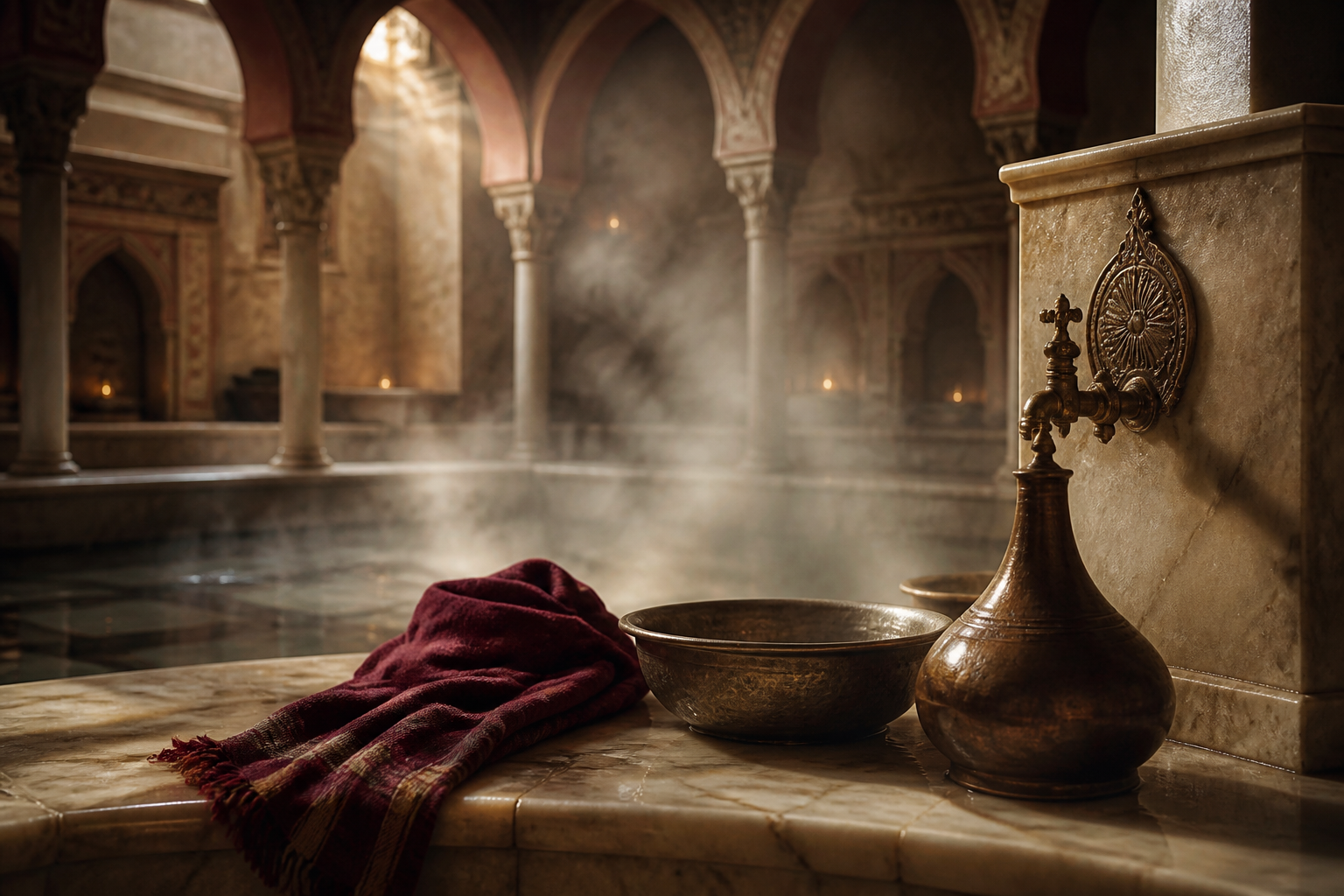
There is a particular silence that only arises where water meets extreme heat. It is a hushed, almost sacred atmosphere where voices level out and the social masks of everyday life melt away. Whether you are sitting on a sun-warmed tarred bench in a Finnish sauna, looking out over a grey Kattegat from a floating sauna pontoon in Gothenburg, or gazing up at the beams of light filtering through the dome of an Ottoman bath in Sarajevo, the experience is the same. The body is returned to its most basic elements.
Historically, bath culture in the Nordic countries and the Balkans developed out of different geographical and religious needs, but fundamentally they share a core philosophy: the bath is not merely a hygienic necessity, but a social ritual and a spiritual cleansing.
İsa Begov Hamam: Sarajevo's Moorish bathhouse dream
In the Bistrik district of Sarajevo, just a stone's throw from the famous Latin Bridge where the shots that triggered the First World War once rang out, lies the İsa Begov Hamam. It is Sarajevo's oldest public bath, founded in the 15th century by İsa-beg Ishaković, the man who also laid the foundations of the entire city during the reign of Sultan Mehmed the Conqueror.
Stepping inside today is like walking through an architectural time portal. After lying in ruins for a long time following the war in the 1990s, the building has been painstakingly restored into an exclusive boutique hotel and wellness centre. The scent of eucalyptus and damp marble greets the visitor the moment the heavy doors close against the noise of the city.
Here, the Ottoman bath ritual is alive. You lie on the heated central marble slab, göbektaşı (belly stone), beneath a dome perforated with small star-shaped glass openings that let in a dreamlike, dappled daylight. The warmth softens the muscles before the bath attendant begins the traditional scrubbing with a coarse silk glove, followed by a massage in a mountain of fluffy soap suds. It is an experience that is as much about touch and weightlessness as it is about cleanliness.
Skopje's sacred trio: When the bath was the heart of the city
Travelling south-east, to North Macedonia's capital Skopje, one finds another aspect of this bathing culture. In the heart of the Old Bazaar, Stara čaršija, lies the Çifte Hamam. Built in the same era in the 15th century – also by İsa-beg – it forms, along with the adjacent Murat Pasha Mosque and the Suli An inn, a so-called "Islamic trio".
This trinity of buildings was the backbone of Ottoman town planning: the inn offered shelter to merchants, the mosque provided spiritual guidance, and the bath ensured hygiene.
– "The hamam in Muslim societies had a profound religious function," explains Professor Mesut Idriz, an expert in Islamic history and civilisation. He emphasises that, unlike the ancient Roman baths, which were primarily places of recreation and pleasure, the hamam was deeply integrated into spiritual life.
Its association with the Islamic ritual full-body ablution, ghusl, made the bathhouse a sacred place. According to Professor Idriz, the hamam tradition is firmly rooted in Islam's emphasis on cleanliness and the sanctity of water.
– "Throughout Muslim history, the hamam has enabled people to maintain both physical purity and spiritual readiness," he notes.
Today, however, steam no longer flows through the Çifte Hamam or its twin, the Daut Pasha Hamam, further down the bazaar. Instead, these monumental buildings with their dozens of domes have been given a new lease of life as art galleries under the National Gallery of North Macedonia. Wandering among contemporary Macedonian sculpture and painting beneath the old, raw brick arches where thousands of bathers once whispered in the steam creates a unique visual contrast.
From Ottoman ablution to Austrian aesthetics
When the Austro-Hungarian Empire took over the administration of Bosnia and Herzegovina in the late 19th century, two completely different worlds met in Sarajevo. The new administration wanted to modernise the city, but was simultaneously fascinated by Oriental aesthetics.
This gave rise to the so-called Pseudo-Moorish style, an architectural hybrid that still characterises Sarajevo today. When the İsa Begov Hamam was damaged and needed to be rebuilt in 1890, the famous Austrian architect Josip Vancaš was commissioned. He integrated the original Ottoman bath features into a facade with zebra-striped bands of colour, horseshoe arches and decorative Moorish details. The bathhouse thus became a physical bridge between East and West, between Central European spa culture and South-East European bathing traditions.
The Nordic response: The urban sauna revolution
While the hamams of the Balkans often carry a heavy historical and architectural palette, Nordic sauna culture has traditionally been more rustic, intimate and close to nature. The Finnish sauna and the Swedish bastu were born in the countryside as practical spaces for childbirth, washing, curing meat, and spiritual recovery in a harsh climate.
But in recent years, something dramatic has happened in Nordic cities. An urban sauna boom has swept through Oslo, Gothenburg, Stockholm and Copenhagen. Along the harbour fronts, spectacular, architectural sauna buildings have risen from the water. No longer a matter of hiding away in a dark basement, the sauna has become a public, social and aesthetic arena.
Here, the old sauna meets the modern wellness trend. Through ritual experiences such as "saunagus" – where a sauna master (gusmester) waves essential oils over the hot stones to the sound of calm music – the sauna has become our era's equivalent to the classical bathhouse. It is a space for community where the CEO sits next to the student, both dressed in nothing but towels, just as the merchants and craftsmen did in Skopje's bazaar five hundred years ago.
Meeting in simplicity
There is a striking parallel in how these two seemingly different cultures approach water. In both the Nordic sauna and the Balkan hamam, the simple elements rule. It is about surrendering control, letting the warmth penetrate to the bone, and allowing the cold water – whether a plunge into an ice hole in the Gulf of Bothnia or a ladle of cold spring water over the head in Sarajevo – to bring the senses back to life.
When we visit the İsa Begov Hamam today or step into a modern floating sauna in the Nordic region, we are essentially doing the same thing. We are seeking a pause in the noise. We are seeking a place where we are allowed to simply be bodies, enveloped in warmth, waiting for the next cooling dip.
Facts
THE THREE PHASES OF THE HAMAM The traditional Ottoman bath ritual follows a careful rise in temperature through three different rooms:
- Camekân (The changing room): A cool reception room where you change, wrap yourself in a cotton towel (peştemal) and drink a cup of tea.
- Ilıklık (The warm room): A transitional room where the body gradually adjusts to the heat and humidity.
- Hararet (The hot room): The heart of the bath, filled with steam and lined with marble. Here you lie on the heated marble slab (göbektaşı) to sweat before scrubbing and washing begin.
Sources & further reading
- eurekalert.orgResearchers highlight the Turkish Hammam's role in ...
- academia.edu"The Ottoman Hammam in Greece and the Balkans ...
- isabegovhotel.comHistory – Isa Begov Hamam Hotel
- lastminute.comİsa Begov Hamam Hotel, Sarajevo | Best deals | lastminute.com
Share the article
Translated from Swedish with AI assistance. Read the original.


