
Bougatsa in Thessaloniki begins with the dough
Semolina custard under icing sugar, salty cheese or spinach between paper-thin layers of dough. Bougatsa is a staple of Thessaloniki's breakfast tables, but the filling only tells half the story. For artisans like Filippos Bantis, the secret lies in the phyllo pastry – and the hands that stretch it.
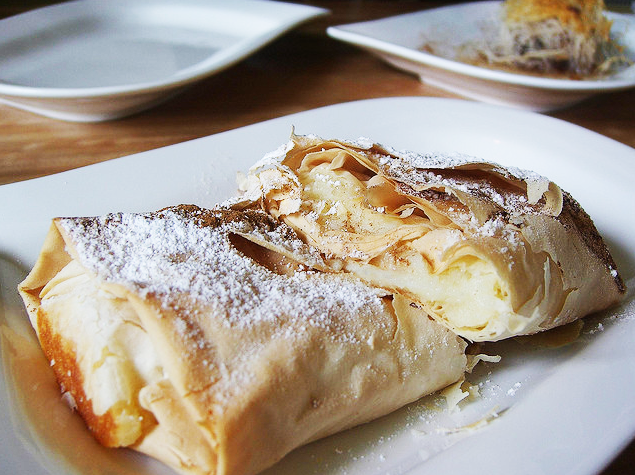
The tricky part of making bougatsa is getting the dough thin enough without tearing it. It must be able to encase a soft filling, fold into multiple layers and still turn out crisp from the oven. When the pastry is sliced into individual portions, the top should shatter into light flakes, whilst the layers closer to the filling retain a degree of suppleness.
It is this very contrast that people eat for breakfast in Thessaloniki. Not simply something sweet to go with coffee, but a pastry that is just as likely to hold cheese, spinach or minced meat. Ordering therefore begins with a choice: sweet or savoury? For those wishing to understand the craft, there is a further question: how is the dough made?
A sheet of dough stretched in the air
Filippos Bantis at Bougatsa Bantis offers a tangible introduction to handmade bougatsa. He works with hand-stretched phyllo, often called fyllo aeros: a dough worked into a thin, continuous sheet using his hands and sweeping motions through the air.
It is easy to get caught up in the performance itself, as the dough is tossed and expands. But the work begins long before that movement. A dough that is to be stretched so thin requires both cohesion and elasticity. Kneading develops the gluten structure; resting allows it to stretch without constantly pulling back. Trying to force a tense dough easily results in thick patches or tears.
During hand-stretching, the baker works progressively across a larger surface. The dough's own weight assists when it is lifted, while the hands guide the expansion. The goal is not merely a translucent centre, but a sheet that functions as a whole. Thick edges alter how the finished pastry bakes and feels in the mouth.
This kind of phyllo should not be confused with puff pastry. Puff pastry is built through repeated rolling and folding with fat between the layers. In bougatsa, the starting point is instead the paper-thin, stretched sheet, which is brushed with fat and folded around the filling. It is a different way of building layers.
The crispness arises between the layers
Once the filling is placed on the dough, the next precision task begins. The sheet must be folded into a parcel that holds together without becoming dense. Fat between the layers helps them remain distinct. In the oven, moisture turns to steam, causing the layers to puff, while the surface dries and browns.
The result depends on the interplay between dough, fat, filling and heat. Too much moisture makes it harder to achieve a crisp base. A dough that is too thick yields a chewy rather than flaky texture. A filling that is unevenly distributed leaves some pieces virtually empty and others heavy.
There are good reasons, therefore, to look at the cross-section, not just the golden top. This reveals how the pastry envelopes the contents. A well-made bougatsa does not need to be bone-dry throughout: the contrast between a crisp shell and a softer interior is part of the appeal.
Even the time spent out of the oven matters. When a hot pastry is boxed up, steam builds up and softens the crunch. Anyone buying bougatsa to take away will therefore have a slightly different experience than someone eating it immediately. This is no mysterious measure of quality, simply the pastry's physical elements continuing to change.
Custard, cheese, spinach or minced meat
The range offered by the Gkekas family provides a useful illustration of bougatsa's scope: custard, cheese, spinach and minced meat. The same basic concept accommodates both a sweet finish to breakfast and something that functions as a fully savoury morning meal.
The custard version contains semolina, which gives the milk custard stability. It needs to hold its shape between the layers of pastry when sliced, rather than running out like a sauce. Icing sugar and cinnamon are customary toppings. The sugar sits on top of the pastry, meaning the sweetness hits the palate before the milder custard does.
The cheese filling offers a different balance. The saltiness contrasts with the pastry's mild flavour and rich fat. The specific cheese blend used affects both acidity and texture, so it is wiser to ask the baker rather than assuming all cheese bougatsa is the same.
The spinach version introduces a greener flavour and a different kind of succulence. Here, managing the moisture becomes particularly important: leafy greens contain a lot of water, yet the dough must still be able to bake properly. Having spinach in the name does not automatically mean the filling is cheese-free, either.
With minced meat, bougatsa approaches a small meal. The filling has more structure than the custard, and each bite relies on the contrast between the meat and the thin layers. It is the same pastry technique, but a different way to start the day.
When the dough is the entire contents
The unfilled version with sugar makes for an particularly interesting comparison. Without custard, cheese or vegetables, the flavour and structure of the dough become clearer. There is no soft centre to steal the limelight.
To dismiss it as simply empty is to miss the point. The folding, the baking and the amount of fat take on greater significance for the final result. The sugar provides sweetness, but it is the baked layers of dough that you are actually eating.
For those wishing to explore, it offers a rewarding contrast to the semolina custard. With custard, there is a meeting of smooth and crisp; without filling, the experience is more about how the layers shatter. However, availability should be checked at each individual bakery – the unfilled version is not to be taken for granted everywhere.
A breakfast map beyond the waterfront
Bougatsa also provides a reason to explore Thessaloniki beyond the waterfront and the busy thoroughfares around Aristotelous Square. The neighbourhoods surrounding the Ministry for Macedonia and Thrace, the areas west of the centre, and Triandria to the east belong to a more everyday map of the city, where the bakery is a stop along the way rather than the day's main destination.
This does not mean that everyone eats the same breakfast or that every neighbourhood has its own style of bougatsa. The difference lies rather in the context: food bought close to home or work, compared to a cafe visit that takes up a larger part of the morning.
The portioned format of bougatsa works in both scenarios. It can be chopped into bite-sized pieces and eaten on the spot, or boxed up to go. However, seating, serving styles and opening hours vary between establishments. A traditional bakery and a pastry shop do not necessarily offer the same kind of morning.
Those primarily wishing to examine the pastry itself would be wise to prioritise a portion fresh from the oven over a long list of addresses. Start with a filling you are curious about and ask what is hot. Sharing one savoury and one sweet option provides a clearer picture of the spectrum than two identical portions.
The craft and larger-scale production
Bantis's hand-stretched dough demonstrates one way of working. Sarri represents larger-scale production within the same bougatsa landscape. Between the family bakery and an operation with higher production volumes lie questions far more interesting than a simplistic division into authentic and inauthentic.
The fact that a bougatsa is baked on the premises, for instance, does not in itself mean the dough was mixed, stretched and filled there. Production, delivery and baking are distinct stages. They need to be examined individually, rather than assuming all operators function in the same way.
For the curious customer, the questions are concrete: Do you make the dough here? Is it stretched by hand? Where are the pastries filled and folded? The answers tell you far more about the work than the word 'traditional' on a sign.
And then, of course, remains the eating. Icing sugar may dust the surface and custard may capture your attention, but it is the dough that holds the bougatsa together. At Bantis, this connection becomes particularly clear: breakfast begins long before the filling is added, with a piece of dough destined to become thin enough to fold into crisp perfection.
Share the article
Translated from Swedish with AI assistance. Read the original.


