
Beyond the espresso: Pristina's devoted quest for the perfect makiato
In Kosovo’s bustling capital, coffee is much more than just a morning routine. It is a social currency, an architectural anchor and the foundation of one of Europe’s most passionate coffee cultures. Join us in Pristina, where the perfect makiato has become an art form that challenges Italian hegemony.
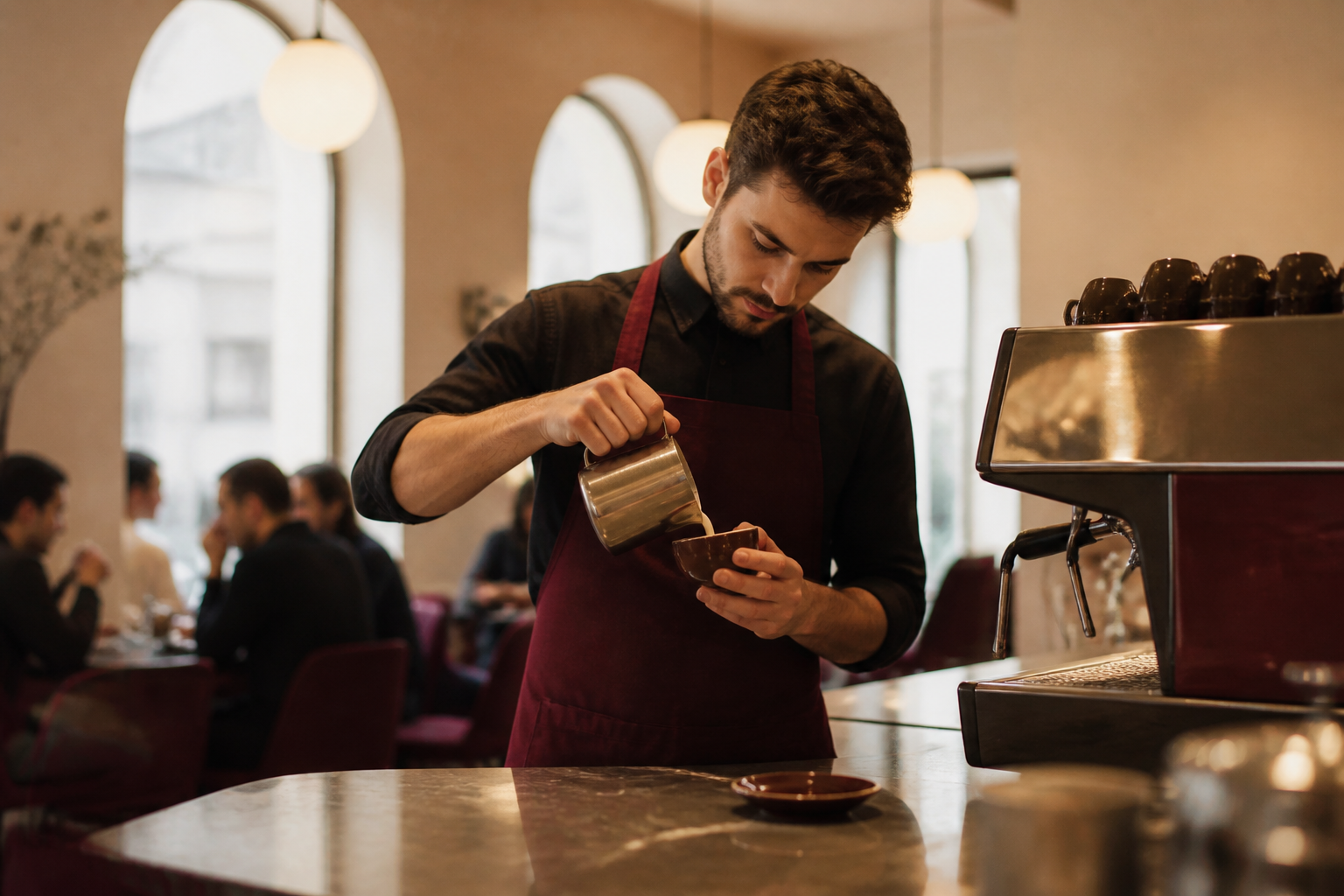
The sun has just broken through the morning mist over Mother Teresa Boulevard in Pristina, but the city’s rhythm has already been underway for a long time. It is not the traffic that is loudest – the pedestrian street is car-free and peaceful – but the mechanical, almost industrial sound of metal against metal, hissing steam and clinking porcelain. It is the sound of a capital waking up through its absolute most important ritual: the preparation of a makiato.
To claim that Pristina serves the world’s best macchiato – or makiato, as it is spelled locally – outside Italy is no exaggeration in the eyes of Kosovars. It is an established fact. For the Nordic visitor stepping into one of the city’s hundreds of cafés, the experience is often a revelation. Forget the layered, sometimes burnt and often oversized drink served at Nordic chains. Here, the makiato is a precision craft at the milligram level, served in small, elegant glasses where the rich shot of espresso meets a velvety, almost creamy crown of milk foam that balances perfectly between sweetness and bitterness.
The secret craft behind the makiato
What is it then that makes the coffee in Pristina so special? The answer lies in a combination of almost religious devotion among the city's baristas and fierce local competition. At cafés like Matisse, Trosha or Half and Half, coffee brewing is no casual occupation; it is a respected career choice. Baristas like Fisnik Mexhuani talk about extraction times, water temperatures and milk fat content with the same precision as a chemist.
In Pristina, the makiato is traditionally made with a double espresso as a base, but the great secret lies in how the milk is steamed. Instead of the airy, bubbly foam often associated with a standard cappuccino, the baristas here work up a so-called microfoam. It is so dense and creamy that it almost has the consistency of melted vanilla ice cream. When poured over the espresso, it blends seamlessly with the coffee, bringing out its natural chocolate and nutty notes without masking its strength. To serve a makiato with visible air bubbles in the foam is regarded in Pristina as a professional failure.
Another critical factor is the equipment. The city's café owners spare no expense; the latest Italian espresso machines gleam behind the counters, and they are carefully calibrated several times a day to compensate for humidity and temperature changes. But the machine is only as good as the person behind it. It takes months of training to master the exact hand movement required to create the perfect texture.
From the buzz of the teahouse to the pulse of the espresso bar
The coffee culture in Kosovo is relatively young in its current form, but its dominance is total. Just a few decades ago, the social map looked completely different. In cities like Vushtrri and in Pristina’s older quarters, it was the teahouses, known as çajtore, that served as the community's natural meeting places. Here, people drank çaj rusi (black tea) from small, hourglass-shaped glasses, sweetened with plenty of sugar, while discussing politics and local news.
Older generations, like Nebih Gerxhaliu, remember the teahouses as the social glue of a different Kosovo. They were places for the older men, characterised by tradition and a slower pace of life. In places like Fisi teahouse, this tradition still lives on in a subdued form, but during the early 2000s, a dramatic generational shift occurred.
As Kosovo was liberated and its young population looked to the West, coffee became the choice of the new generation – a symbol of modernity, European integration and urban lifestyle. Entrepreneurs like Nesim Ispahiu began opening modern espresso bars targeting a new, cosmopolitan generation. The contrast was absolute: where the teahouses historically had been male-dominated and traditional, Pristina’s new coffee bars became inclusive, gender-equal and design-conscious spaces where young women and men meet on equal terms. What survived the shift, however, was the willingness to sit for a long time and talk.
The book cafés shaping the city's cultural life
In Pristina, coffee has also become inseparable from the city’s intellectual and artistic scene. The most prominent examples of this are Soma Book Station and Dit e Nat, two institutions that have shaped the city’s cultural life over the past decade.
Soma Book Station is more than just a café; it functions as a gigantic communal living room filled with vinyl records, fiction and lush plants. Here, local writers, foreign diplomats and young artists meet over perfectly balanced makiatos in the morning, before transitioning to craft beers and live jazz in the evening. Dit e Nat, with its vegetarian profile and focus on independent film and literature, serves as a creative sanctuary in the city. In these places, the coffee cup is not just an energy boost, but a ticket to an ongoing conversation about art, politics and Kosovo’s place in the world. This is where the city’s future is formulated, one sip at a time.
A million makiatos a day – coffee as a social engine
In a country with a young population, coffee culture also has a deeper socio-economic function. To "go for a coffee" – me pi kafe – is not a leisure activity in Kosovo; it is the very lifeblood. It is around the café tables that deals are made, job interviews are held, political alliances are forged and friendships are cemented.
Since a makiato in Pristina is still very affordable – often costing around one to one and a half euros – the barrier to participating in social life is extremely low. You do not just buy a drink; you rent a chair and a social context for several hours. No barista dreams of, and no owner would think of, rushing a guest who has been sitting with an empty cup for two hours. On the contrary, the slow pace, the constant flow of people and the generous hospitality are what define Pristina’s urban soul. It is estimated that vast quantities of makiato are drunk in the city every day, making coffee one of the country's most important informal economic engines.
Perhaps this is precisely why the coffee in Pristina surpasses most of what you can find in Rome or Milan. In Italy, the espresso is often a quick, functional affair, drunk standing at a bar counter. In Pristina, every makiato is an acknowledgment of the guest’s time, a testament to the barista’s professional pride and a celebration of good conversation. For the Nordic traveller wishing to experience the Balkans beyond the usual tourist spots, Pristina's coffee bars are the perfect starting point: a place where the European future tastes just as rich and velvety as it should.
Facts
Pristina's coffee guide – 3 stops for a perfect makiato
- Soma Book Station (Street: Fazli Grajcevci): The intellectual hub with a lush courtyard, books, vinyls and fantastic coffee.
- Dit e Nat (Street: Fazli Grajcevci): A green oasis for book lovers, coffee enthusiasts and culture seekers.
- Half and Half (Mother Teresa Boulevard): Perfect location on the boulevard for people-watching and experiencing the modern, vibrant coffee vibe.
Sources & further reading
- Prishtina InsightPrishtina Insight
- dailysabah.comTea or coffee? Kosovo's cultural caffeine clash
- awaywithmaja.comThe Best Cafes and Bars in Pristina, Kosovo - Away With Maja
- pelago.comPrishtina Culture & History Sightseeing Tour in Pristina | Pelago
Share the article
Translated from Swedish with AI assistance. Read the original.


