
Beyond the Alpine crowds: Peaks of the Balkans beckons to the forbidden mountains
Forget queues for Alpine huts and well-trodden tourist trails in Chamonix. Along the 192-kilometre Peaks of the Balkans hiking trail, you’ll find wild limestone peaks, deep valleys and a hospitality shaped by centuries of isolation. In the borderlands between Albania, Kosovo and Montenegro, the former “cursed mountains” have become one of Europe’s most spectacular and sustainable hiking adventures.
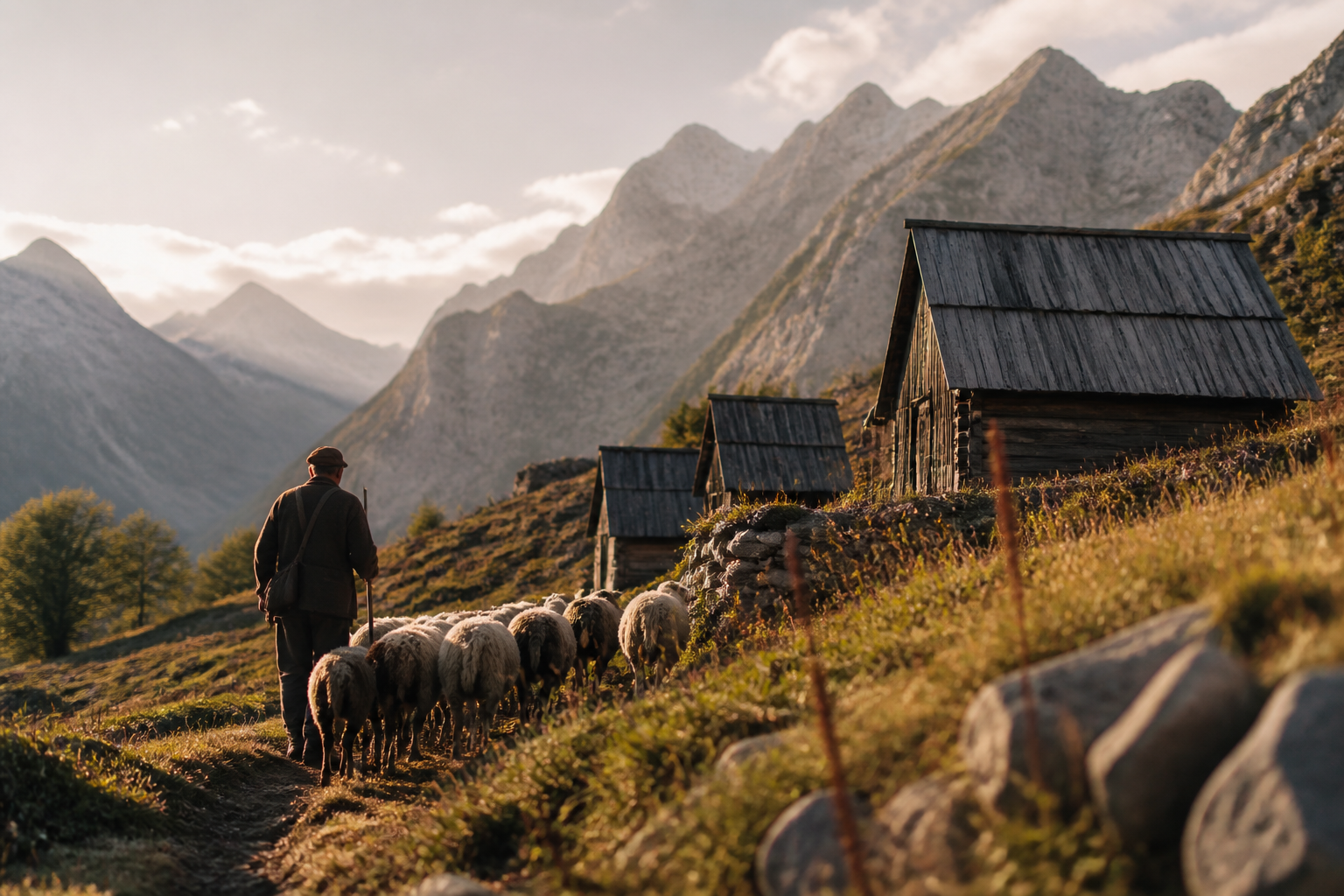
The morning sun has just reached the sheer limestone walls of the Karanfil massif. In Grebaje Valley, a thin ribbon of smoke rises from the chimney of Katun Maja Karanfil, where the aroma of freshly brewed Turkish coffee mingles with the cold, damp mountain air. Here, deep in the Prokletije Mountains – better known as the Cursed Mountains – the silence is almost total. The only sounds are the distant clanging of sheep bells and the faint rush of a glacial stream.
It feels light years away from the commercialised, overcrowded hiking trails of western Europe. More and more hikers are now making their way to this south-eastern European mountain range. The appeal lies in the combination of magnificent alpine scenery and a genuine encounter with a living shepherd culture that has all but disappeared from the Alps.
From closed military zone to peace project
For a long time, hiking freely across these borders was impossible. During the Cold War, the Prokletije region was one of the world’s most heavily guarded and dangerous places. Albania, under Enver Hoxha’s paranoid dictatorship, cut itself off completely from the outside world and mined the border zones with what was then Yugoslavia. Hundreds of concrete bunkers were placed on the most inaccessible mountain passes to stop would-be infiltrators.
History is ever-present along the trail. Even today, hikers may come across the grey, dome-shaped bunkers, half-sunken in alpine vegetation, now more historical curiosities than military threats. What was once an Iron Curtain of suspicion has become a bridge between peoples.
Peaks of the Balkans was created in 2011 as a cross-border peace project, initiated by local organisations in cooperation with international aid agencies. The aim was to provide the poor mountain villages of Albania, Kosovo and Montenegro with a sustainable source of income through ecotourism, while preserving the region’s unique natural and cultural heritage. Today, the trail is a symbol of reconciliation and cooperation in a region historically marked by conflict.
Cross-border bureaucracy at the green borders
Hiking Peaks of the Balkans means crossing international borders in places with neither customs stations nor passport controls – so-called green borders. This requires some planning. To hike legally, you must apply for cross-border permits well in advance of your trip.
Applications must be submitted at least two weeks in advance to the police authorities in each country. The process has become considerably easier in recent years, and most hikers choose to have local tourist offices in towns such as Plav or Gusinje in Montenegro, or Peja in Kosovo, handle the paperwork for a small fee. Setting out without these permits is not recommended; although checks are rare, you could face a hefty fine if stopped by border police at one of the high passes.
Katun hospitality and slow food at altitude
One of the most memorable experiences along Peaks of the Balkans is the accommodation. The trail avoids large hotel complexes and instead leads hikers to traditional shepherd settlements, known as katuns, and family-run guesthouses in remote villages such as Doberdol in Albania or Babino Polje in Montenegro.
In Doberdol, a roadless valley at nearly 1,800 metres where electricity comes from solar panels and water is drawn directly from the spring, accommodation is simple. Shepherd families welcome visitors and open their homes to tired hikers. Hospitality is deeply rooted in the local culture and guided by the traditional code of honour, Kanun, under which guests are to be treated with the greatest respect.
The food served is the opposite of freeze-dried trail rations. Everything is about hyper-local “slow food”. After a long day’s hiking, dishes such as flija – a traditional Albanian pancake-like pie baked in layers over an open fire – are served alongside fresh sheep’s cheese, kajmak, homemade bread, honey and freshly picked wild blueberries. This is often accompanied by a glass of local rakija, the fruit brandy that serves both as a welcome drink and a cure-all for tired muscles.
In Vusanje, on the Montenegrin side, places such as Eko Katun Rosi offer a more comfortable base while retaining the same family atmosphere. By staying at places like these, you contribute directly to the local economy, helping young people in these families see a future in the mountains rather than moving to the big cities.
Prokletije’s dramatic geography
In terms of natural scenery, Prokletije offers some of Europe’s most dramatic views. Geologically, the mountains are part of the Dinaric Alps, characterised by extreme karst topography, with wild, eroded limestone formations, deep gorges and underground river systems.
The two most spectacular valleys on the Montenegrin side are Grebaje and Ropojana, both easily accessible from the town of Gusinje. Grebaje Valley is flanked by the dramatic spires of Karanfil, which rise almost vertically above the green meadows. It is a playground for climbers and experienced hikers, with places to stay such as WildBeauty Grebaje offering a perfect base.
Ropojana Valley offers a different kind of magic. Here you’ll find the spring known as Savino Oko (Sava’s Eye) or Syri i Kaltër in Albanian – an icy, funnel-shaped spring with almost otherworldly blue, clear water, where meltwater from the higher peaks is forced up to the surface.
Further east, near Babino Polje, Hridsko jezero (Lake Hrid) lies at just under 2,000 metres. It is often called the “Lake of Happiness” and is surrounded by dense pine forest and dramatic boulders. According to local folklore, the lake was created by the gods so that mountain fairies could bathe in peace, and anyone who takes a dip is said to be blessed with health and marital happiness.
The adventure towards the peaks: Maja Jezerce and Zla Kolata
The Peaks of the Balkans trail itself requires no technical climbing, but it is physically demanding, with daily stages that often involve 1,000 to 1,500 metres of ascent and descent on steep, rocky paths in places.
For those looking for an extra challenge, there are several legendary summit ascents to take on as side trips from the main trail. The best known is Maja Jezerce (Jezerca Peak) in Albania. At 2,694 metres above sea level, it is the highest peak in the entire Prokletije massif. The ascent is steep and requires good fitness and experience in alpine terrain; early in the season, an ice axe and crampons are often needed because of the permanent snowfields.
Another classic is Zla Kolata (2,534 m), Montenegro’s highest point, situated right on the border with Albania. The hike up from the village of Vusanje takes a full day and offers breathtaking panoramic views, with vistas stretching for miles across the three neighbouring countries on a clear day.
It is this sense of boundless freedom that makes Peaks of the Balkans stay with you long after your boots have been put away. In a world where it is becoming ever harder to find unexplored places, the Cursed Mountains still offer a genuine adventure – on nature’s and the local people’s own terms.
Facts
Sources & further reading
- thoroughlytravel.comWhere to Stay for Prokletije National Park: Best Valleys, Towns & Katuns
- zbulo.orgGuide to the Peaks of the Balkans Trail - Zbulo
- thesandyfeet.comPeaks of the Balkans Accommodation: All The Best ...
- ruralholiday.meBabino Polje: Luxurious Ambiance of Traditional Hospitality
Share the article
Translated from Swedish with AI assistance. Read the original.


