
Between Marine Gardens and Yugoslav Modernism – Herceg Novi's Low-Key Transformation
While Budva's beaches are filled to the brim and Kotor's medieval alleys are crowded with cruise passengers, the westernmost outpost of the Boka Bay has chosen a completely different path. Herceg Novi, historically known as the city of writers and mimosa, is now stepping forward as the Adriatic's most interesting cultural oasis. Here, rich spa history, hidden socialist luxury villas, and carefully restored stone houses meet against a lush backdrop where the mountains plunge straight down into the cobalt-blue sea.
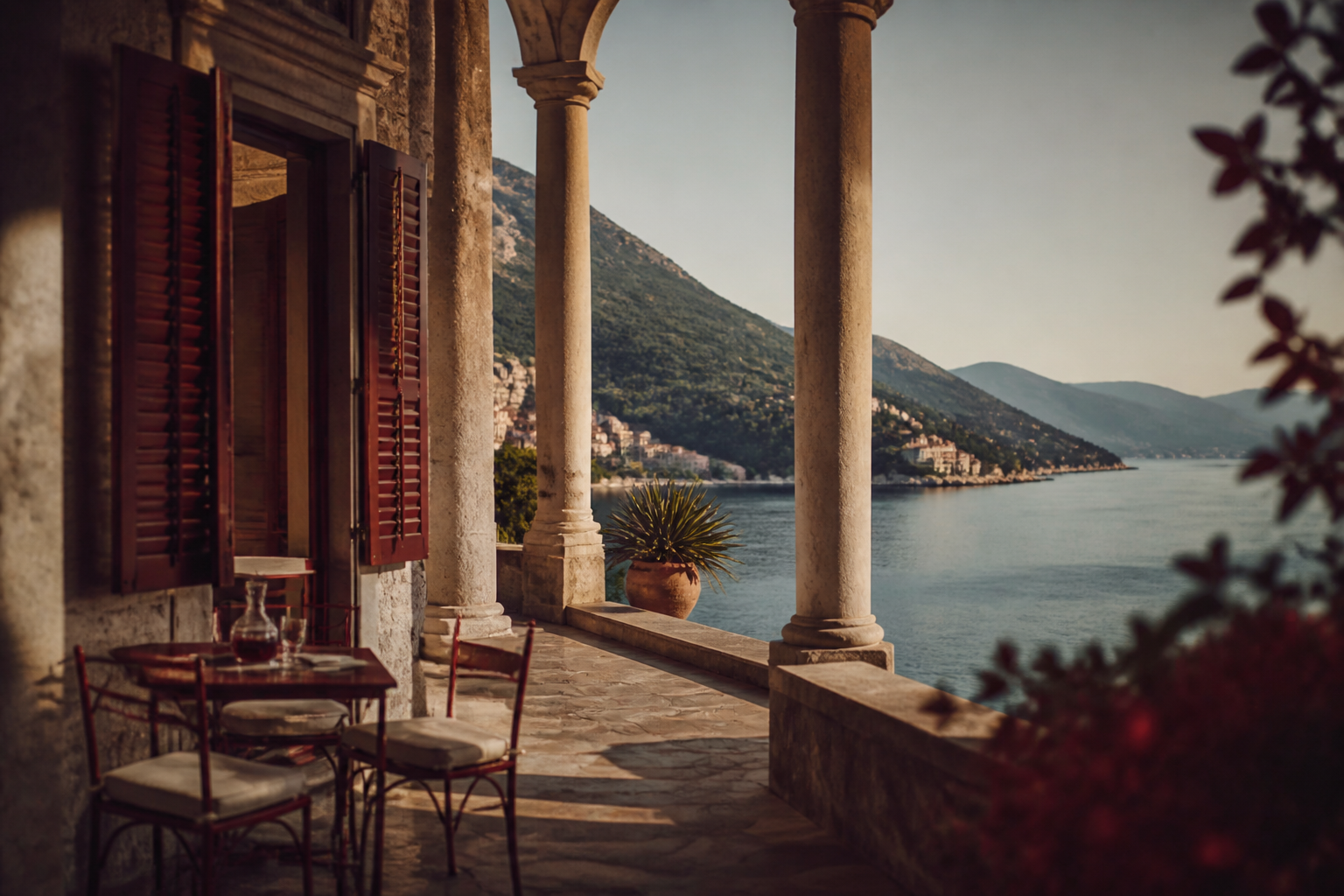
They say you smell Herceg Novi before you see it. Once the ferry has crossed the narrow Verige Strait and the road winds westward along the Bay of Kotor, the landscape changes. The air is filled with a sharp yet sweet aroma of eucalyptus, wild lavender, citrus trees, and pine needles. This is no coincidence. Over centuries of seafaring, the city's sea captains brought exotic plants home from their global voyages. Today, the town appears as a gigantic, terraced marine garden climbing the steep slopes towards the Orjen massif.
Herceg Novi has always been different from its more famous neighbours in the bay. The town was founded in 1382 by the Bosnian King Tvrtko I under the name Sveti Stefan, with the strategic goal of controlling the salt trade. Since then, the town has been conquered, shaped, and left as a legacy by Ottomans, Spaniards, Venetians, Austrians, and the French. The result is an architectural and cultural tapestry unmatched in the region.
Fortresses, steps and the scent of mimosa
Exploring Herceg Novi is a physical activity. Locally, it is known as the "town of 100,000 steps", and the narrow stone staircases connect the lively Šetalište Pet Danica promenade with the old town square, Trg od Knjige (Book Square).
Along this vertical geography, monumental fortresses watch over the sea gate. Kanli Kula, the Ottoman "bloody tower", has been transformed from an infamous prison into one of the Adriatic's most spectacular open-air stages with panoramic views of the bay. Higher up lies Španjola, a fortress bearing traces of the brief Spanish era in the 16th century, now an abandoned but atmospheric ruin where wild capers grow from cracks in the walls. Below, surrounded by ancient cypresses and vineyards, lies the Savina Monastery, where Orthodox monks have been making wine since the Middle Ages.
The seven-kilometre-long promenade, named after five young women who were all named Danica and lost their lives during the Second World War, follows the old railway embankment where trains once thundered between Sarajevo and Zelenika. Today, the promenade is the town's social artery, lined with small swimming coves, fish restaurants, and cafés where locals drink their espresso with eyes turned towards the Luštica peninsula.
Villa Galeb: Tito's hidden space-age palace
In the neighbourhood of Igalo, known for its therapeutic mineral mud and health spas, lies one of the region's best-kept architectural secrets. Villa Galeb, completed in 1976 as a summer residence for Yugoslavia's long-standing leader Josip Broz Tito, is a monument to Yugoslav space-age modernism.
The monumental villa was designed by architect Milorad Petijević and spans over 5,500 square metres, hidden behind dense pine forests. Here, visitors are greeted by an interior that seems frozen in time: deep brown wood panelling, fitted carpets in period-typical olive green and orange, and custom-designed Yugoslav furniture.
The villa was not only a place for recreation, but also a diplomatic arena. Here, Tito received world leaders and cultural figures. The building houses a private therapeutic pool area with mineral water, a cinema, conference rooms, and the private suites of Tito and his wife Jovanka, fully equipped with the most advanced technology of the time. Beneath the surface, a fully equipped nuclear bunker is also hidden. Villa Galeb offers a unique insight into an era when Yugoslavia balanced between East and West, packaged in an aesthetic that feels straight out of an early James Bond film.
Lazure: Historic stone meets modern luxury
The hunger for cultural-historical depth has also shaped Herceg Novi's modern tourism industry. In Meljine, just east of the town centre, the old 18th-century lazaretto has been given a new lease of life as the Lazure Hotel & Marina. Under the rule of the Republic of Venice, this massive stone building served as a quarantine station for sailors and merchants arriving in the bay.
The restoration of the historic complex is a textbook example of how cultural heritage can be preserved and integrated into modern premium tourism. The rough, hand-hewn stone walls and old courtyards have been preserved, but filled with modern Scandinavian-influenced minimalism, a luxurious spa, and a modern marina for yachts. Here, the breath of history and the comforts of contemporary life meet without losing the integrity of the original architecture.
The wild hinterland of the Orjen Mountains
Behind Herceg Novi rises Orjen, the highest mountain range along the Adriatic coast with peaks of nearly 1,900 metres above sea level. This wild hinterland, or zaleđe, offers a sharp contrast to the maritime life of the coast.
Here, dedicated advocates like Željko Starčević have worked to make the mountains accessible to hikers and to preserve traditional stone villages. Orjen is known for its dramatic limestone formations and deep sinkholes, but also for its old military roads and fortifications from the Austro-Hungarian era. A hike here offers not only spectacular views over the entire Boka Bay, but also encounters with traditional Montenegrin pastoral life, where locally produced cheese, smoked ham (pršut), and wild herbs still form the basis of the diet.
Comic book artists and literary heritage
Herceg Novi's artistic soul is not just historical. The town has long attracted writers and artists – Nobel laureate Ivo Andrić chose to build his house here, fascinated by the town's light and vegetation.
Today, this creative heritage lives on through new forms of expression. The most striking example is the Hercegnovski Strip Festival (HSF), a comic book festival that over recent decades has grown to become one of the most respected cultural events in Southeast Europe.
During the festival, the town's squares, cafés, and historic settings are filled with international comic book artists, illustrators, and writers drawing live in front of audiences and running workshops. The fact that the festival has gained such an enormous impact in Herceg Novi is no coincidence. In the former Yugoslavia, comic books – and in particular the Italian cult series Alan Ford – held an almost religious status. When the festival recently celebrated its anniversary, it featured a visit from Riccardo Secchi, son of the legendary Max Bunker who created Alan Ford in 1969. The presentations in the lush garden of Hotel Herceg Novi, the former Lazarev Garden, demonstrate how the town manages to tie popular culture, nostalgia, and international art together in the very same setting.
Herceg Novi has pulled off the feat of renewing itself without selling its soul. By highlighting its unique history – from medieval salt monopolies and Venetian quarantine stations to Yugoslav modernism and contemporary comic book culture – the town offers an alternative for the traveller seeking connection and slowness. It is a destination that does not demand your attention with garish neon signs, but patiently waits to be discovered, one step at a time.
Facts
CULTURE AND HISTORY IN HERCEG NOVI
- Šetalište Pet Danica: A seven-kilometre-long promenade stretching from Igalo to Meljine, built on the old railway line.
- Villa Galeb (Tito's villa): Located in Igalo. Open for guided tours during the summer season, where visitors can experience the space-age design and nuclear bunker of the Yugoslav state residence.
- Lazure Hotel & Marina: A restored 18th-century lazaretto in Meljine, which today serves as a hotel and marina.
- Hercegnovski Strip Festival (HSF): An annual international comic book festival held in September, bringing world-leading illustrators and cartoonists to the town's squares and galleries.
Sources & further reading
- Herceg Novi Tourist OrganisationHerceg Novi | Turistička organizacija
- adriaticways.comHerceg Novi Travel Guide: The Resident's 2026 Insider ...
- muzejigalerijativat.meKonferencija: Nematerijalno kulturno nasljeđe i održivi turizam
- sharemontenegro.meFestival vjetra: Održivi turizam nemoguć bez očuvane kulturne ...
Share the article
Translated from Swedish with AI assistance. Read the original.


