
Athens at the Foot of the Acropolis – Between the Mosque, the Alleys and the Lunch Table
On Monastiraki Square, several layers of Athens come together in a single glance: the Acropolis rising above, a preserved Ottoman mosque, and people moving between the metro and the shops. Follow this walk through the city’s historical layers, continuing towards the narrow alleys of Plaka and a lunch table featuring Greek salad and souvlaki. Here, both the sights and the pauses are given their rightful place.
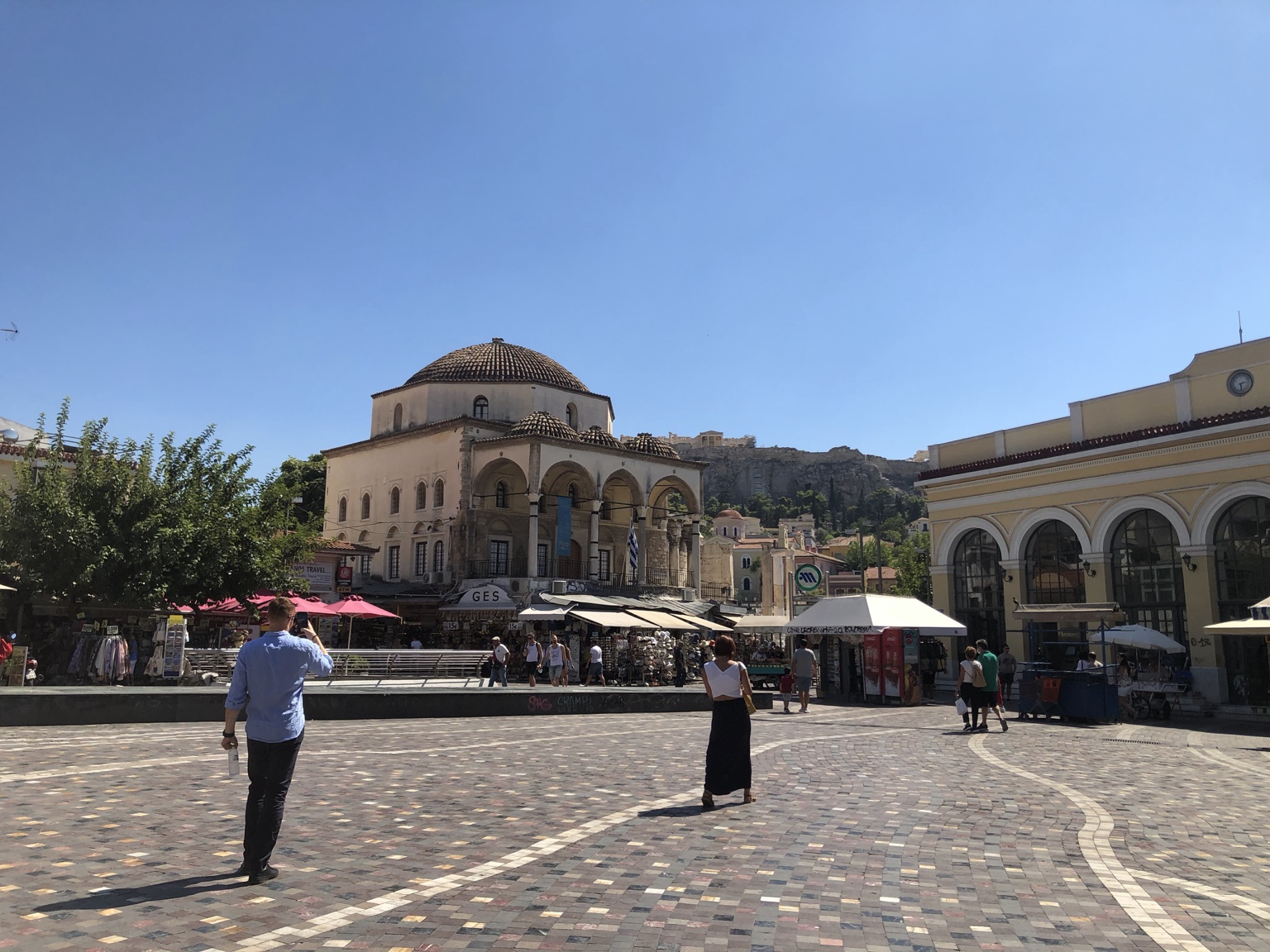
At Monastiraki, there is no need to choose between history and the modern city. They already stand side by side. Behind the domed mosque, the rock of the Acropolis rises. Down on the square, people cross the patterned stone paving, moving between outdoor cafés, small kiosks and the metro entrance.
It is a view that says something about Athens. Antiquity sits high up there, but far from everything that makes the city interesting belongs to it. Here, there are also traces of Ottoman rule, the Orthodox Church, and the commerce that continues around the buildings. The Acropolis holds the view together, but down on the street, Athens reveals multiple faces. This walk therefore begins in the square and moves onwards towards Plaka, with time allowed for both ancient walls and lunch. See it as a direction to follow, with room to stop whenever something catches your eye.
The mosque that became a museum
The building with the dome and the arched portico on Monastiraki Square is the Tzistarakis Mosque. It was built in 1759 by Athens' then Ottoman governor, Mustafa Aga Tzistarakis, in the city’s market area. The mosque remains, but its use has changed. It was restored in 1915 and opened as a museum in 1918. Today, it belongs to the Museum of Modern Greek Culture, where the building is used for an exhibition on the museum's history and collections. This makes it more than just a beautiful dome in a picture of the square. It tells the story of an Athens that easily ends up in the shadow of the ancient monuments: the Ottoman city, its buildings, and how they have since been repurposed. Stand back a little and see how the portico's arches, the dome and the Acropolis all fit into the same view. Then step closer. When you separate the buildings, their distinct histories also become clearer.
A church and a library, a few steps away
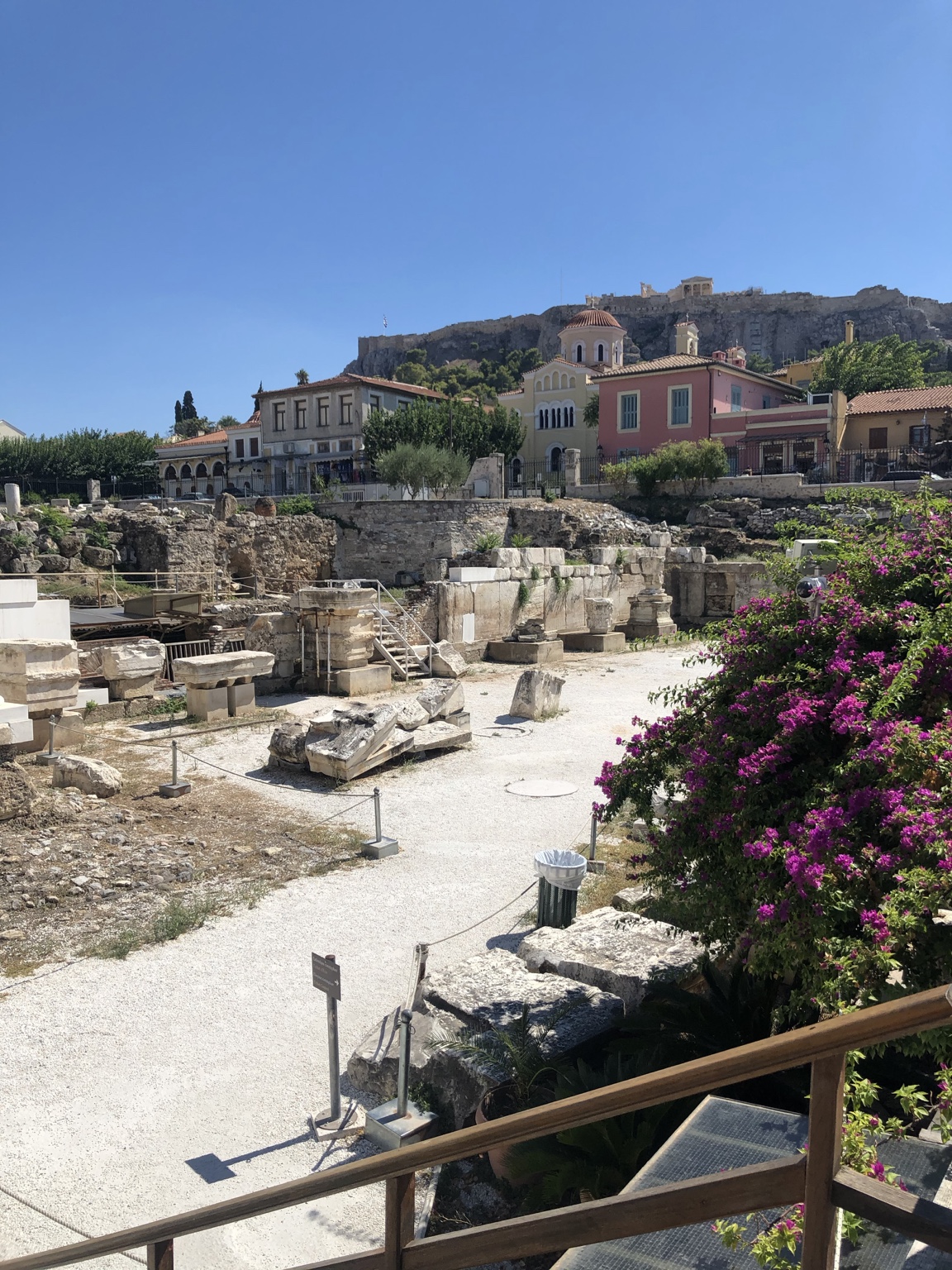
On the same square lies the small Pantanassa Church, a remnant of the monastery that gave Monastiraki its name. The name is usually translated as 'the little monastery'. The scale of the church is different from that of the rock and the mosque, but it is an important part of the site’s story. A visit to a church also requires a different pace than a stroll across the square. If the church is open to visitors, follow the rules and show respect to those who come there to pray. Let your camera wait if the situation requires it. Right next to it is Hadrian’s Library, built in 132 AD under the Roman Emperor Hadrian. Literary works and legal documents were stored here, but the complex also provided space for lectures and philosophical schools. The columns and walls hint at a larger complex. First, look at how the ruins lie in relation to today's streets, and then move close to a detail: a capital, a niche or a stone block. You do not need to know the history of every building to begin noticing the differences between them.
Where the souvenirs also belong to the city
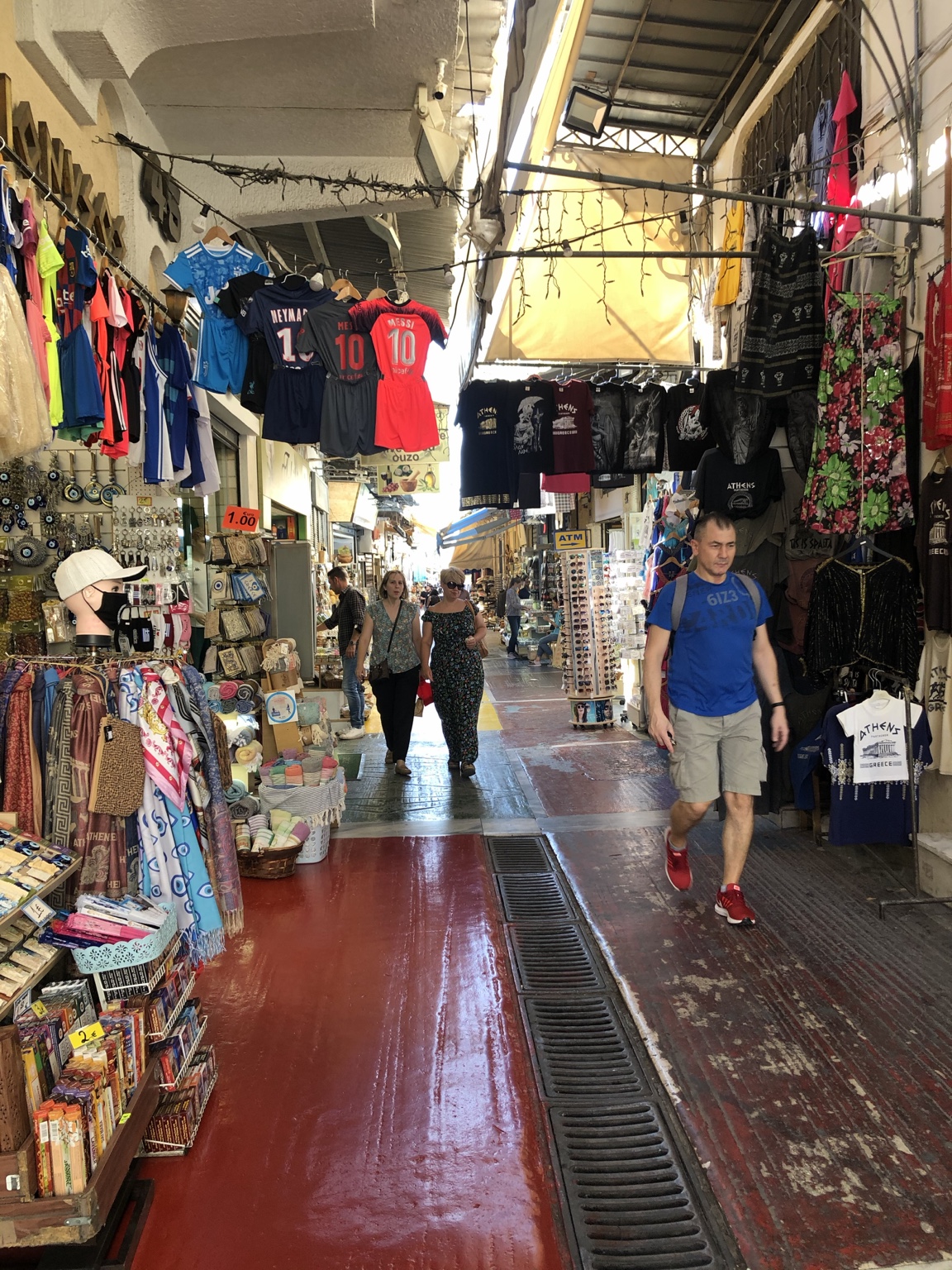
Leave some time for the shopping streets around the square. Football shirts, clothes and souvenirs give the walk a different rhythm than the columns. In the narrow passages, the signage and merchandise become part of the streetscape. It doesn't have to be a hunt for a bargain. A brief detour is enough to see how modern trade finds its place next to the older buildings. Not all items are antiques, and not every shop needs to be a stop. Choose what actually interests you. > The Acropolis holds the view together, but down on the street, Athens reveals multiple faces. Onwards towards the alleys of Plaka Plaka spreads out at the foot of the Acropolis, with neoclassical houses, churches, cafés and shops. Here, the walk can continue on a smaller scale: a street, a flight of steps, an opening where the rock becomes visible once more between the houses. Leave a section of the route unplanned. It is easy to start treating every neighbourhood as just another box to tick, even though revisiting the same street sometimes offers more than a long list of new destinations.
Higher up lies Anafiotika, whose whitewashed houses are associated with the workers from the island of Anafi who founded the neighbourhood. This can make for a lovely detour for those who wish to and are able to climb steps. However, the narrow passages are also part of a residential area; keep your distance from private doorways and courtyards. If you wish to visit the Acropolis itself or the Acropolis Museum, give that visit plenty of time. Consider choosing one of them as the main highlight of the day and let the walk adjust around it. Check current tickets and visitor conditions on official websites before your visit.
Greek salad, souvlaki and time to linger
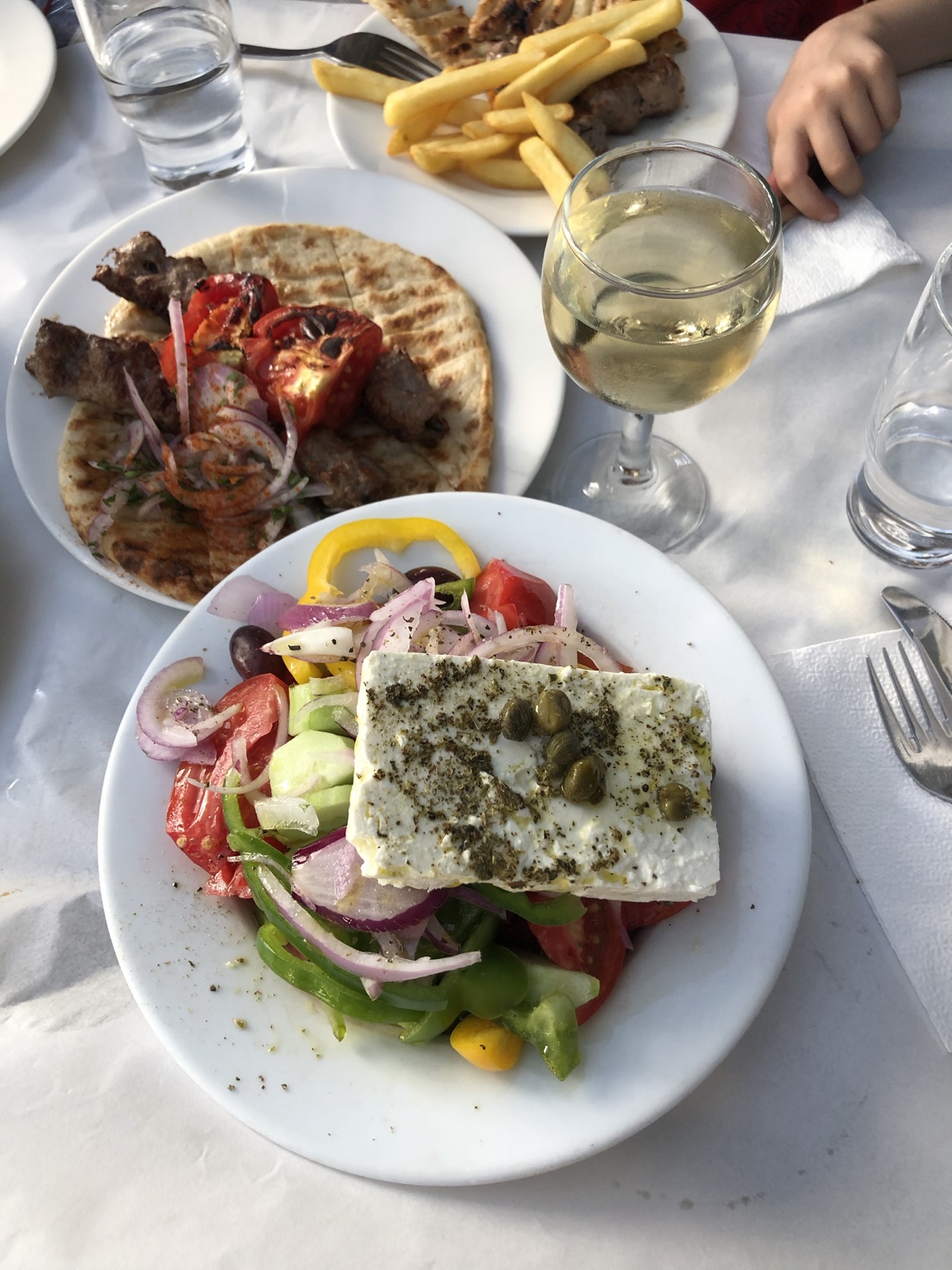
After the buildings and alleys, the lunch table can become the next focal point. The food image shows a Greek salad with a generous block of feta, olives and capers in front of a plate of grilled meat and pita bread. It is a different kind of image of Athens, where attention is allowed to rest on what is right in front of you. Horiatiki, the Greek salad, is typically based on tomato, cucumber, onion, feta, olives, olive oil and oregano. The presentation can vary, and the salad in the picture also includes bell peppers and capers. Souvlaki is associated with grilled pieces of meat on skewers. In Athens, the term kalamaki is often used for the skewers, which can be served with bread or in a pita. Ask how the dish is served if you prefer a plate rather than a wrap; accompaniments and the type of meat can differ between places. Choose based on the menu and what you want to eat. A table with a view can be tempting, but the food and the opportunity to sit in peace are also worth considering. Give your meal plenty of time before deciding on your next stop.
More than just an image of the Acropolis
When the walk is over, the memory does not have to be only the view towards the rock. It could just as easily be the arches of the mosque, the church in the middle of the lively square, or a detail in the library’s ancient walls. And sometimes, it is the lunch table that gives the day its own shape. It is precisely this alternation that gives the walk its substance. The Acropolis is always close, while your attention moves between the centuries and what is happening on the street. Give that Athens some time too.
Share the article
Translated from Swedish with AI assistance. Read the original.


